MNQ vs NQ 2026
MNQ vs NQ and MES vs ES, in dollars per tick and per point, and how many contracts a prop firm drawdown really allows.
Contract specifications and Phidias limits and commissions checked on November 10, 2026.
MNQ is the Micro E-mini Nasdaq-100: $2 per index point, $0.50 per tick. NQ is the E-mini: $20 per point, $5 per tick. Same index, same 0.25 point tick, same trading hours, so 10 MNQ equal 1 NQ. MES and ES follow the same rule: $5 against $50 per point.
Updated on 11 November 2026
In short
- NQ: $20 x Nasdaq-100, tick 0.25 = $5. MNQ: $2 x Nasdaq-100, tick 0.25 = $0.50.
- ES: $50 x S&P 500, tick = $12.50. MES: $5 x S&P 500, tick = $1.25.
- 10 micros = 1 E-mini in dollar exposure. Our limits are written in both units: 2 E-mini or 20 micro on the 25K Express to Live.
- On a $500 drawdown: one NQ has 25 points of room, one MNQ has 250. That is why micros come first on small accounts.
- The cost: 10 MNQ round trip cost about three times the commission of 1 NQ. At 10 micros or more, switch to the E-mini.
- Static drawdown: the floor never moves, so every dollar of profit adds room you can turn into more contracts.
What is the difference between MNQ and NQ?
Only the multiplier. MNQ and NQ track the same Nasdaq-100 Index, move in the same 0.25 point ticks and trade the same hours: Sunday to Friday, 5:00 PM to 4:00 PM CT, with a one hour halt each day. The micro is simply one tenth of the E-mini.
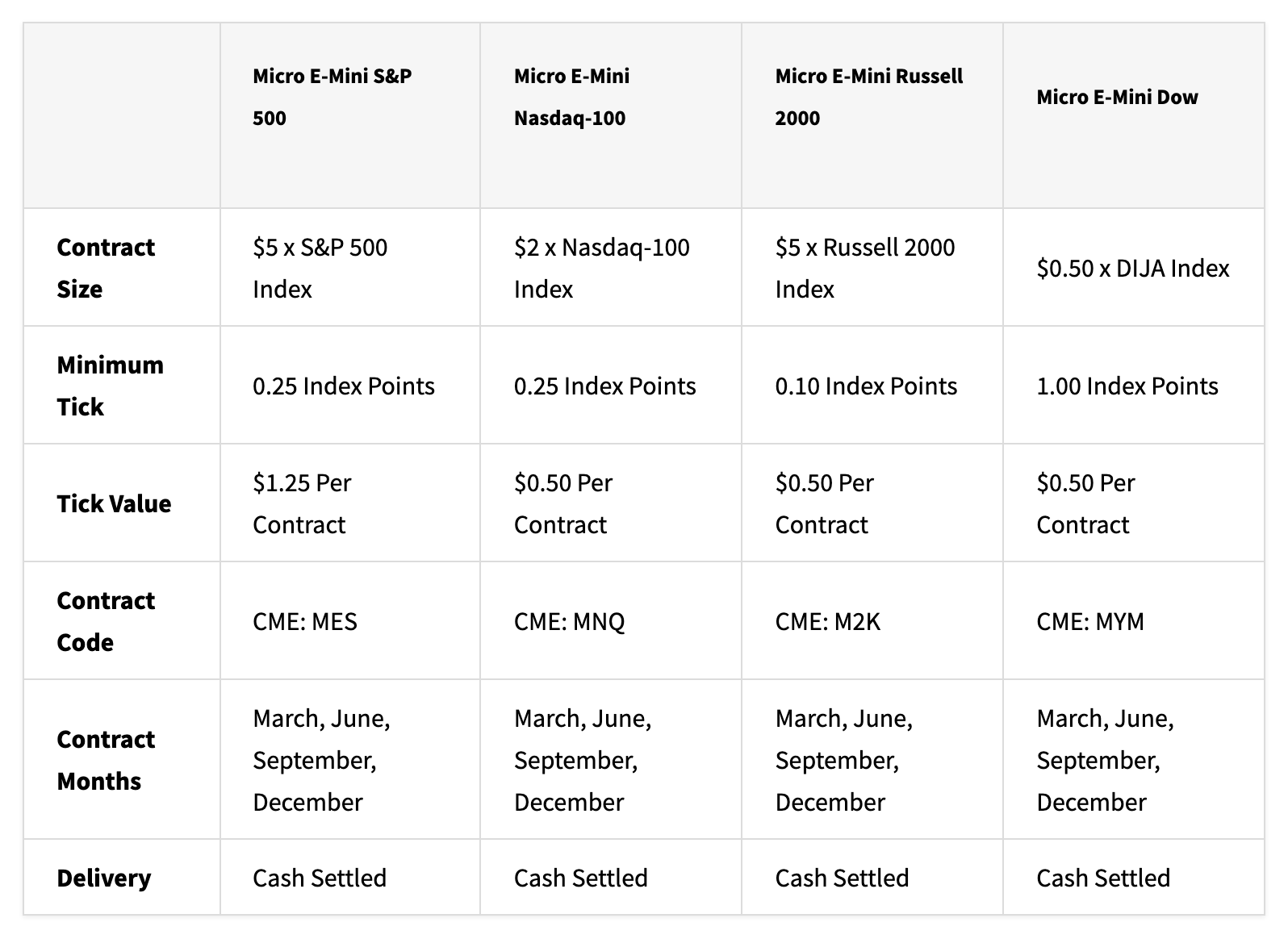
The micros were launched by CME Group in May 2019. They are cash settled, with March, June, September and December contracts. Because MNQ and NQ track the same index in the same 0.25 point ticks, the only thing that changes between them is the dollar value of each tick.
MNQ vs NQ tick value and point value
A tick is 0.25 point, so four ticks make one point. That gives $2 per point on MNQ and $20 per point on NQ. Here is what common moves are worth for one contract:
The formula works for any move: dollars = points x point value x contracts. Notional value follows the same multiplier: at an illustrative Nasdaq-100 level of 20,000, one NQ controls $400,000 of index and one MNQ $40,000.
MNQ (Micro E-mini Nasdaq-100)
NQ (E-mini Nasdaq-100)
How many MNQ equal 1 NQ?
Ten. $2 x 10 = $20, so 10 MNQ move exactly like 1 NQ, tick for tick. The same goes for 10 MES and 1 ES ($5 x 10 = $50).
At Phidias, every Express to Live account lists its maximum in both units: 2 E-mini / 20 micro on the 25K Express to Live, 9 E-mini / 90 micro on the 150K Express to Live. Check how your own firm counts micros before you size up.
MNQ vs MES: which micro should you trade?
Compare them in dollars per stop, not in contracts. MNQ pays $2 per Nasdaq point and MES $5 per S&P point, but the two indices are not quoted on the same scale, so a point on one is not a point on the other.
The practical test: take the stop your setup needs on each market, multiply by the point value, and see which one fits your risk per trade. Pick the market you read best; the sizing math is identical.
Micro or E-mini on a prop firm account?
Your drawdown decides, not your conviction. Divide the drawdown by the point value and you get the number of points you can lose before the account is gone. On small prop accounts, the E-mini leaves very little room.
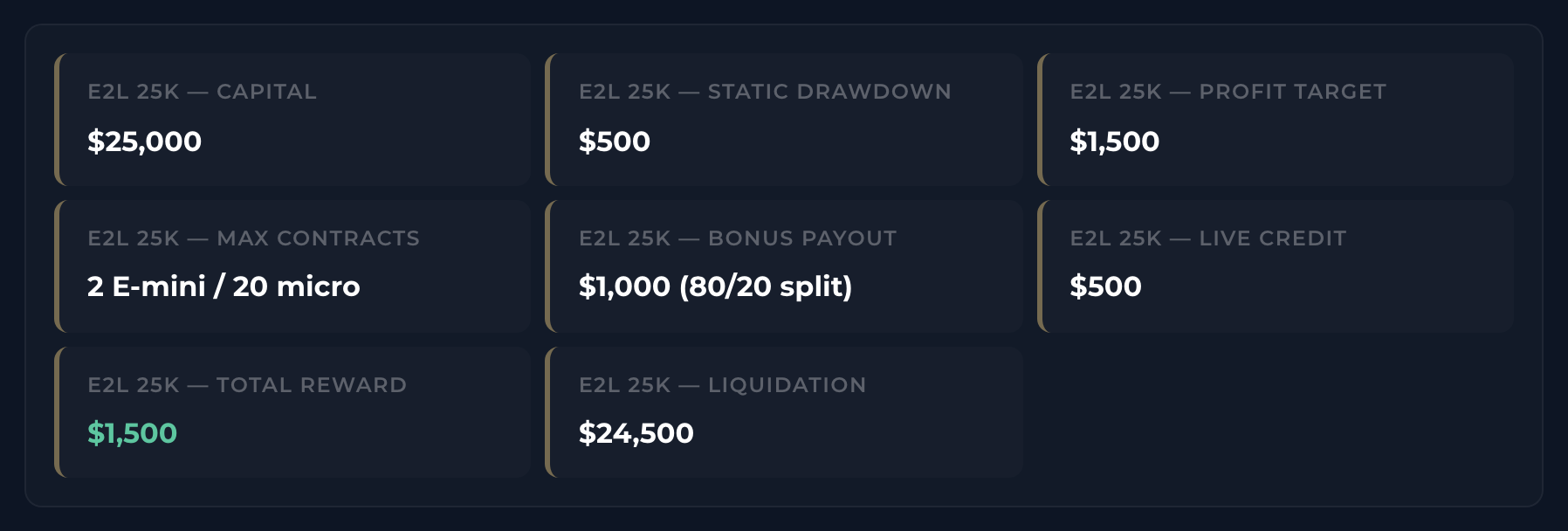
Two NQ, the 25K maximum, put the whole $500 at risk in 12.5 points. Twenty MNQ is the same exposure. The limit is a ceiling, not a target: the room is what you size to.
How many micros should you trade? The sizing formula
Contracts = risk per trade in dollars / (stop in points x point value). Decide the risk first, as a share of the drawdown, then let the stop give you the size.
- Account: 25K Express to Live, $500 static drawdown.
- Risk per trade: $100, a fifth of the drawdown.
- Stop: 20 Nasdaq points.
- On NQ: 20 x $20 = $400 per contract. Even one NQ risks four times your plan.
- On MNQ: 20 x $2 = $40 per contract. 2 MNQ = $80, inside the plan.
Dollar risk of a 20 point Nasdaq stop, 25K Express to Live
Commissions come on top, charged per side and per contract (on Tradovate and NinjaTrader they are deducted automatically at execution), so count them in your risk per trade.
Why micros and a static drawdown work together
A static floor never moves. On our 25K Express to Live it sits at $24,500 and stays there, so every dollar of profit is new room. Up $300, you have $800 above the floor: 40 NQ points, or 400 MNQ points.
Micros let you turn that cushion into size in small steps: one more MNQ for every $40 of extra risk on a 20 point stop, instead of waiting for $400 to add a single NQ. On a trailing drawdown the floor follows your peak, so profit does not build room the same way.
The honest limit. Our Express to Live drawdown is small in dollars: $500 on 25K, $1,000 on 150K. That is exactly why micros matter on it. The trade off is a floor that never trails, no daily loss limit, no consistency rule and no minimum days, so the full allowance stays yours to manage, one micro at a time.
Do micros cost more in commissions?
Per contract, less. Per dollar of exposure, a lot more. Commissions are charged per side and per contract, so ten micros pay ten times. Here are the rates on our rules page:
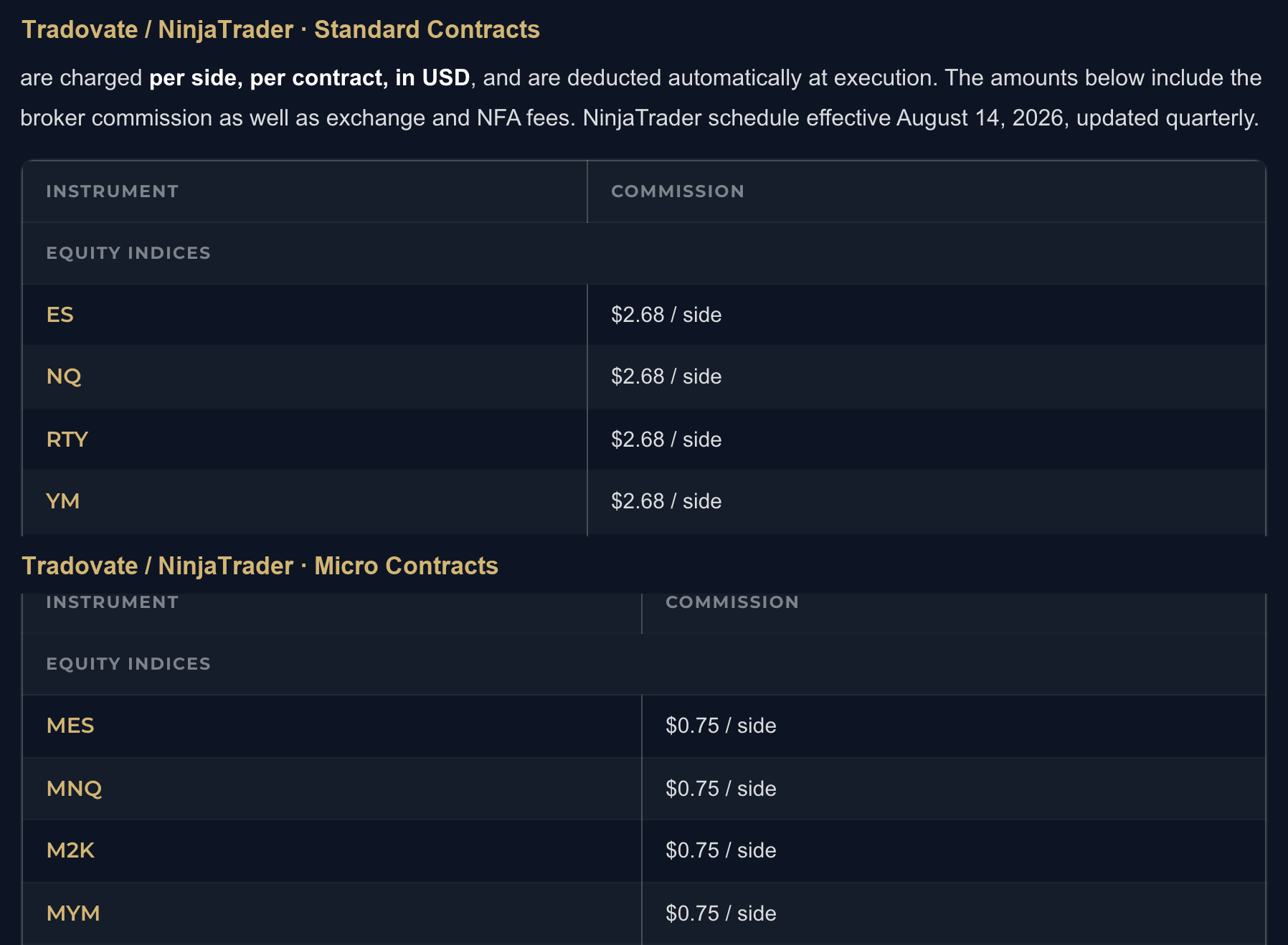
For the same dollar move, 10 MNQ cost about 2.8 times the commission of 1 NQ on Tradovate, and 3.6 times on Rithmic. Measured in ticks, one MNQ round trip on Tradovate costs $1.50, or 3 MNQ ticks; one NQ round trip costs $5.36, just over 1 NQ tick. If you scalp for a few ticks, that gap is your edge or your loss.
The Tradovate and NinjaTrader rates include exchange and NFA fees, and our rules page notes they are indicative and may change with broker and exchange pricing. Which data feed suits you is covered in Rithmic vs Tradovate.
When should you switch from MNQ to NQ?
- When you trade 10 micros or more. You already carry the risk of one E-mini; the E-mini carries it for less commission.
- When your cushion covers your plan on NQ. If one NQ on your normal stop is a small share of the room above your floor, the micro has done its job.
- Keep micros for the remainder. 13 MNQ worth of risk can be 1 NQ and 3 MNQ where your firm allows it: ask before mixing.
- Go back to micros after a drawdown. Less room means smaller size, and micros let you cut it without stopping.
MNQ and NQ at Phidias Express to Live
Both are allowed on every account, along with MES, ES, MYM, YM, M2K and RTY. Here is how the limits and the room translate:
Every size has a static drawdown that never trails, no daily loss limit, no consistency rule, no minimum days, and news trading in evaluation, CASH and LIVE. Positions cannot be held overnight. Payout on Day 1 is possible on every size: 90% of payouts are processed in under 30 minutes, all within 24 hours, and our record from purchase to payout is 6 hours 18 minutes. Your first payout converts the account to LIVE.
Our guide to static drawdown prop firms compares fixed floors across the market, and the best futures prop firms compares the main firms on their own rules. Session times for NQ and MNQ are in our futures trading hours guide.
Start on MNQ with Express to Live
Test: MNQ or NQ for your account?
Four questions on your drawdown, your stop and your size. No email.
30 second check
MNQ or NQ: which contract fits your account?
MNQ vs NQ: frequently asked questions
What is the difference between MNQ and NQ?
Only the size. Both track the Nasdaq-100 Index, tick in 0.25 index points and trade the same hours. NQ (E-mini) is $20 times the index, so a tick is worth $5. MNQ (Micro E-mini) is $2 times the index, so a tick is worth $0.50. One MNQ is one tenth of one NQ.
How many MNQ equal 1 NQ?
Ten. MNQ is $2 per index point and NQ is $20 per index point, so 10 MNQ move exactly like 1 NQ in dollars. The same ratio applies to MES and ES: 10 MES equal 1 ES.
What is the MNQ tick value?
$0.50 per tick. The minimum tick is 0.25 index points and the contract is $2 times the Nasdaq-100 Index, so one full point is $2 per contract.
What is the NQ tick value?
$5 per tick. NQ is $20 times the Nasdaq-100 Index with a 0.25 point tick, so one full point is worth $20 per contract.
What is the difference between MES and ES?
Same S&P 500 Index, same 0.25 point tick, one tenth of the size. ES is $50 times the index ($12.50 a tick, $50 a point). MES is $5 times the index ($1.25 a tick, $5 a point). Ten MES equal one ES.
Should you trade MNQ or NQ in a prop firm evaluation?
Start with MNQ if your drawdown is small. On a $500 static drawdown, one NQ can lose the whole allowance in 25 points, while one MNQ has 250 points of room. Micros let you size to your stop. Move to NQ once you trade 10 micros or more and the commissions start to matter.
How many micros can you trade on a Phidias account?
Express to Live allows 2 E-mini or 20 micro on 25K, 5 or 50 on 50K, 7 or 70 on 100K and 9 or 90 on 150K. Fundamental and Premium allow 10, 14 and 17 E-mini, or 100, 140 and 170 micro, on 50K, 100K and 150K.
Are commissions higher on micro futures?
Per contract, no. Per dollar of exposure, yes. At Phidias on Tradovate or NinjaTrader, NQ costs $2.68 per side and MNQ $0.75. Ten MNQ round trip cost $15.00 against $5.36 for one NQ, for the same dollar move. On Rithmic it is $15.80 against $4.40.
Related guides
Read it yourself
The verdict
“MNQ and NQ are the same trade at two sizes. On a small drawdown, one E-mini can turn a single normal stop into most of your allowance; the micro turns it into a planned loss. Start in micros, let a static floor turn your profit into room, and move to the E-mini once ten micros are paying about three times the commission for the same move.”
William G., CMO at Phidias Propfirm
William G., CMO at Phidias Propfirm. Writes about prop firm rules, costs and payouts from the operator’s side.
Last reviewed 2026. Contract specifications and Phidias limits and commissions checked on November 10, 2026. The sources are linked above. Not financial advice: trading futures involves substantial risk of loss.