Futures prop firms explained, 2026
How futures prop firms work from the evaluation to a LIVE account: the funding model, the rules that end accounts, sizes and contracts, the real costs, and how to choose.
Rules read at the source at Phidias, Topstep, Apex Trader Funding, Tradeify and Bulenox on November 12, 2026.
A futures prop firm sells you an evaluation on a simulated futures account: reach its profit target without breaking its loss limit, and you trade a funded account for most of the profit: 90% at Topstep, 80% on Phidias LIVE accounts. You risk a fee, not a deposit. At Topstep and Phidias the account stays simulated until a LIVE stage, and Apex says all of its trading activity is simulated.
Updated on 12 November 2026
How we checked: on 12 November 2026 we read the rules pages and help centers of five futures prop firms (Phidias, Topstep, Apex Trader Funding, Tradeify and Bulenox), 11 pages in all, plus the contract specifications of four CME index futures as published by the futures broker Ironbeam (read 10 November 2026). Five screenshots show each firm’s rules in its own words, and every source is linked at the end. Phidias rules come from our own rules page; our prices, payout times and trader cases come from our verified internal data.
In short
- What it is: a company that lets you trade CME futures on its account after you pass an evaluation. You keep most of the profit: 90/10 at Topstep, 80/20 on Phidias LIVE accounts.
- The funding model: pay an evaluation fee, reach a profit target ($1,500 on a 25K at Apex and Bulenox, $9,000 on a 150K at Topstep, Apex and Bulenox), trade a funded account, take payouts. Real market access starts at LIVE.
- The rules: a drawdown that is static, end-of-day trailing or intraday trailing, and at some firms a daily loss limit, a consistency rule and minimum days.
- Sizes and contracts: 25K to 150K. A 50K allows 5 to 10 E-mini contracts at Phidias, Apex and Bulenox, and 1 E-mini equals 10 micros.
- Money to start: a 25K Phidias Express to Live is $69 with code PHIDIAS (catalog $277) as a one-time payment, funded stage included. A 25K at Bulenox costs $288 with its activation fee.
- Fastest path: on Express to Live the first payout converts the account to LIVE. Our fastest verified cycle from purchase to payout is 6 hours 18 minutes.
$650 to $2,500
Drawdown on the five 50K accounts we compare
25K to 150K
Account sizes on sale
$69
25K Express to Live, one-time payment (catalog $277)
6h 18m
Fastest verified purchase to payout at Phidias
What is a futures prop firm?
A futures prop firm, short for proprietary trading firm, is a company that gives you a funded futures account to trade once you pass an evaluation, and shares the profit with you. You do not deposit trading capital. You pay a fee, follow the firm’s risk rules, and withdraw your share of the profit through payouts.
The products are futures contracts listed on CME Group exchanges: the E-mini S&P 500 (ES), the E-mini Nasdaq-100 (NQ), their Micro versions (MES and MNQ), and contracts on energy and metals. Phidias accounts trade products from the CME, CBOT, NYMEX and COMEX exchanges, and its rules also list Eurex contracts.
Three numbers define every account:
- The size, from 25K to 150K, which sets your contract limit and your profit target.
- The drawdown, the loss limit your balance must never touch.
- The profit split: 90/10 at Topstep, 80/20 on Phidias LIVE accounts.
The size is not money you can withdraw. At Topstep, the funded account balance even starts at $0: the 50K label is buying power, not a balance.
What you actually buy from a futures prop firm
You buy a test and a set of rules, not capital. The fee pays for an evaluation account that tracks your trades against a profit target and a loss limit. Apex calls its intraday evaluation a 30-day assessment, and Bulenox sells a Qualification account whose access is valid for 30 days. A Phidias evaluation bought as a one-time payment has no time limit, and the funded CASH account comes with it.
When you pass, the firm opens a funded account under the same or similar rules, and from then on your profit turns into payouts. Read the rulebook before the price. Two accounts with the same $50,000 label can give you $650 or $2,500 of room, a floor that moves or one that never does, and a daily limit that closes your trade or none at all. Our guide to what a prop firm account is walks through the account types one by one.
Futures prop firms vs forex prop firms
Futures prop firms trade exchange-listed contracts; forex prop firms generally trade currency pairs as CFDs or spot contracts quoted by a broker. A futures contract has a fixed size set by the exchange: one E-mini S&P 500 is worth $50 per index point, its Micro version $5.
Every trader sees the same exchange prices and the same session: Sunday to Friday, 5:00 PM to 4:00 PM CT, with a one-hour daily halt. At the five futures firms we checked, the drawdown is a dollar amount, not a percentage of the balance, and at Phidias, Apex and Bulenox the size limit is a number of contracts, not lots. Intraday accounts at Phidias must also be flat before the session ends, which is why overnight rules matter. If you are still choosing an instrument, read our comparison of futures vs CFDs and our page on forex prop firms.
How does a futures prop firm funding model work?
The funding model has four stages: you pay for an evaluation, you pass it, you trade a funded account for payouts, and some traders reach a LIVE account. The firm earns the fees and you earn your share of the profit. At Topstep and Phidias the trades stay simulated until LIVE, and Apex describes all of its activity as simulated.
Evaluation
Pay a fee, hit the target without touching the drawdown
Funded account
Same or similar rules, you trade for payouts
Payout
Your share of the profit, on the firm's conditions
LIVE account
Real market access, by rule or by review
- Evaluation. You trade to a profit target: $1,500 on a 25K at Apex, Bulenox and Phidias Express to Live, $3,000 on a 50K at Topstep, Apex and Bulenox. Topstep says you can pass in as few as 2 days; Apex’s intraday evaluation, Bulenox and Express to Live set no minimum days.
- Funded account. At Apex you have 7 days to activate the funded Performance Account. At Bulenox you pay a one-time activation fee per Master account. A Phidias one-time payment includes the funded CASH account.
- Payouts. You withdraw your share once the firm’s conditions are met: winning days, caps per request, sometimes a consistency check.
- LIVE. The last stage, where trades reach the market. Each firm has its own gate, explained below.
How do futures prop firms make money?
A futures prop firm earns from what traders pay: evaluation fees, activation fees, resets and data add-ons. Its main cost is the payouts it sends to funded traders. While the funded account is simulated, the trades never reach the market, so payouts are not funded by market gains.
That is why rules differ so much from one firm to the next: each rulebook decides who gets paid, how often and how much. Speed is where a firm shows its hand. At Phidias, 90% of payouts are processed in under 30 minutes, and every payout within 24 hours. Once a trader reaches LIVE, trades go to the real market, which is why LIVE access has its own conditions. We break the economics down in how prop firms make money.
Is a futures prop firm account real money?
Not before the LIVE stage. Topstep’s help center says it in one line:
“The Express Funded Account® (XFA) is the simulated funded-level account you earn after passing your Trading Combine.”
Topstep help center, Express Funded Account Parameters, read November 12, 2026
Apex’s risk disclosure says all activity occurs in a simulated environment using virtual funds, with no live market execution. Phidias CASH accounts are simulated too. The payouts you receive are real money; the trades that earn them are not executed in the market. Market access starts at LIVE: a Phidias Express to Live account converts with a $500 to $2,000 LIVE credit, and a Topstep Live Funded Account starts with 20% of its balance available to trade and 80% held in reserve. Our guide on whether prop firms use real money goes firm by firm.
How a futures trader reaches a LIVE account
Each firm sets its own gate to LIVE, and the gate matters as much as the evaluation. At Topstep the move to the Live Funded Account comes by call-up, and every Express Funded Account closes when it happens. At Phidias, Fundamental and Premium traders become eligible for a review after 5 successful payouts or $100,000 in cumulative profits; the risk team decides, and meeting a threshold is no guarantee.
On Express to Live the rule is mechanical. You hit the profit target on the evaluation, hit it again on the funded CASH account under the same rules, and the first payout converts the account to LIVE. The LIVE account then pays every day, with no maximum and a $500 minimum, at a flat 80/20 split, the same LIVE split whatever Phidias account you came from. Our funded trading account guide follows that path step by step, with its costs and payouts.
Futures prop firm rules explained
Futures prop firm rules come down to six: the drawdown, the daily loss limit, the consistency rule, the profit target, minimum trading days and the contract limit. Add the session rules: overnight holds and news trading. The drawdown is the one rule that fails an account at every firm we checked; session rules can too (Phidias disqualifies an intraday account left open after the close), and the others pause you, delay a payout or raise your target.
The table below puts five 50K accounts side by side. Green is good for the trader, amber costs you something, red is the strictest version of the rule.
Drawdown: static, end-of-day trailing or intraday trailing
The drawdown is the loss limit your balance must never touch, and how it moves matters more than its size. A static drawdown never moves: on a 50K Phidias Express to Live it sits at $49,350, $650 below the start, from the first trade to the last. An end-of-day trailing drawdown rises with your best closing balance:
“The MLL is a trailing limit. It rises as your end-of-day balance grows, but never moves down. Once it reaches your starting balance, it locks permanently.”
Topstep help center, What is the Maximum Loss Limit?, read November 12, 2026
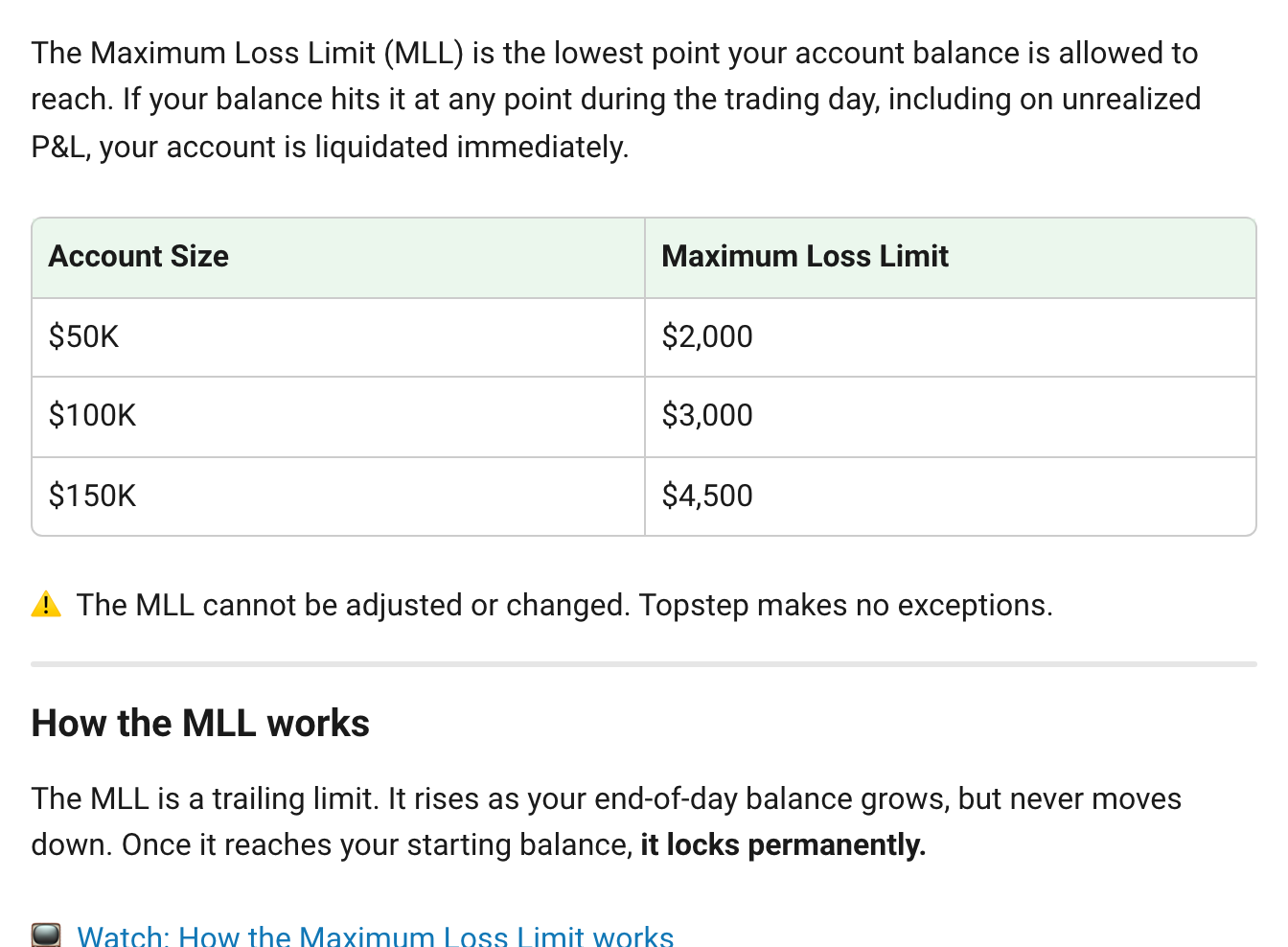
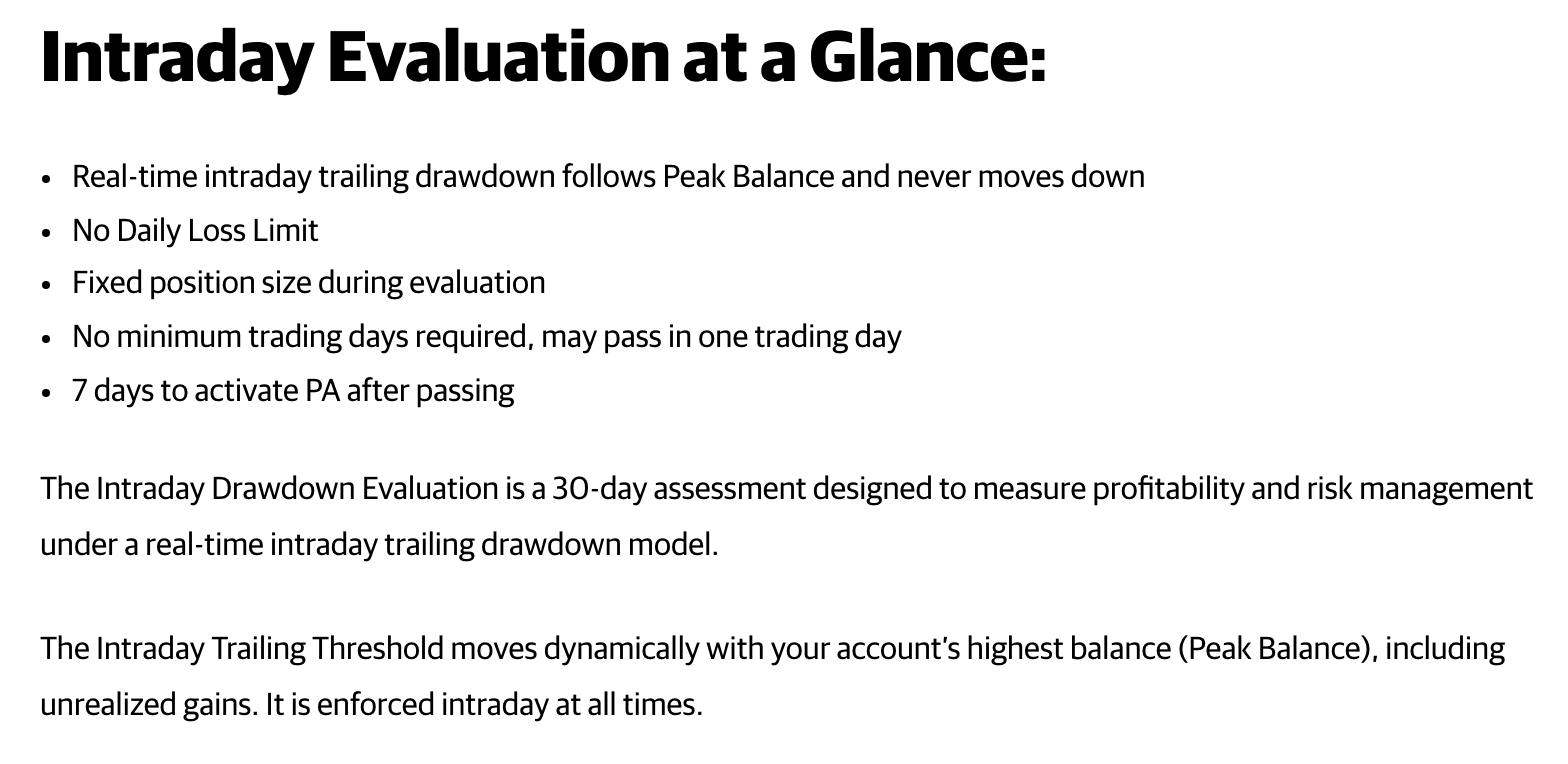
An intraday trailing drawdown is the strictest: it follows your peak in real time, open profit included. Apex’s intraday evaluation works that way, with $2,000 on a 50K, and so does the trailing option at Bulenox, a choice Bulenox locks for the life of the account. Our trailing drawdown guide compares the three mechanics, and our list of static drawdown prop firms shows who still offers a floor that never moves.
Static vs trailing drawdown on the same trades
The same six days of trading can pass under a static floor and fail under a trailing one. Take a 50K with a $2,000 limit, the size of Topstep’s 50K Maximum Loss Limit, and these closes: $50,500, $51,200, $51,800, then $51,300, $50,600 and $49,700.
The trailing floor climbs from $48,000 to $49,800 after the $51,800 close, and the account fails on day 6 when the balance drops through it. With a static floor at $48,000, the same account still has $1,700 of room. A trailing limit is often bigger in dollars ($2,000 on Topstep’s 50K against $650 on a 50K Express to Live), so compare the room you keep after a good week, not the headline figure.
Daily loss limit
A daily loss limit caps what you can lose in one session; hitting it usually pauses you for the day rather than failing the account. At Topstep it is optional in the Trading Combine and the funded account, $1,000 on a 50K, and automatic in the Live Funded Account. When it triggers, open positions are flattened and you wait for the next session at 5 PM CT.
Tradeify applies one on its Growth, Lightning and Select Daily funded accounts, starting at $1,250 on a 50K Growth, and pauses trading until the next session after 6:00 PM ET; its Select Flex accounts have none. Tradeify’s own help center warns:
“NEVER use the DLL as a stop loss.”
Tradeify help center, Rules: Daily Loss Limit, read November 12, 2026
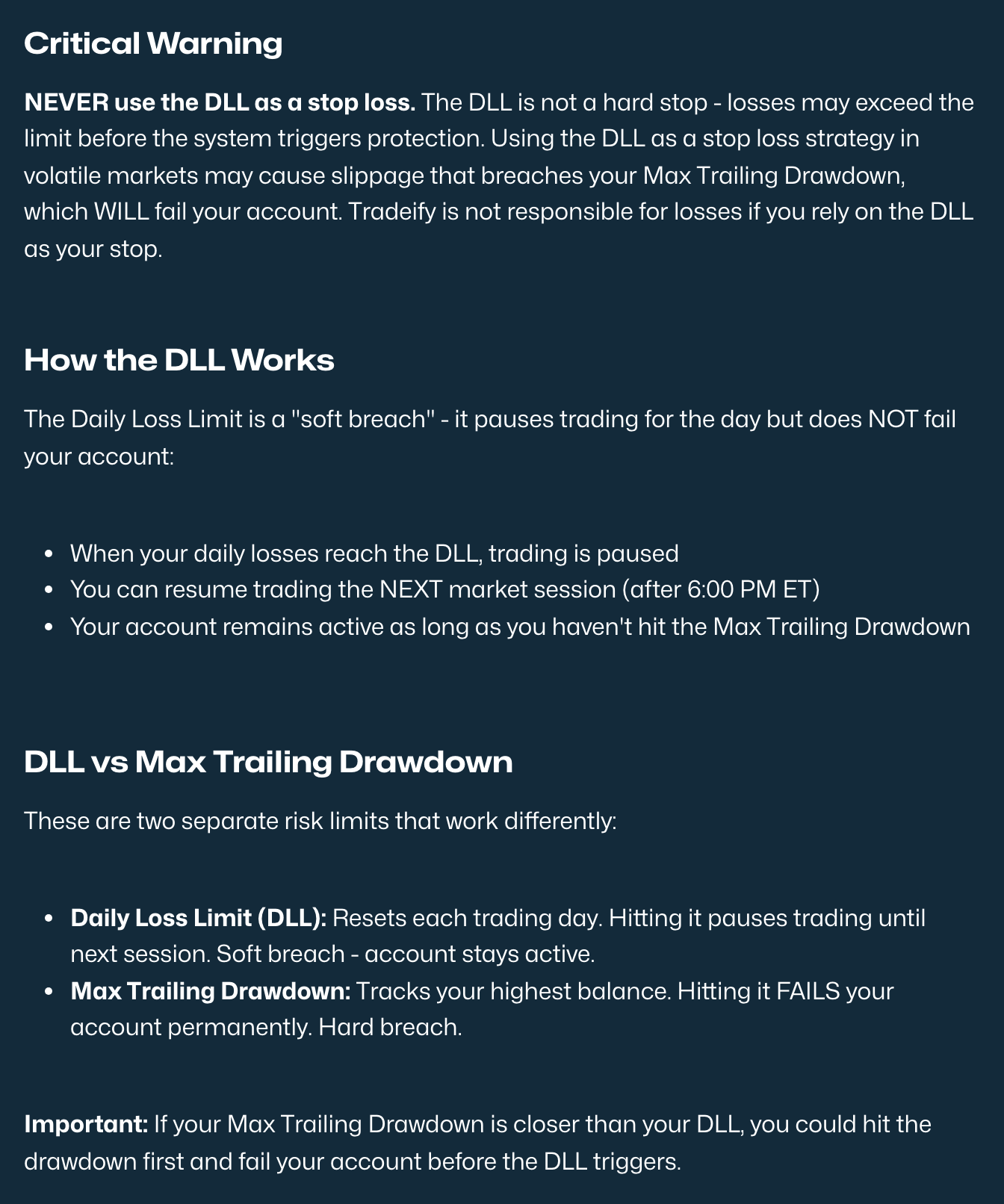
Topstep explains why it offers one: over 63% of traders have lost an account in a single day, in its own words. A daily limit can slow down a trader on tilt. It also turns a floating loss into a realized one and closes a position that might have come back, and Tradeify warns that losses can run past the limit before it triggers. Apex’s intraday evaluation and Bulenox’s Qualification on its trailing option have none, and Phidias Express to Live, Fundamental and Premium have no daily loss limit. Our list of prop firms with no daily loss limit compares the rest.
Consistency rule
A consistency rule does not close your account: it raises your target or blocks a payout when one day carries too much of your profit. In the Topstep Trading Combine, your best day must stay at or below 55% of the profit target, or the target increases. On Topstep’s funded Consistency payout path, your best day must stay at or below 40% of total profit, over at least 3 trading days.
Apex lists consistency as “Not Applied” in its intraday evaluation. At Phidias, Fundamental and Premium apply a 30% consistency rule on the funded CASH account only, never in the evaluation, and Express to Live has none at any stage. For a beginner the rule matters most when one news day makes the week: under a 40% cap, a $1,000 day needs at least $2,500 of total profit before you can ask for a payout. Our consistency rule guide has the formula and a calculator.
Contract limits, news and overnight positions
The contract limit caps your position size, and it grows with the account. On a 50K, Phidias Express to Live allows 5 E-mini contracts, Apex’s intraday evaluation 6, Bulenox’s Qualification 7, and Phidias Fundamental and Premium 10. The next section has every size.
Session rules are the other half. At Phidias, economic news trading is permitted on all account types. Express to Live and Fundamental positions must be closed before the end of the trading day, while Premium allows overnight and over-week positions. A beginner who holds a position through the close on an intraday-only account loses it: Phidias rules disqualify an account that fails to close before the deadline. Check these three lines (contracts, news, overnight) on every rules page before you buy, because they decide which strategy the account can carry.
Futures prop firm account sizes and how many contracts you can trade
Futures prop firm accounts come in 25K, 50K, 100K and 150K at most firms we checked (Topstep’s help center lists 50K, 100K and 150K), and the size sets your contract limit. On a 50K that limit is 5 E-mini contracts on Phidias Express to Live, 6 at Apex, 7 at Bulenox and 10 on Phidias Fundamental and Premium.
Limits as each firm publishes them on 12 November 2026. A bigger account does not mean more room to be wrong. On Express to Live the drawdown grows more slowly than the contract limit: the 150K allows 9 E-mini contracts against a $1,000 static drawdown, so the limit is a ceiling, not a target. Bulenox states the conversion in four words, “1 mini = 10 micros”, and Phidias writes every limit the same way, 10 micros for each E-mini.
E-mini vs Micro contracts: what one contract risks
A Micro contract is one tenth of its E-mini: $5 per point on the MES against $50 on the ES, $2 on the MNQ against $20 on the NQ. All four tick in 0.25 index points, so the tick is worth $12.50 on the ES, $1.25 on the MES, $5.00 on the NQ and $0.50 on the MNQ.
Divide your drawdown by the point value and you know how far the market can move against one contract before the account fails. With the $650 of a 50K Express to Live: 13 points on one ES, 130 points on one MES, 32.5 points on one NQ and 325 points on one MNQ. That is why beginners start on micros: the stop fits the setup instead of the setup fitting the stop.
Points against you before a $650 drawdown, one contract
How much money do you need to start with a futures prop firm?
You need the evaluation fee, not trading capital. A 25K Phidias Express to Live bought as a one-time payment costs $69 with code PHIDIAS (catalog $277), funded stage included. A 25K Bulenox Qualification costs $145, plus a $143 activation fee when you pass. Losses on the account are capped by the drawdown: a breached account closes, and at Topstep, Apex and Phidias, where the account is simulated, there is no market loss to repay. What you lose is the fee.
Compare the total to reach a funded account, not the sticker price. On a 50K, the Bulenox route costs $175 + $148 = $323 at published prices; Bulenox also runs an always-on code, BULENOX, and shows no discounted price before checkout. A 50K Express to Live costs $144.60 and a 50K Fundamental $116 as one-time payments with code PHIDIAS, with the funded CASH account included and no activation fee.
Cost to reach a funded 50K account
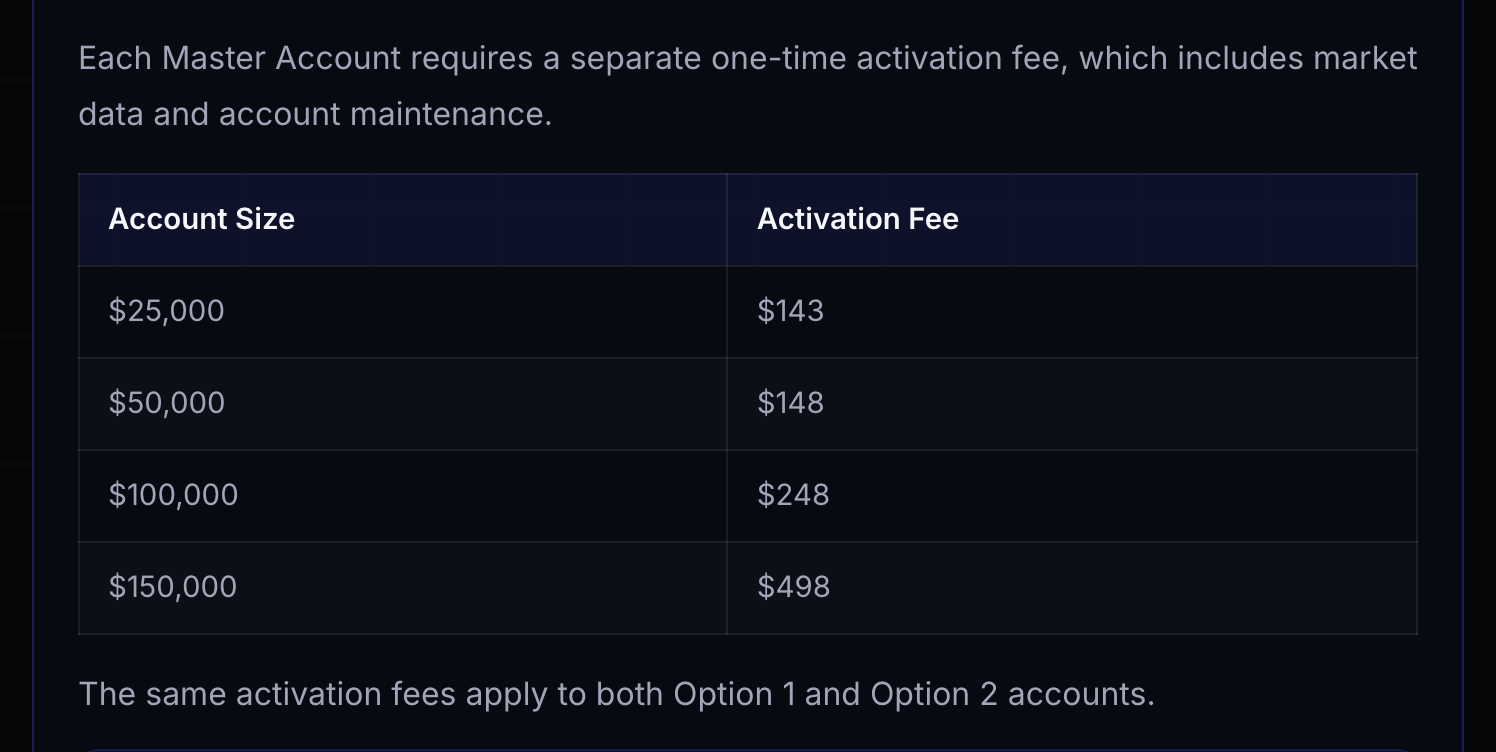
Futures prop firm fees to check before you buy
Five fees decide what a futures prop firm really costs: the evaluation, the activation, the subscription, the reset and the market data.
Bulenox puts the data trap plainly on its pricing page: one checkbox can cost $116 a month, and the professional or non-professional status you declare is locked for the life of the account. Our list of prop firms with no activation fee compares the activation line across the market.
How do futures prop firm evaluations work?
An evaluation is a simulated account with a profit target and a drawdown: reach the target without touching the drawdown and you pass. Targets run from $1,500 on a 25K to $9,000 on a 150K at the firms we checked, and some add minimum days, a consistency rule or a time limit.
Read the target next to the drawdown. Express to Live asks for $2,500 on a 50K with $650 of static room; Apex asks for $3,000 with $2,000 that trails your peak in real time. A smaller target is not an easier evaluation, and neither is a bigger drawdown: what matters is how much of your best day the rules let you keep.
Tips to pass a futures prop firm evaluation
- Write down your liquidation level before the first trade. On a 50K Express to Live it is $49,350, and it never moves.
- Risk a fixed share of the drawdown per trade. A quarter of $650 is $162.50, or 32.5 MES points: size the stop to that.
- Trade micros until your stop fits. One ES equals ten MES; scale up only when the stop you need fits the limit.
- Stop for the day after two losing trades. None of the rulebooks we read requires it, but it protects the drawdown better than waiting for a daily limit.
- Know the session close. Express to Live and Fundamental positions must be closed before the end of the trading day.
- Do not force the target in one day where a consistency rule applies. In the Topstep Combine, a best day above 55% of the target raises the target.
- Keep a journal. Write the setup, the size and the reason for each exit; the pattern behind a breach shows up within a week.
Mistakes that fail futures evaluations
Size is the first thing to get right, before direction. The contract limit is a ceiling: 10 E-mini contracts on a 50K Fundamental with a $2,500 drawdown leaves room for a 5 point move on the ES before the account is gone. Revenge trading after a loss comes next, and on an intraday trailing account every unrealized gain you give back is room lost, because the floor already rose with it.
Three mistakes are specific to prop firm rules. Holding through the session close on an intraday-only account disqualifies it. Using a daily loss limit as a stop is the one Tradeify warns against, because the limit is not a hard stop. And trading the same plan on a static and a trailing account without adjusting the size: on a trailing drawdown, a good week raises the floor without adding room, while on a static drawdown every dollar of profit adds room. See what happens when you lose money at a prop firm for the consequences.
How futures prop firm payouts work
A payout is the withdrawal of your share of the profit, once the firm’s conditions are met: winning days, a cap per request, sometimes a consistency check. The conditions decide how soon the first payout can come, far more than the split.
On Express to Live the first payout is a fixed bonus, $1,000 on a 25K, $2,000 on a 50K, $3,000 on a 100K and $4,500 on a 150K, credited to your Phidias Wallet at 80/20, and that payout converts the account to LIVE. On a 50K, that is $1,600 for you plus a $1,000 LIVE credit. Speed is the part we control: 90% of Phidias payouts are processed in under 30 minutes, and every payout within 24 hours.
Same-day payouts on Express to Live
Buy to LIVE in one day: a 25K Express to Live
11:06 AM
Evaluation bought
25K Express to Live
1:45 PM
Funded
Evaluation passed, CASH account opened
9:30 PM
Payout and LIVE
$1,000 bonus payout and $500 LIVE credit
Shreyansh G. bought a 25K Express to Live at 11:06 AM, was funded at 1:45 PM and paid at 9:30 PM the same day: $1,000 bonus payout ($800 after the 80/20 split) and a $500 LIVE credit. Our fastest verified cycle is 6 hours 18 minutes from evaluation purchase to payout received (Varun M., May 15, 2026). It is a capability, not a promise: you still have to hit the target twice. Our page on daily payout prop firms compares payout rhythms across the market.
Express to Live: no minimum days, payout on Day 1
How to choose a futures prop firm: a beginner’s checklist
Choose on the rules first, then on the price: how the drawdown moves, whether a daily limit can close your trade, what stands between you and a payout, the total cost to a funded account, and the path to LIVE.
- Drawdown type. Static, end-of-day trailing or intraday trailing: on the same trades, the third fails first.
- Daily loss limit. None, optional (Topstep, $1,000 on a 50K) or built in (Tradeify Growth, from $1,250 on a 50K).
- Consistency rule. In the evaluation, on the funded account, or neither.
- Total cost to a funded account. Evaluation plus activation: $323 on a 50K at Bulenox, $144.60 on a 50K Express to Live bought as a one-time payment.
- Time limit. 30 days at Apex and Bulenox; none on a Phidias one-time payment.
- Payout conditions. Winning days, minimum days, caps per request, and how fast the money arrives.
- Path to LIVE. By call-up, by review, or by rule.
- Platforms. Phidias runs on DeepCharts with dxFeed, Rithmic platforms and NinjaTrader / Tradovate, with TradingView execution through Tradovate.
Which futures prop firm account fits a beginner?
Intraday, fewest rules
Phidias Express to Live
Static drawdown, no daily loss limit, no consistency rule, no minimum days
Holds overnight
Phidias Premium
End-of-day trailing drawdown, overnight and over-week holds, payouts every 5 days
Wants more dollar room
An end-of-day trailing 50K
$2,500 on Phidias Fundamental, $2,000 at Topstep, with a floor that rises
Still learning
Micro contracts first
One MES moves $5 per point: practice sizing before you pay a fee
Ranking firms is a different job, done account by account in our comparison of the best futures prop firms. This checklist is the filter to read any rules page with, ours included.
Phidias accounts explained: Express to Live, Fundamental and Premium
Phidias sells three account families: Express to Live, which replaced the old Static range, Premium, which replaced the Swing range, and Fundamental, the original Phidias account. Each family has its own drawdown, payout rhythm and path to LIVE, and you can run up to 5 CASH accounts per family, 15 in total (a 150K Fundamental or Premium counts as two).
“E2L accounts have no profit consistency rule and no daily loss limit.”
Phidias Propfirm, rules page, read November 12, 2026
Express to Live: the flagship
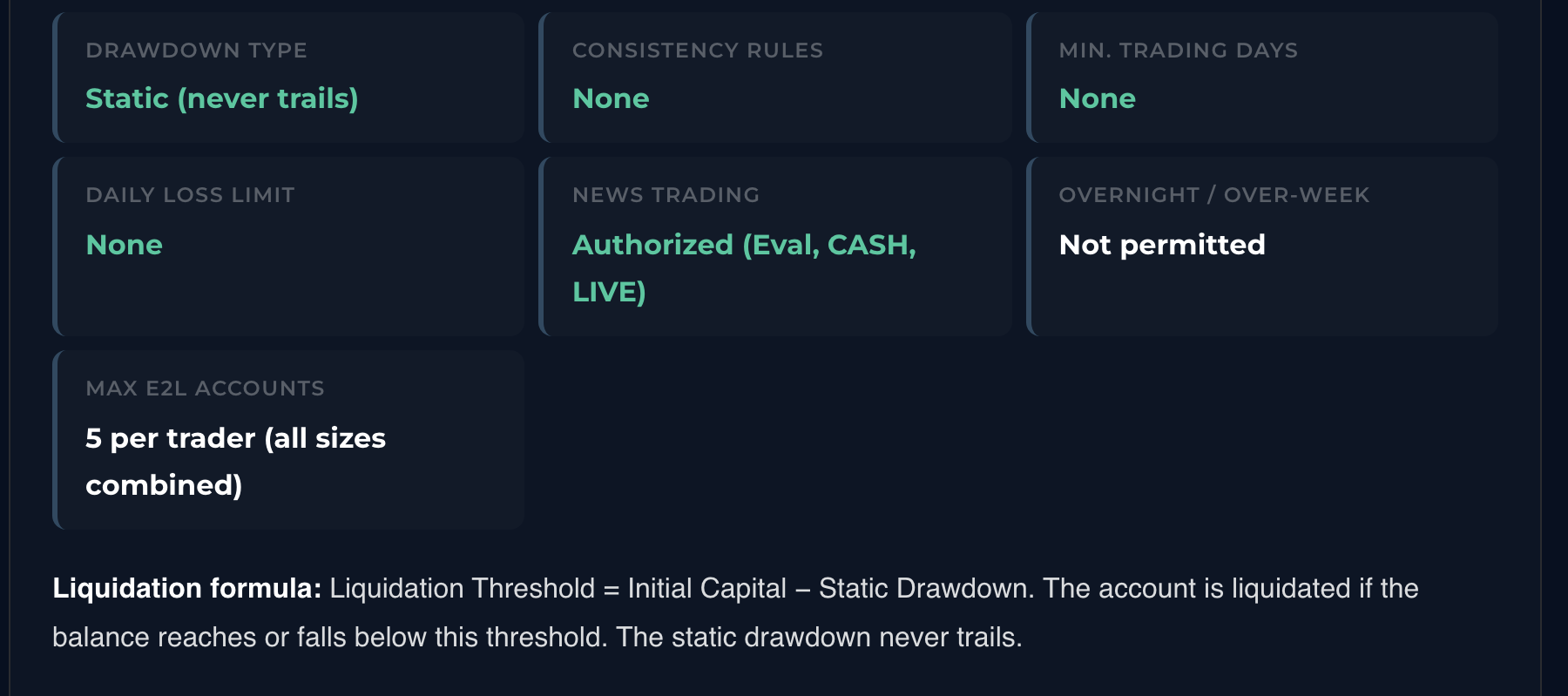
Express to Live is the flagship: a static drawdown that never trails, news trading at every stage, and the first payout converts the account to LIVE. Two honest limits: the drawdown is small in dollars, $500 to $1,000, and positions close before the end of the session.
Fundamental and Premium
Fundamental is the classic intraday account: an end-of-day trailing drawdown of $2,500 on a 50K, 3 minimum days in the evaluation and 10 on the funded account, no daily loss limit, a 30% consistency rule on the funded CASH account only, and an 80/20 split. It is our lowest-priced 50K: $116 as a one-time payment with code PHIDIAS.
Premium is built for swing traders: overnight and over-week positions, a CASH account 1 trading day after you pass, payouts every 5 days, a split on the CASH account that climbs from 75% to 100% over the first 5 payouts, and one Cash Account Reset per account. On LIVE, every Phidias account pays a flat 80/20. More than 50,000 traders have been funded at Phidias.
What our funded traders say
Reviews shared by Phidias traders, published on this page since 2025


Which futures prop firm account fits you?
Four questions on how you trade, the rule that would hurt you most, when you want a first payout and what you want after it. The answer points to one account family, or to the rules to learn first. No email, no sign-up, and every fact in the results is in the article above.
30 second check
Which futures prop firm account fits you?
Futures prop firms 2026: frequently asked questions
What is a futures prop firm?
A futures prop firm is a company that lets you trade CME futures on its account once you pass an evaluation, and shares the profit with you: 90/10 at Topstep, 80/20 on Phidias LIVE accounts. You pay a fee instead of depositing capital, and a drawdown caps what you can lose. At Topstep, Apex and Phidias the evaluation and the funded account are simulated; real market access starts at a LIVE account, where a firm offers one.
How does a futures prop firm funding model work?
You pay for an evaluation, reach its profit target without touching the drawdown, then trade a funded account and withdraw your share of the profit as payouts. The firm earns the fees; you earn the payouts. Some traders then reach a LIVE account: at Topstep by call-up, at Phidias after a review on Fundamental and Premium, and on Express to Live the first payout converts the account to LIVE.
What is the minimum capital to start with a futures prop firm?
Only the evaluation fee. A 25K Phidias Express to Live bought as a one-time payment costs $69 with code PHIDIAS (catalog $277), funded stage included. A 25K Bulenox Qualification costs $145, plus a $143 activation fee when you pass, $288 in total at published prices. Trading losses are capped by the drawdown: the account closes, and since you never deposited trading capital, what you lose is the fee.
How many contracts can you trade at a futures prop firm?
It depends on the account size and the firm. On a 50K, Phidias Express to Live allows 5 E-mini contracts (50 micros), Apex’s intraday evaluation 6, Bulenox’s Qualification 7 and Phidias Fundamental and Premium 10. One E-mini equals 10 micros, so a beginner can size down with Micro contracts such as MES or MNQ.
Are futures prop firm accounts real money?
Not before LIVE. Topstep calls its Express Funded Account a simulated funded-level account, Apex says its programs run in a simulated environment with virtual funds, and Phidias CASH accounts are simulated. The payouts you receive are real money. On Phidias Express to Live, the first payout converts the account to LIVE with a $500 to $2,000 LIVE credit.
What are the main futures prop firm rules?
The drawdown, which fails the account when touched, then the daily loss limit, the consistency rule, the profit target, minimum trading days and the contract limit. The drawdown is static, end-of-day trailing or intraday trailing depending on the firm. Phidias Express to Live keeps only a static drawdown: no daily loss limit, no consistency rule and no minimum days.
How long does it take to get a first payout from a futures prop firm?
From the same day to a few weeks. Topstep’s Standard path asks for 5 winning days of $150 or more before a payout. Phidias Fundamental asks for 10 trading days on the funded account and Premium pays every 5 days. On Express to Live there are no minimum days: our fastest verified cycle from purchase to payout is 6 hours 18 minutes, and 90% of Phidias payouts are processed in under 30 minutes.
Can you have several futures prop firm accounts?
Yes, within each firm’s cap. Topstep allows up to 5 active Express Funded Accounts, Bulenox up to five Master-level accounts at once, and Phidias up to 5 CASH accounts per family: 5 Express to Live, 5 Fundamental and 5 Premium, 15 in total, with a 150K Fundamental or Premium counting as two. Several accounts multiply the payouts, but also the fees, so add accounts once one is paying.
How do futures prop firms make money?
From what traders pay: evaluation fees, activation fees, resets and data add-ons. Their main cost is the payouts they send to funded traders. While accounts are simulated, payouts are not funded by market gains, because the trades never reach the market; once a trader reaches LIVE, trades go to the real market.
Related guides
- The best futures prop firms in 2026
- Funded trading account: how it works, costs and payouts
- What is a prop firm account?
- Do prop firms use real money?
- Static drawdown prop firms
- Trailing drawdown: intraday, end-of-day or static
- Prop firms with no daily loss limit
- The consistency rule, with a calculator
Read it yourself
- Phidias rules (Express to Live, Fundamental, Premium, activation fees, market data)
- Phidias accounts and prices
- Topstep: Express Funded Account parameters
- Topstep: Maximum Loss Limit
- Topstep: Daily Loss Limit
- Topstep: consistency rules
- Topstep: payout policy
- Topstep: Live Funded Account parameters
- Apex Trader Funding: intraday trailing drawdown evaluations
- Tradeify: daily loss limit rules
- Bulenox: accounts and pricing
- Bulenox: Master activation fee
- Ironbeam: E-mini S&P 500 (ES) contract specifications
- Ironbeam: Micro E-mini S&P 500 (MES) contract specifications
- Ironbeam: E-mini Nasdaq-100 (NQ) contract specifications
- Ironbeam: Micro E-mini Nasdaq-100 (MNQ) contract specifications
The verdict
“A futures prop firm is a rulebook with a price tag. Beginners compare the price and the account size; traders who last compare how the drawdown moves, what can close a trade, and what stands between the first payout and a LIVE account. Read those three lines on any rules page, ours included. On Express to Live the floor never moves and the first payout is the conversion.”
William G., CMO at Phidias Propfirm
William G., CMO at Phidias Propfirm
William runs communication at Phidias Propfirm and reads competitor rules at the source for every guide we publish. Last reviewed 2026. The primary sources are linked above.
Start with a funded futures account
Competitor rules as read on each firm’s website or help center on November 12, 2026; contract values as published by Ironbeam on November 10, 2026. Rules change often, so check the source before you buy. Phidias evaluation, funded CASH and LIVE accounts follow the Phidias rules page. Futures trading involves substantial risk of loss. This page is not tax, legal or investment advice.