Lucid Trading copy trading rules, 2026
Lucid permits trade copiers and bots on its accounts. What it does not permit is two of your accounts facing opposite ways, and a copier can do that without asking you.
Read from Lucid Trading’s help center, rules and account pages (most updated 26 August 2026), on 2 October 2026.
We are a competing prop firm, so read our comparison at the end with that in mind. Everything before it is Lucid Trading’s own documentation, linked at the bottom.
Yes, Lucid Trading allows copy trading and bots on its accounts. The rules that decide whether your setup survives are elsewhere: no opposite positions across your accounts, including on correlated contracts and at other firms, no high frequency trading, no microscalping, a maximum of 5 funded accounts per household, and full responsibility for any software error.
In short
- Copiers and bots: permitted, in Lucid’s own words. Lucid names no approved copier.
- Account limit: 5 funded per household, 10 in total with evaluations, 5 LucidLive.
- The trap: hedging across accounts is prohibited, including long ES on one account and short NQ on another. First flag: accounts reset to the prior day’s balance.
- Bots: high frequency trading banned; microscalping flagged above 50% of profits from trades of 5 seconds or less.
- Timing: positions auto-closed at 4:45 PM EST on Pro, Flex and Direct; red folder news is a hard breach on LucidDaily.
Does Lucid Trading allow copy trading?
Yes, explicitly. Lucid’s Other Trading Activities page lists automated strategies alongside scaling, scalping and flipping, and settles the question in one line: “Automated trading systems and trade copiers are permitted.”
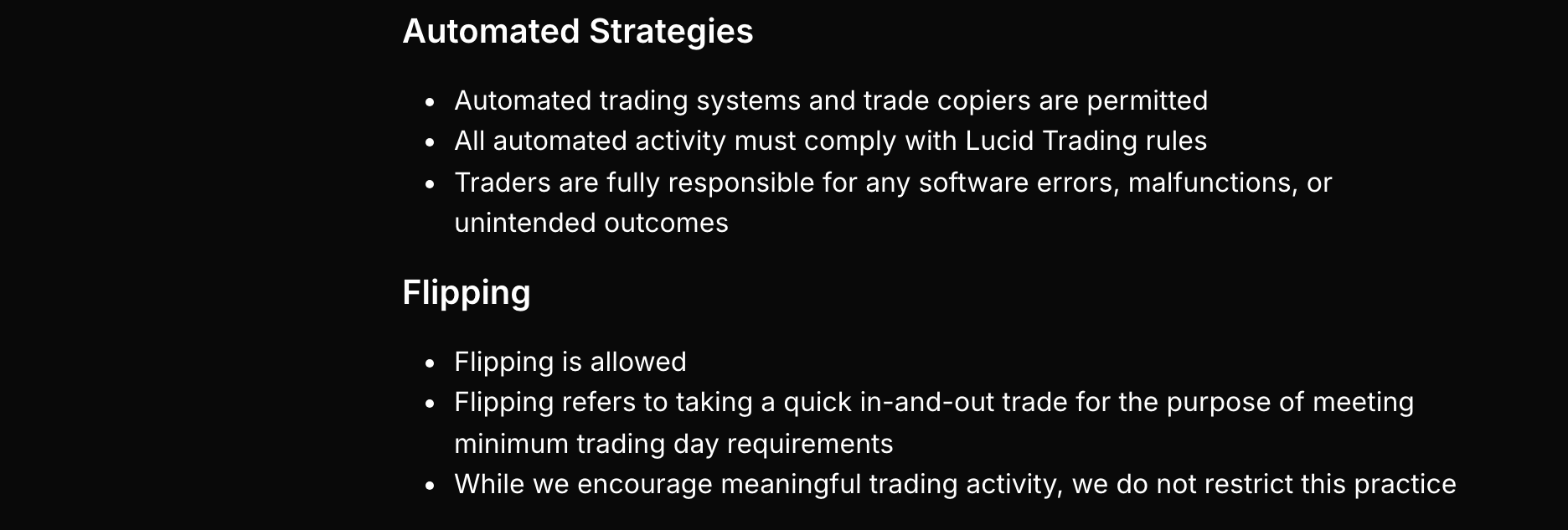
Two conditions come with it. All automated activity must comply with Lucid’s rules, and the trader is fully responsible for any software errors, malfunctions, or unintended outcomes. If the copier fails, the account still answers for what it did.
Unlike Take Profit Trader, Lucid publishes no list of approved copiers. Our Take Profit Trader copy trading guide shows what a named list looks like; at Lucid the choice of tool is yours, and so is the risk.
How many Lucid accounts can you copy trade?
Five funded accounts per household, across all plans combined. Evaluations share a wider ceiling of ten.
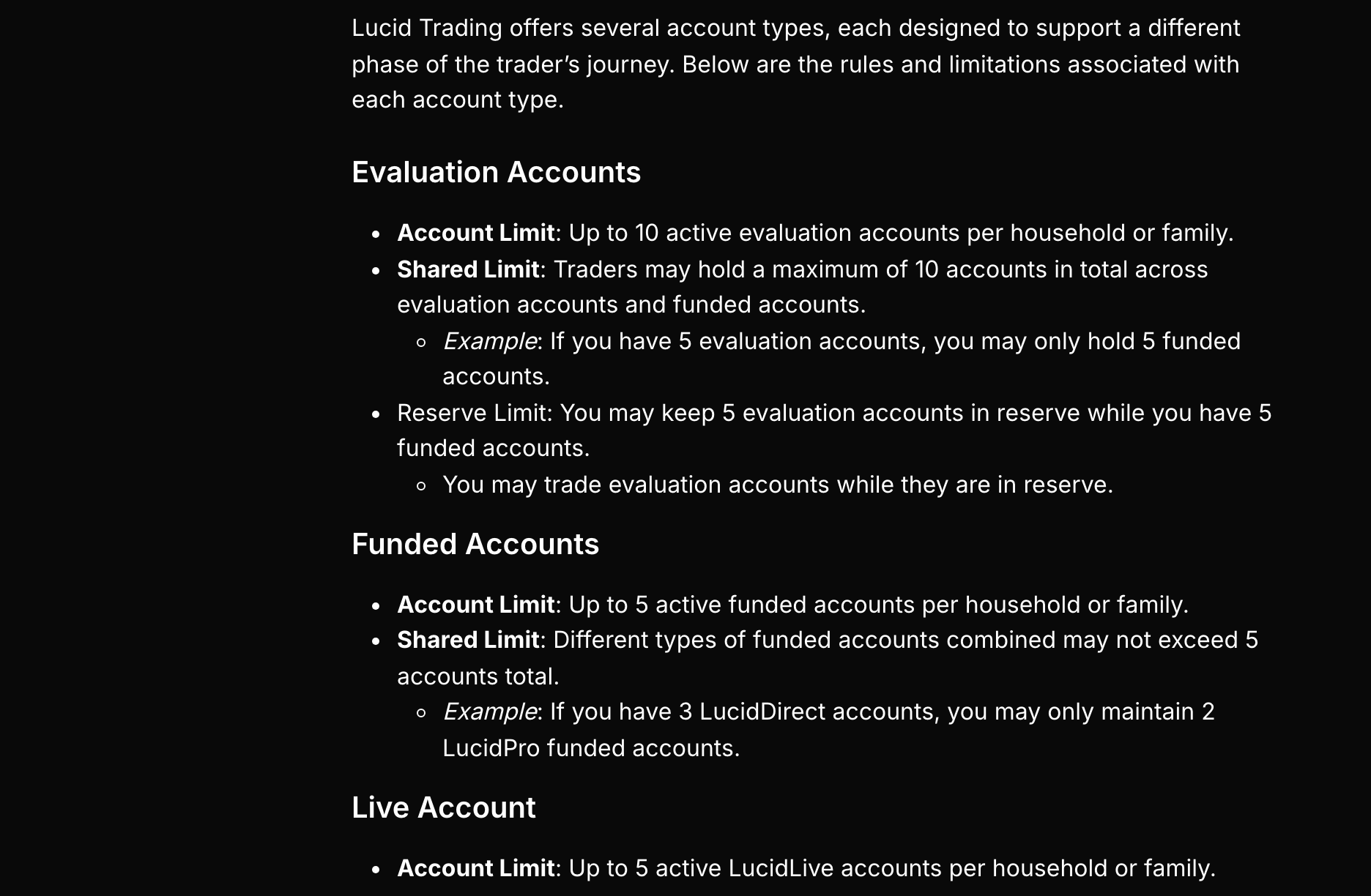
The limit is per household or family, not per login. And the copy grid has an end date: when Lucid moves you live, all simulated accounts are closed, including evaluations kept in reserve, so the five accounts you were copying become live accounts or disappear.
The hedging trap: when a copier breaks the rules for you
This is the rule that catches copy traders. Lucid prohibits every form of hedging, which it defines as using multiple accounts to take opposing positions. Its own FAQ draws the lines precisely:
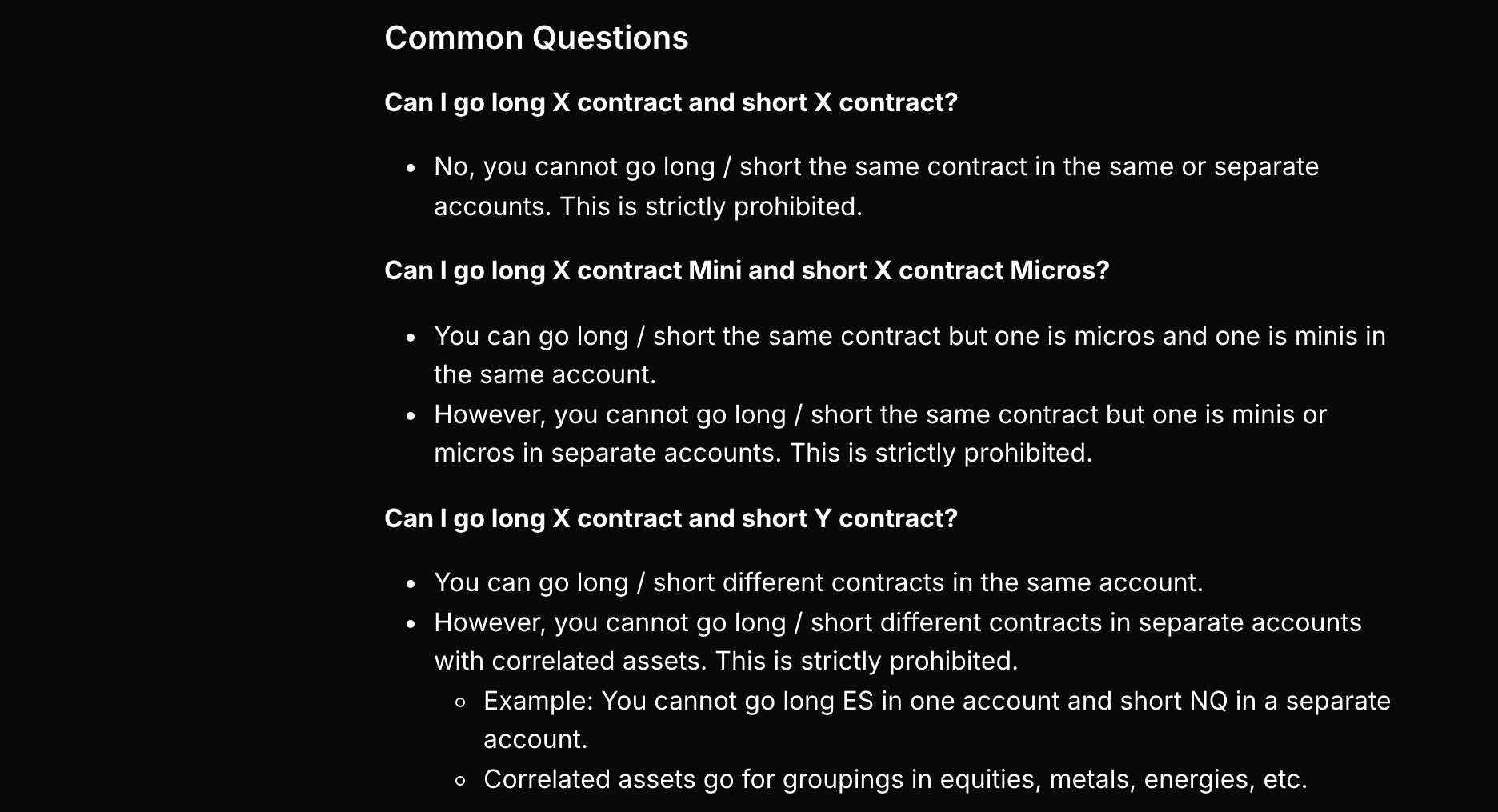
The correlated rule is the one people miss. Lucid’s own example: “You cannot go long ES in one account and short NQ in a separate account.” The prohibition also extends to hedging between different users’ accounts and between different firms or funded platforms.
A copier is designed to keep every account on the same side, which is exactly why it is allowed. The risk is the moment it does not:
- A follower misses an exit. The leader closes and reverses short; one follower is still long. Two accounts, same contract, opposite sides.
- A manual override. You close or flip one account by hand while the copier keeps the others running.
- Different bots on different accounts. A long NQ strategy on one account and a short ES strategy on another is a correlated hedge, even if neither bot knows about the other.
- Reverse copying across firms. Any feature that mirrors trades in the opposite direction at another firm is hedging between firms.
The sanction is automatic before it is personal. Lucid detects hedging with automated systems. A first flag brings an email notice and resets the associated accounts to the prior day’s balance, which erases that day’s profit on every account involved. Repeated offenses breach all involved accounts and can end in a permanent restriction. Check every follower after every exit, not just the leader.
Does Lucid allow bots and algo trading?
Yes, under the same Automated Strategies rule as copiers. Two limits apply to bots in particular.
High frequency trading is prohibited. Lucid flags it automatically. A first offense brings a written warning; repeated offenses remove all profits generated by HFT, close the accounts and permanently restrict the trader. Its stated reason is the load that hundreds of orders in minutes put on the platform.
Microscalping is flagged by a published threshold.
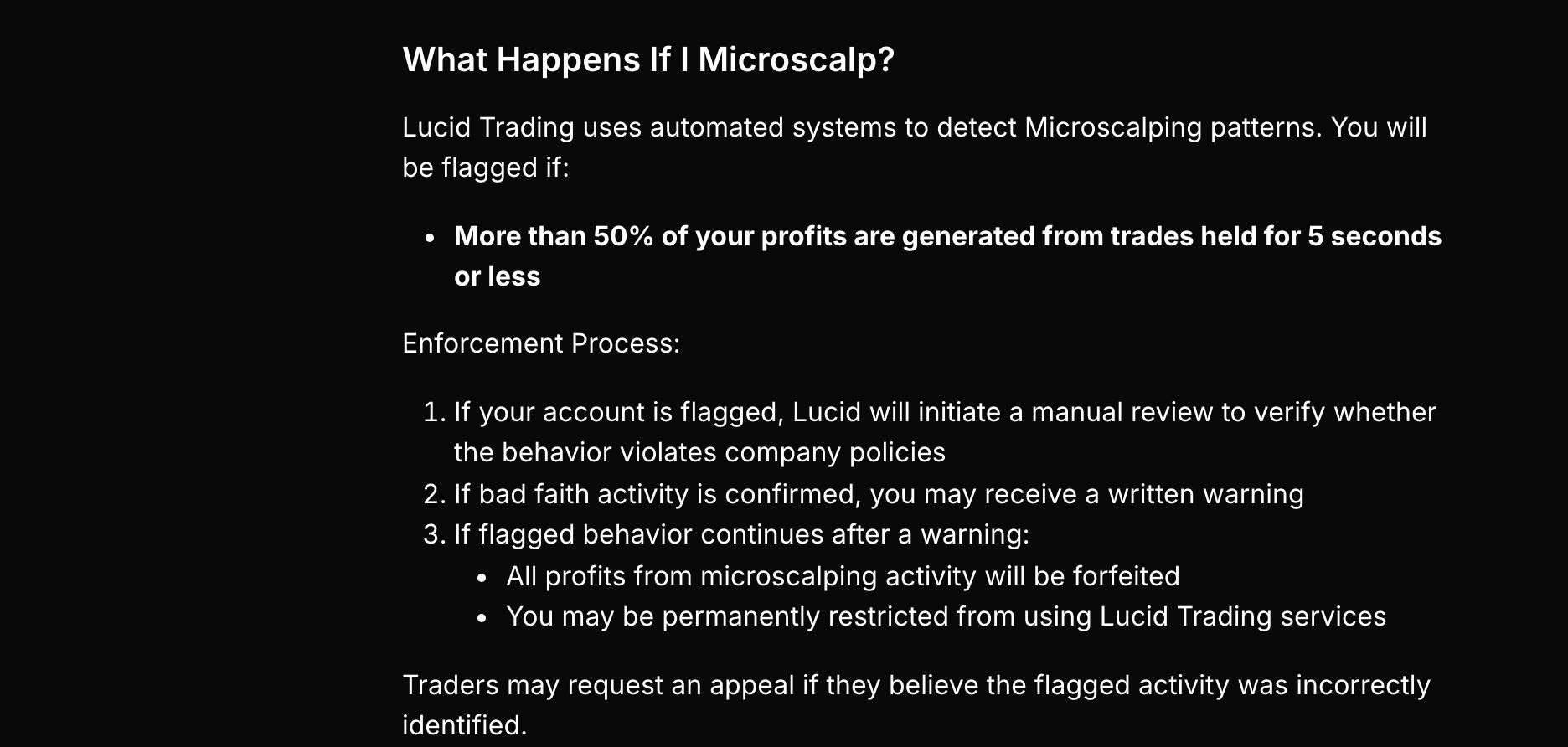
If more than 50% of your profits come from trades held for 5 seconds or less, the account is flagged for a manual review. If bad faith is confirmed, you may receive a written warning; continued after the warning, those profits are forfeited and you may be restricted for good. Genuine scalping, Lucid adds, remains allowed.
For a bot, that means checking the distribution of hold times, not just the win rate. A strategy whose edge comes from very fast exits can cross the line without any intent to game the fills.
Apex Trader Funding takes the opposite line: no automation on its accounts, and copying limited to your own manual trades across your own PAs. Our Apex copy trading rules set out the difference.
Four timing rules that break a bot
- 4:45 PM EST cut-off. On LucidPro, LucidFlex and LucidDirect, open positions are closed automatically at 4:45 PM EST, Monday to Friday. It is not a failed account, but a bot that expects to hold will be flattened.
- 6:00 PM EST restart. Trading resumes Sunday to Thursday at 6:00 PM EST. On holidays with early closes, positions must be flat before the market closes.
- News on LucidDaily. In Lucid’s words, “Trading red folder news on the LucidDaily is a hard breach.” On Pro, Flex and Direct, news trading is allowed. A bot copied across a mix of plans needs a news filter on its Daily accounts.
- LucidLive. No swing trading; positions must be closed by 4:45 PM EST on Tradovate live accounts and 4:15 PM EST on Rithmic live accounts.
The news rule matters most because it is the only one that breaks an account outright. Our LucidDaily guide covers the rest of that plan.
Which platforms and copiers work with Lucid?
Every listed platform works with every Lucid account type, through one of two data connections:
Lucid does not endorse a copier, so the tool depends on where your accounts live: a copier that works inside one platform can only reach accounts connected to it. If you copy across a CQG account and a Rithmic account, you need a tool that bridges both, and the responsibility for a missed fill stays with you.
Topstep takes the opposite approach and builds a Trade Copier into its own TopstepX platform, though not for its Live account. Our Topstep copy trading rules explain how it works.
Copying multiplies your commissions too
Every follower pays its own commissions. Lucid charges per side: $1.75 on ES and NQ, $0.50 on the equity index micros. One round turn on one ES contract costs $3.50; copied across five accounts, it costs $17.50. On those micros, $1 becomes $5.
That is fine for a strategy with a wide average win. For a bot that trades often for small gains, five times the commissions can turn a profitable strategy into a flat one.
Lucid vs Phidias on copy trading
Both firms allow copy trading, and both leave the copier and its failures to you. The difference is in how many accounts you can copy, and where they lead.
Lucid’s rules for copiers and bots are clear, and its explicit permission for automated systems is a genuine advantage for algorithmic traders. Our rules page covers copy trading; for anything beyond it, ask our support before you build around it.
Where we differ is the destination. On Express to Live, you reach the target on the CASH account, click Switch to Live, and the fixed bonus payout converts the account to a LIVE account. That conversion is an Express to Live rule; on our Fundamental and Premium accounts, moving to LIVE is discretionary. If you copy trade on Phidias, our DeepCharts trade copier guide walks through the setup.
See Phidias accounts and pricing
Test: is your copy setup safe on Lucid?
Four questions on how many accounts you run, whether they always trade the same side, how long your strategy holds and which plan you copy on. No email.
30 second check
Is your copy setup safe on Lucid?
Lucid Trading copy trading: frequently asked questions
Does Lucid Trading allow copy trading?
Yes. Lucid’s help center states that “automated trading systems and trade copiers are permitted” provided all automated activity complies with Lucid’s rules. The trader is fully responsible for software errors, malfunctions or unintended outcomes, and Lucid does not name any approved copier.
How many Lucid accounts can you copy trade?
Up to 5 funded accounts per household, across all plans combined, and up to 10 accounts in total when evaluations are included. Lucid also allows up to 5 LucidLive accounts per household. Any copy setup has to fit inside those limits.
Does Lucid Trading allow bots and algo trading?
Yes, automated systems are permitted, with two hard limits. High frequency trading is prohibited: a written warning first, then profits removed, accounts closed and a permanent restriction for repeat offenses. And an account is flagged for microscalping if more than 50% of its profits come from trades held for 5 seconds or less.
What counts as hedging at Lucid Trading?
Opposite positions on the same contract in separate accounts, a mini against a micro of the same contract in separate accounts, or opposite positions on correlated contracts in separate accounts, such as long ES in one and short NQ in another. It also covers hedging between different users’ accounts and between different firms. Inside a single account, long minis and short micros of the same contract are allowed.
Can you copy trade Lucid and another prop firm at the same time?
Lucid’s rules prohibit hedging “between different firms or funded platforms”, so an opposite position at another firm is a violation. Copying in the same direction across firms is not addressed in Lucid’s hedging page. Check the other firm’s own rules as well.
What happens if Lucid flags you for hedging?
You receive an email notice and the associated accounts are reset to the prior day’s balance. After repeated offenses, all involved accounts are breached and you may be permanently restricted from Lucid’s services.
Can a bot trade news on Lucid Trading?
On LucidPro, LucidFlex and LucidDirect, yes: entering or exiting around news is not a breach. On LucidDaily it is: Lucid states that trading red folder news on LucidDaily is a hard breach, so any automated strategy running on a LucidDaily account has to be switched off around those releases.
Which platforms can you copy trade on at Lucid?
Lucid supports NinjaTrader, Tradovate and TradingView through CQG, and MotiveWave, Quantower, Tradesea, Sierra Chart, Jigsaw, Bookmap, ATAS, R|Trader Pro and MultiCharts through Rithmic, on every account type. It does not publish a list of approved copiers, unlike Take Profit Trader.
How does Phidias compare on copy trading?
Phidias allows copy trading within its account limits: up to 5 CASH Premium, 5 CASH Fundamental and 5 Express to Live accounts per person, company or internet connection, with third-party copier software at your own risk. Lucid caps funded accounts at 5 per household. On Express to Live, the payout at the target converts the account to a LIVE account.
Related guides
Read it yourself
- Lucid: Other Trading Activities (automated strategies, news, scalping)
- Lucid: Prohibited Hedging (the full FAQ)
- Lucid: Prohibited High Frequency Trading
- Lucid: Prohibited Microscalping
- Lucid: Maximum Number of Accounts
- Lucid: Allowed Trading Times
- Phidias accounts and pricing
The verdict
“Lucid is one of the clearest firms on copiers and bots: it allows them in writing and publishes its microscalping threshold. The risk is not the copier, it is the day one account ends up on the other side of another. Build your setup so that can never happen, and check every follower after every exit.”
William G., CMO at Phidias Propfirm