Take Profit Trader copy trading, 2026
Copy trading is permitted at Take Profit Trader, across accounts you own and control. Four third-party entries are named, plus platform-native tools.
There are two lines, not one. The tool has to be on the list, and the accounts have to be yours.
Running several funded accounts? Phidias Express to Live is the alternative we build. First, exactly what Take Profit Trader permits.
Does Take Profit Trader allow copy trading?
Yes. Take Profit Trader permits trade copiers, solely for managing accounts owned and controlled by you. It publishes an approved list, and copying trades across your own accounts is explicitly named as a permitted use. What is prohibited is copying or synchronising trades between different users or identities.
Our verdict (William G.)
We compete with Take Profit Trader, so read this knowing that, and then note that we think this is the best-written policy at the firm. Most prop firms handle copiers with a vague sentence that lets them decide after the fact. Take Profit Trader names the approved tools, names the prohibited behaviours, lists the surveillance signals it actually uses, and states in writing that enforcement is based on behaviour rather than on which software you ran. You can read this policy and know where you stand, which is rarer than it should be. Our one criticism: the approved list and the behaviour rules are easy to read as a single test when they are two, and the sentence about tools not deciding enforcement sits several paragraphs away from the one saying unapproved tools are enforceable on their own.
The approved copiers, by name
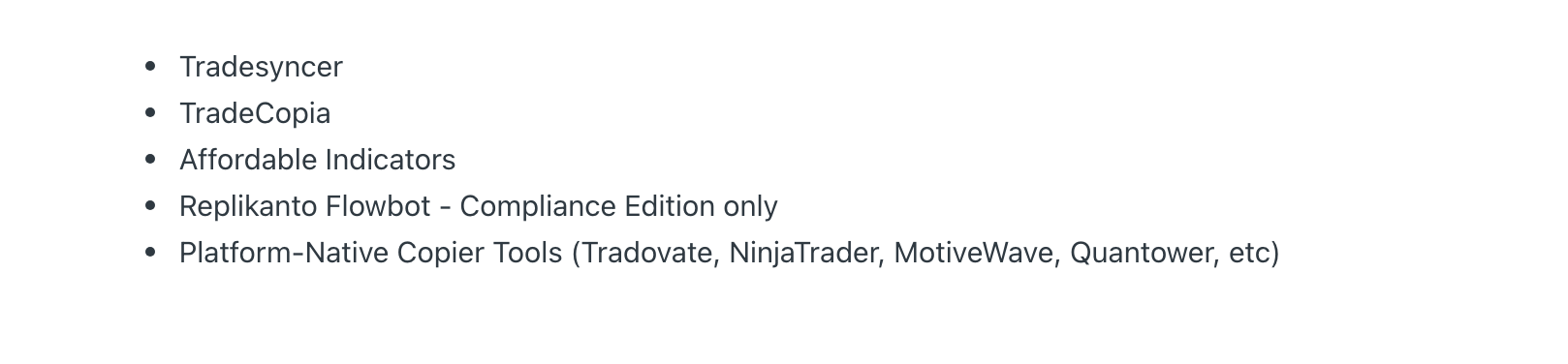
Four third-party entries are approved: Tradesyncer, TradeCopia, Affordable Indicators, and a fourth line that reads Replikanto Flowbot, Compliance Edition only.
That fourth line is worth reproducing exactly as Take Profit Trader writes it, because it is a single entry rather than two. The dedicated section underneath it names only Replikanto. If the tool you intend to use is Flowbot, confirm with support that it is covered before you connect anything, since using an unapproved copier is an offence in its own right.
Alongside them, platform-native copier tools are approved as a category, with Tradovate, NinjaTrader, MotiveWave and Quantower named as examples. That list ends with an explicit etc, so treat the four as illustrations rather than an exhaustive set.
If you have not chosen a platform yet, that overlaps with a decision covered in our guide to Take Profit Trader platforms: picking one whose copier is native saves you validating a third-party tool against this list.
The edition matters, and it is enforceable
Replikanto is approved only in its Compliance Edition. Take Profit Trader states that standard, modified or non-compliance versions are not permitted, and ties the requirement to CME Group standards requiring trading activity to reflect independent decision-making.
They can ask you to prove it. Take Profit Trader may require verification at any time, including version identification, configuration review or execution behaviour analysis. Failing to provide that verification on request may itself result in enforcement action.
Take Profit Trader also reserves the right to modify the approved list at any time. If you are relying on a specific tool, check the policy page rather than a forum post before you set it up.
What you are allowed to do
The permitted uses are stated positively, which is unusual and helpful.
You may copy trades across your accounts. You may manage multiple accounts as part of your individual trading strategy. You may use a copier to improve execution efficiency across your own accounts.
There is also a clause worth knowing if you follow other traders: you may manually follow or learn from other traders, provided the trading decisions and executions are independently made by the account holder. Watching someone and forming your own view is fine. Wiring your account to theirs is not.
Apex Trader Funding draws a similar line in fewer words: copying across your own personal and business PAs is allowed, copying with other traders is forbidden. Our Apex copy trading rules cover its 20 PA limit and its one-direction rule.
Two lines, and you have to stay inside both
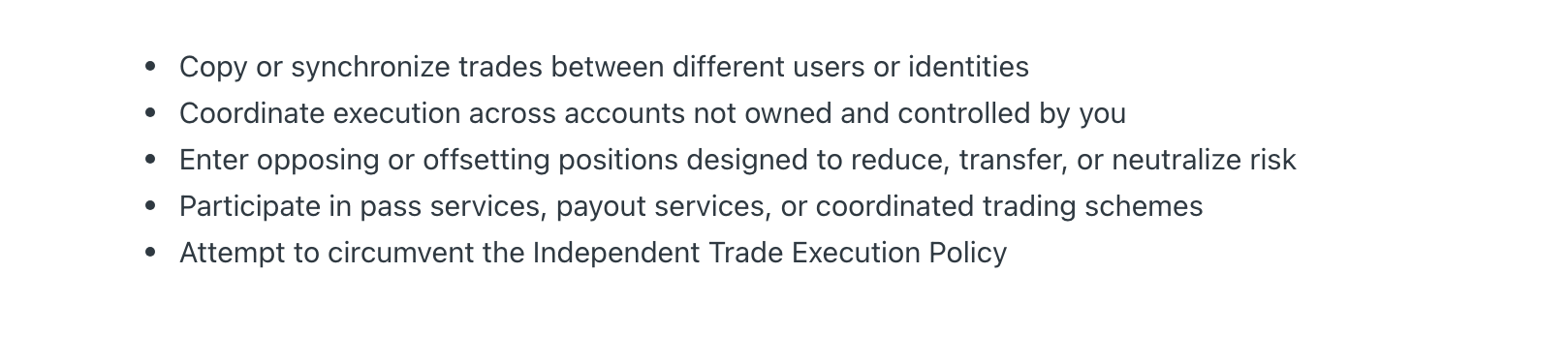
Copiers may not be used to copy or synchronise trades between different users or identities, to coordinate execution across accounts not owned and controlled by you, to enter opposing or offsetting positions designed to reduce, transfer or neutralise risk, to participate in pass services, payout services or coordinated trading schemes, or to attempt to circumvent the Independent Trade Execution Policy.
Three of those five turn on identity. Two do not, and they are the ones that catch traders who checked the ownership question and stopped there: the offsetting prohibition, which applies across accounts you own, and the catch-all against circumventing the policy.
Take Profit Trader then addresses tooling directly, in the enforcement section of its execution policy: enforcement decisions are based on a combination of behavioural, statistical and infrastructure-related analysis, not the specific software or tools used.
It would be easy to read that as permission to run whatever you like. It is not, and the copier policy closes the gap in a sentence worth quoting alongside it: use of unapproved trade copiers, modified versions, or non-compliance editions, or copier-based services may result in enforcement action.
So there are two tests and you have to pass both. The tool has to be on the list. Then your behaviour has to look like one person trading independently. Being approved does not protect a prohibited pattern, and a clean pattern does not excuse an unapproved tool.
Where automation stops
An article about copying software has to answer an obvious objection, and Take Profit Trader’s rulebooks state it plainly: trading bots and algorithms are not permitted, of any kind. The Universal Trading Policies apply that to every account type, Test, PRO and PRO+, and the PRO rulebook repeats it.
The two rules are reconciled by what the software is allowed to do. Take Profit Trader writes that you are free to use tools that assist with order execution or trade management, including trade copiers, provided each account represents independent trading activity.
So the boundary sits at the decision. A copier replicating a trade you decided and entered by hand is the permitted case. Anything that makes the entry decision for you is a bot, and that is a separate and absolute violation no approved-list membership will cover.
Lucid Trading takes a different route: it permits copiers and bots without naming any approved tool, and draws its line at hedging across accounts, including correlated contracts. The detail is in our Lucid Trading copy trading rules.
The trap that applies even on your own accounts
Most traders read the policy, confirm every account is theirs, and stop there. There is one restriction that survives that check.
Synchronisation across accounts you solely own and control is permitted, but not if it is used to enter opposing, offsetting or risk-neutralising positions. Take Profit Trader says this twice, in both policies, which is a fair signal of how much it matters.
So a copier that mirrors the same trade across five of your own accounts is exactly what the policy contemplates. A setup where account A is long and account B is short the same or a closely related product, hedging one against the other, is prohibited even though both accounts are yours.
A misconfigured copier is your responsibility, not the tool’s. Take Profit Trader answers the question directly: if a trade copier causes opposing positions, does that count as a violation? Yes. Traders are fully responsible for the use of any copier or third-party automation connected to their accounts, including configuring it correctly and monitoring all copied activity. Trades executed through a copier are treated as the trader’s own actions under every rule. A fill delay, an unreplicated leg or a forgotten setting are not mitigating circumstances.
This connects to the counter-position rule that applies across every account type, Test, PRO and PRO+, which we cover with the rest of the rulebook in our guide to the Take Profit Trader rules. The consequences there are among the heaviest at the firm.
The account-structuring prohibition is broader still. Take Profit Trader also prohibits structuring accounts so that the failure of some accounts statistically increases the likelihood of success of others, and opening accounts under separate identities to distribute materially similar high-risk trades. That is a direct ban on the scatter-gun approach of buying many accounts, trading them aggressively, and counting on one surviving.
What their surveillance actually looks for
Take Profit Trader publishes the signals, which lets you assess your own setup honestly instead of guessing.
Their systems monitor trade timing correlation, strategy similarity, risk and position sizing patterns, execution clustering, account relationship indicators, and device or infrastructure clustering.
There is an important piece of reassurance attached, and it is the sort of thing most firms would leave unsaid: no single signal, such as a shared IP address or device, constitutes a violation in isolation. It is combined indicators that reasonably suggest centralised control, coordinated execution or structured risk dispersion that trigger action.
That matters in practice. Two traders in the same household, or two accounts you run from one machine, are not automatically a problem. A group of accounts entering the same trades within seconds of each other, sized identically, from one location, is.
What it costs if they decide you crossed the line
The escalation is published, and it goes further than most.
The published measures run from account review to profit forfeiture, account reset, account liquidation and a permanent ban in cases of severe or repeated violations. Take Profit Trader states they are determined by the severity and frequency of violations, in no fixed order, so a single serious breach can go straight to liquidation.
One line deserves reading twice if you are planning around payouts: enforcement may occur before, during, or after a payout review. Clearing a withdrawal is not a clean bill of health, and a pattern identified later can still reach money already reviewed.
Why this is exchange regulation rather than house policy
It would be easy to read all of this as a firm protecting itself from clever traders. Take Profit Trader gives a fuller explanation, and it is worth taking seriously because it changes how negotiable the rules are.
Two reasons are given. First, the firm operates a diversified risk model, and accounts trading in synchronisation, particularly in groups, create concentrated exposure that they say defeats the purpose of evaluation and puts the whole trader base at risk.
Second, and more binding: coordinated offsetting or inverse trading designed to neutralise risk is inconsistent with exchange principles that prohibit pre-arranged or accommodation trades. Take Profit Trader states these restrictions align with CME and CFTC requirements.
Note the exact wording: Take Profit Trader says these restrictions align with exchange standards rather than claiming the exchanges impose them directly on your account. That distinction matters, since Test and PRO accounts run in a simulated environment. But it tells you how the firm treats them, which is as a standard it will not waive rather than a house preference it might.
Is your copy trading setup inside the line?
Four questions on whose accounts receive the trades, whether they ever take opposite sides, what you are worried about and where you trade from. The check tells you which side of Take Profit Trader’s line you are on. No email.
40-second check
Is your copy trading setup inside the line?
How we see it at Phidias
We are not going to claim a better copier policy than a firm that publishes its approved list, its surveillance signals and its enforcement ladder. On this specific subject, Take Profit Trader has done the work.
Where we differ is the product underneath. Phidias Express to Live converts to a live account at your first payout, and there is no monthly subscription attached to the evaluation, so running more than one account does not mean running more than one meter.
Our record
Our fastest verified cycle, from evaluation purchase to payout received. Separately, the full Express to Live cycle, through to a LIVE account, can be completed in under a day.
Take Profit Trader copy trading: frequently asked questions
Does Take Profit Trader allow copy trading?
Yes, solely for managing accounts owned and controlled by you. Copying trades across your own accounts is explicitly listed as a permitted use. Copying between different users or identities is prohibited.
Which trade copiers are approved?
Take Profit Trader lists Tradesyncer, TradeCopia, Affordable Indicators, and a fourth entry reading Replikanto Flowbot in Compliance Edition only, plus platform-native copier tools with Tradovate, NinjaTrader, MotiveWave and Quantower named as examples.
Can I use Replikanto with Take Profit Trader?
Only in its designated Compliance Edition. Standard, modified or non-compliance versions are not permitted, and Take Profit Trader may ask you to verify the version, configuration or execution behaviour at any time.
Can I copy trade with a friend or a signal provider?
No. Copying or synchronising trades between different users or identities is prohibited, as is participating in pass services or payout services. You may manually follow or learn from other traders, but the decisions and executions must be your own.
Can I hedge one of my accounts against another?
No. Synchronisation across accounts you own is permitted, but not to enter opposing, offsetting or risk-neutralising positions. This holds even when every account involved is yours.
What happens if my copier creates opposing positions?
It is a violation, and it is attributed to you. Take Profit Trader states that traders are fully responsible for the use of any copier or automation tool connected to their accounts, including its configuration and the monitoring of copied activity, and that trades placed through a copier are treated as the trader’s own actions under every rule.
Will sharing an IP address get me banned?
Not on its own. Take Profit Trader states that no single signal, such as a shared IP address or device, constitutes a violation in isolation. Enforcement follows combined indicators suggesting centralised control or coordinated execution.
What does Take Profit Trader monitor?
Trade timing correlation, strategy similarity, risk and position sizing patterns, execution clustering, account relationship indicators, and device or infrastructure clustering.
What are the penalties for prohibited copy trading?
Account review, profit forfeiture, account reset, account liquidation, and a permanent ban for severe or repeated violations. Enforcement may occur before, during or after a payout review.
Can I buy several accounts and trade them aggressively hoping one survives?
Under separate identities, that is prohibited by name: Take Profit Trader bans opening accounts under separate identities to distribute materially similar high-risk trades, and structuring accounts so that the failure of some statistically increases the likelihood of others succeeding. Under your own single identity, holding multiple accounts is explicitly allowed, provided you never hold opposing positions. What the Sustainable Trading Policy does name is account churning and routine maximum sizing, as higher-risk patterns attracting closer review, with the firm reserving the right to part ways.
Why does Take Profit Trader restrict this at all?
They cite a diversified risk model, and state that coordinated offsetting or inverse trading is inconsistent with exchange principles prohibiting pre-arranged or accommodation trades, aligning the restrictions with CME and CFTC requirements.
Useful resources
Take Profit Trader’s own documentation
· Independent Trade Execution Policy
Related guides
· Take Profit Trader explained: accounts, rules and payouts
· Take Profit Trader rules: the three rulebooks
About the author
William G. is CMO at Phidias Propfirm. He writes the firm’s competitor analyses from primary sources: help centres, terms of service and published policies, never aggregator sites. Every rule on this page was read from Take Profit Trader’s own two policy documents in August 2026, both linked above.