Tradeify rules, 2026
Tradeify documents its rules across eight separate help pages, and sorts fatal from temporary on only two of them. The other four rules are never placed in that frame at all.
So here they are, sorted by what they actually do to you.
Prefer a floor that never moves and no consistency rule at all? Here is Phidias Express to Live. First, how Tradeify’s rulebook really works.
What are Tradeify’s rules?
Tradeify’s rules split into two families that behave completely differently. The max trailing drawdown and the hedging ban are hard breaches: hit either and the account is gone permanently. The daily loss limit, the consistency rule and the microscalping rule never touch your account. They only decide whether you can trade today and whether you can be paid.
Compiled from the eight “Rules:” pages of Tradeify’s own help center, checked August 2026.
Our verdict (William G.)
Tradeify’s rulebook is more permissive than most of the market, and I will say that plainly: no news restriction at all, an end-of-day drawdown rather than an intraday one, and a daily loss limit that pauses you instead of killing you. The two things that catch people are not harsh rules, they are badly signposted ones: a drawdown that updates at the close but is enforced in real time, and a microscalping rule that quietly blocks payouts for anyone who trades fast.
Hard breach or soft breach: the distinction that matters most
Tradeify defines both terms clearly, and to its credit it does contrast them: the drawdown page carries a “Critical Concept: Hard Breach” box, and the daily loss limit page has a whole “DLL vs Max Trailing Drawdown” section. What it never does is apply that frame to the four other rules. That is the gap this page fills.
Hard breach
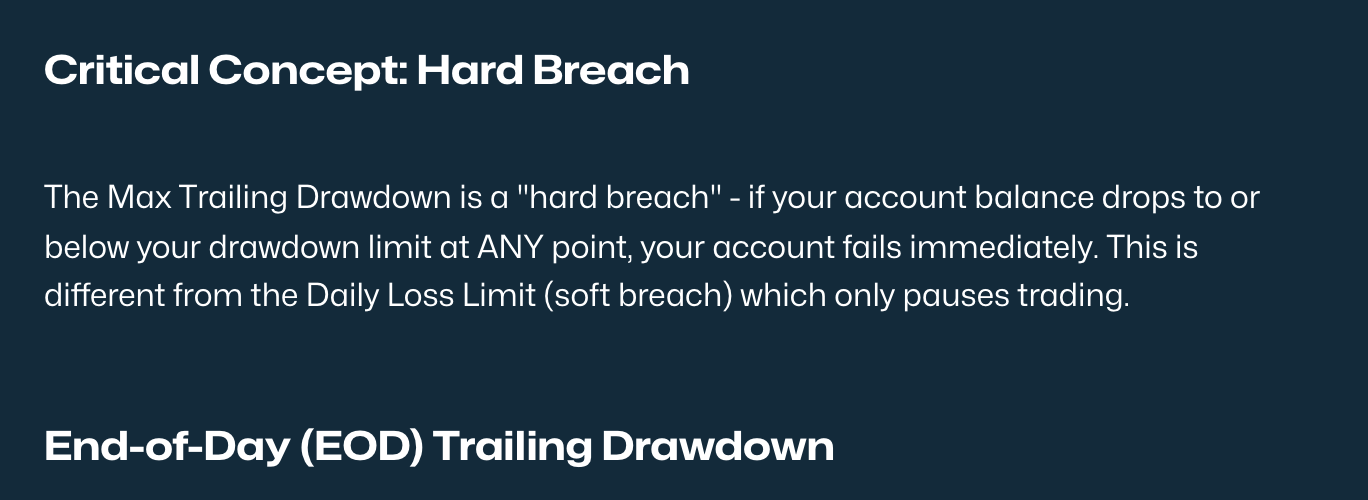
The account fails immediately and permanently. There is no recovery, no reset of the situation, no next session. Only the max trailing drawdown is documented this way. Tradeify reserves the term for it and for nothing else.
Soft breach
Trading is paused, or a payout is refused. The account stays alive. The daily loss limit, the consistency rule and the microscalping rule all sit here.
Tradeify states it directly: the daily loss limit “does NOT fail your account, you can resume trading the next session”, while the max trailing drawdown “FAILS your account permanently” with “no recovery from a drawdown breach”.
The max trailing drawdown: the only rule that ends the account
Every Tradeify account, Growth, Select and Lightning alike, uses an end-of-day trailing drawdown. Your limit trails your highest ever end-of-day balance, and it only ever moves up.
Tradeify’s own worked example, on a 100K with a $3,500 drawdown starting at a $96,500 limit: end day one at $103,000 and the limit rises to $99,500. End day two at $101,000 and the limit stays at $99,500. It does not recalculate downward.
The trap almost nobody catches
“Even though EOD drawdown only UPDATES at end of day, it is ENFORCED in real-time. If your balance hits the drawdown limit during trading, your account fails immediately, even if you might have recovered by end of day.”
Tradeify help center, Rules: Trailing Max Drawdowns.
Read that twice. Tradeify markets end-of-day drawdown as freedom from intraday traps, and on the upward side that is true: a good afternoon does not raise your floor until the close. But on the downward side the floor is live. Touch it at 11 AM and you do not get until 4:45 PM to climb back.
This is the difference between “my floor updates at the close” and “my floor is checked at the close”. Only the first is true here.
When the drawdown locks, and why it is the best day of the account
On funded accounts only, the trailing drawdown stops trailing once you are $100 clear of your drawdown amount. After that it becomes a fixed floor that never moves again.
End-of-day balance required to trigger the lock. Source: Tradeify help center, Rules: Trailing Max Drawdowns.
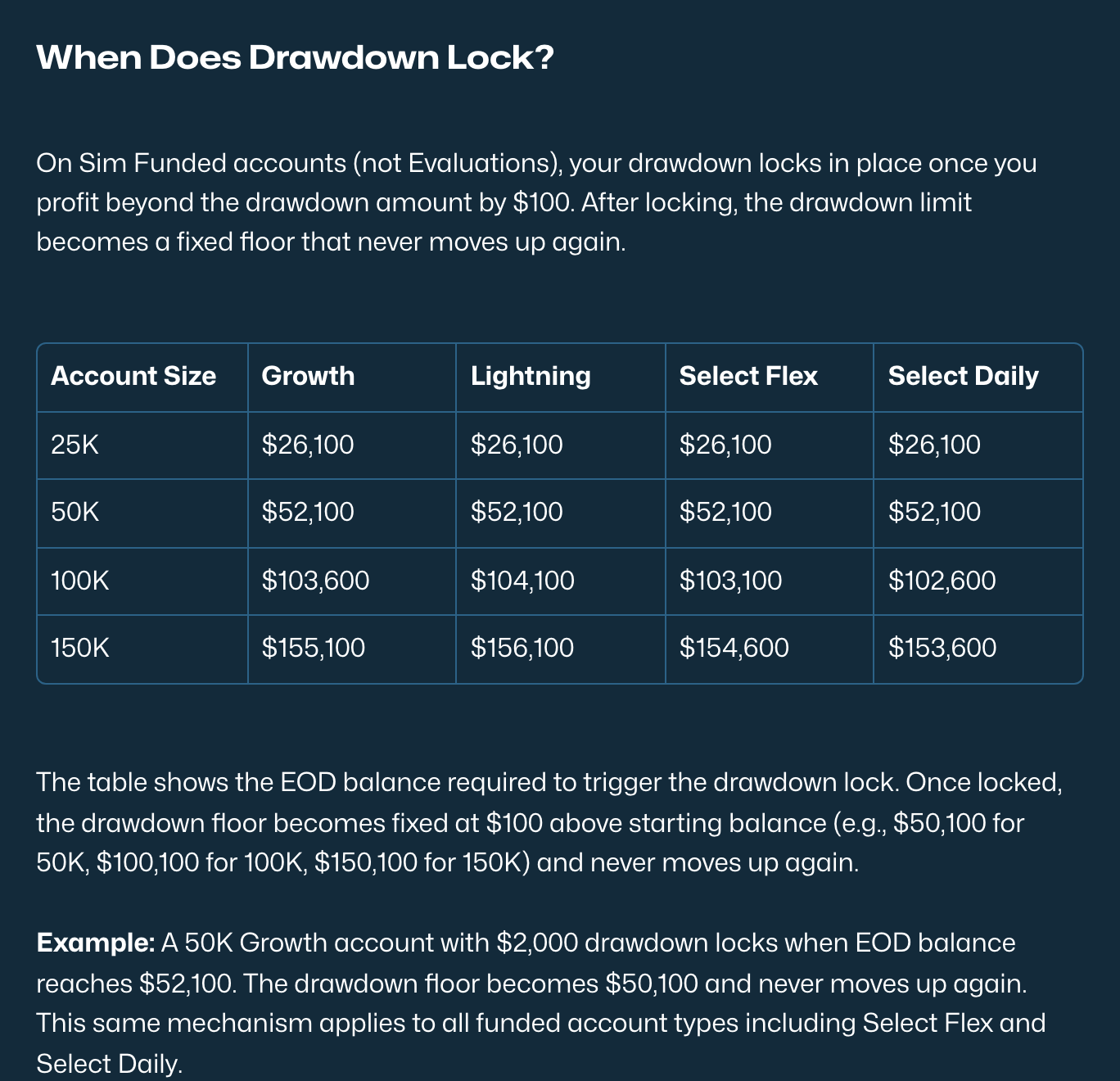
Once it locks, the floor sits at $100 above your starting balance: $50,100 on a 50K, $100,100 on a 100K, $150,100 on a 150K. From that point the account can never fail on a trailing floor again, only on a floor you can see and that does not move.
The balance is not the only trigger. Tradeify states that the lock happens “either automatically at EOD when your balance reaches $52,100 (for 50K), or immediately when you request a payout, whichever comes first”. Taking an early payout therefore locks your floor early, which is often the better move.
And Select Daily locks earliest of the four at the larger sizes, at $102,600 on a 100K against $104,100 for Lightning.
The daily loss limit: the rule that pauses you
The daily loss limit stops your trading for the session when your losses reach a threshold. It applies to Growth, Lightning and Select Daily. Select Flex has no daily loss limit at all.
On the 150K, the number changes with the phase. Tradeify’s Daily Loss Limit page covers funded accounts and gives $3,000; its Growth Evaluation page and its Essential Trading Rules Overview cover the evaluation and both give $3,750. Same account size, tighter limit once you are funded. Every smaller size carries the same DLL in both phases, so the 150K is the only one where the phase matters.
Hit it and trading resumes at 6:00 PM ET, when the next session opens. The account is untouched.
The limit also widens once you reach 6% profit, taking effect the following session rather than immediately. On a 50K that means $53,000 in balance and a DLL that grows to $2,000. On a 100K, $106,000 lifts Growth to $3,500 and Lightning to $4,000.
Tradeify’s own warning, and it deserves repeating: “NEVER use the DLL as a stop loss.” It is not a hard stop. Losses can exceed it before the system reacts, and in a fast market that slippage can push you through your max trailing drawdown, which does fail the account. A soft rule can hand you to a hard one.
Select Flex has no daily loss limit. That is not automatically a gift.
No DLL means nothing pauses you on a bad day. It also means the only thing standing between you and a failed account is the trailing drawdown, and that one is a hard breach.
On the other three accounts, a bad session usually ends with a pause. On Select Flex, a bad session ends wherever your discipline ends. If you already run a mechanical daily stop, Flex removes a constraint you did not need. If you do not, it removes your last safety net.
The consistency rule: it blocks payouts, not trades
This is the rule most often misunderstood. It does not restrict your trading in any way. It decides whether you are allowed to request a payout.
The rule: no single day’s profit may exceed a set share of your total profit.
Select is the outlier and it is a real advantage. Clear the 40% during the evaluation and the rule disappears entirely once funded, on both the Daily and the Flex path.
Lightning is the outlier in the other direction. Its rule tightens as you succeed: 20% on the first payout, 25% on the second, 30% from the third onward. Accounts bought before 12 September 2025 keep a flat 20% for every payout.
The arithmetic Tradeify publishes is simple: biggest end-of-day profit divided by the consistency rate equals the total balance you need. A $1,000 best day under a 20% rule needs $5,000 of total profit before you may request. Under Growth’s 35%, that same $1,000 day needs $2,857.
And the counter resets after every approved payout. You start rebuilding consistency from zero each cycle.
The microscalping rule nobody reads
It sits on the news-trading page and in the Essential Trading Rules Overview, but never on a “Rules:” page of its own. A condition that disqualifies an entire trading style has no dedicated home.
“Over 50% of your trades are longer than 10 seconds AND over 50% of your profit must come from trades held longer than 10 seconds. If you do not meet the criteria, you will not be able to request a payout.”
Tradeify help center, Rules: News Trading.
Both halves must hold. A trader whose trade count is mostly slow but whose profit comes from a handful of ten-second scalps fails the second half and cannot withdraw.
Nothing warns you during the account. You discover it when the payout request is refused.
News trading: Tradeify has no rule at all
Credit where it is due. Most futures prop firms restrict trading around high-impact releases, and several treat a breach as fatal. Tradeify does not.
“We do not have any rules against or guidelines around trading news events. Free reign, but beware of volatility and how it can affect your account.”
Tradeify help center, Rules: News Trading.
For a trader who builds their edge around economic releases, this is one of the strongest reasons to pick Tradeify over a firm that hard-breaches you for holding through a print. The caveats are honest and practical: slippage is yours, and the daily loss limit will not save you in a violent move.
Hedging: the rule that can get you banned
Tradeify prohibits holding opposing positions on the same instrument or on two products from the same Product Group. The part that catches people: it applies across your own accounts.
Long ES on account A + short ES on account B = violation, same instrument.
Long ES on account A + short NQ on account B = violation, both are equity index products.
Long MES on account A + short NQ on account B = violation, contract size is irrelevant.
The consequences are the harshest in the rulebook, but they are discretionary, not automatic: violations are detected by system and then reviewed by the risk team. They may include disqualification, payout denial, violation status on the accounts involved, and a permanent ban “for deliberate or repeated violations”. It applies to evaluation accounts, sim funded accounts and Elite Live accounts alike.
The threshold almost nobody quotes
The automated check breaches an account only if all three conditions hold at once: opposing positions exist, the hedge lasts more than 10 seconds, and it generates more than $150. A momentary overlap while you roll a position, closed inside ten seconds or making less than $150, does not trip the automatic breach. The rule is far less binary than it reads.
Running a copier? Tradeify allows copy trading between your own accounts as long as every follower holds the same direction, and an inverted follower is a hedge. Our Tradeify copy trading rules cover copiers, bots and the 10-second rule.
Session close: 4:45 PM ET, and the auto-close is harmless
All positions must be closed by 4:45 PM ET Monday to Friday, ahead of the 5:00 PM daily maintenance break. On shortened holiday sessions the deadline is 12:59 PM ET. This applies to every account type including Elite Live.
A nuance Tradeify’s own summary gets wrong. The headline says no overnight holds. Its FAQ says the opposite: “Can I stay positioned overnight? Yes, within a single trading session.” A session runs almost 23 hours, so opening at 8 PM Monday and closing at 2 PM Tuesday is fine. What you cannot do is hold through the 4:45 PM close, the maintenance window, or the weekend.
If you leave something open, Tradeify closes it for you. Crucially: “This automatic closure will NOT result in account failure or loss of your account.” You may get a poor fill. You will not lose the account.
A Tradeify trading day runs 6:00 PM ET to 5:00 PM ET the next calendar day, which matters for counting qualifying days: a trade at 1 AM Tuesday and one at 7 PM Tuesday belong to two different trading days.
A worked example: 50K Growth, three sessions
Starting balance $50,000, drawdown $2,000, so the initial floor sits at $48,000. Daily loss limit $1,250. The lock triggers at an end-of-day balance of $52,100.
Session 1: +$1,800. Close at $51,800. The floor rises to $49,800. Note what did not change: you were $2,000 from failure at the start, and you are still exactly $2,000 from failure. That is the whole point of a trailing floor. A good day buys you no room.
Session 2: down $1,250. The daily loss limit triggers and trading pauses. Balance $50,550. The floor stays at $49,800, it never recalculates downward. You are $750 from a hard breach and you are locked out until 6:00 PM ET. That lockout is protecting you.
Session 3: +$1,550. Close at $52,100. The lock triggers. Your floor becomes a fixed $50,100 and never moves again.
What changed: before session 3 you were carrying a floor that climbed every time you had a good day. After it, you are carrying a number. That is the moment a Tradeify funded account becomes comfortable.
Find your perfect Tradeify account
Four questions on payout cadence, consistency tolerance, whether you want a daily loss limit, and whether you will sit an evaluation. It names the right Tradeify account for you, and the one thing Phidias does better on that exact account. No email required.
40-second quiz
Find your perfect Tradeify account
Tradeify wins the news question outright, and we are not going to pretend otherwise. Where it costs you is everything downstream of a good day: a floor that climbed with you, a consistency counter that resets, and a payout condition tied to how long you hold trades.
Tradeify rules: frequently asked questions
What are Tradeify’s main trading rules?
Six matter. A max trailing drawdown and a hedging ban that both fail the account permanently. A daily loss limit that pauses trading until the next session. A consistency rule and a microscalping condition that block payout requests without touching the account. And a 4:45 PM ET session close that is enforced by an automatic flatten.
Does Tradeify use intraday or end-of-day drawdown?
End of day, on every account type. The limit trails your highest end-of-day balance and only moves up. But Tradeify states that it is enforced in real time: touching it during the session fails the account immediately, even if you would have recovered by the close.
What is the Tradeify consistency rule?
No single day’s profit may exceed a set share of your total profit before you request a payout. Growth: 35% once funded. Select: 40% during the evaluation only, none once funded. Lightning: 20% on the first payout, 25% on the second, 30% from the third. Divide your biggest day by the rate to get the total profit you need.
Does hitting the daily loss limit fail my Tradeify account?
No. It is a soft breach: trading pauses and resumes at 6:00 PM ET in the next session. The account stays active as long as you have not hit the max trailing drawdown. Tradeify warns explicitly against using the DLL as a stop loss, because slippage past it can breach the drawdown, which does fail the account.
Which Tradeify account has no daily loss limit?
Select Flex. The 25K Lightning also has no DLL protection. On every other account and size, a DLL applies: $600 on a 25K Growth up to $3,000 on a funded 150K, and $500 to $1,750 on Select Daily. The 150K is the one size where the phase changes the number: $3,750 during the evaluation, $3,000 once funded. Every other size carries the same limit in both phases.
When does the Tradeify drawdown stop trailing?
On funded accounts, once your balance is $100 clear of your drawdown amount: $52,100 on a 50K, and between $102,600 and $104,100 on a 100K depending on the plan. The floor then fixes at $100 above your starting balance and never moves again. There are two triggers and whichever comes first wins: the end-of-day balance threshold, or simply requesting a payout.
Can you trade news on Tradeify?
Yes, with no restriction. Tradeify states it has “no rules against or guidelines around trading news events” and calls it “free reign”. That is unusual in futures prop trading and it is a genuine advantage for release traders. Slippage risk is yours, and the daily loss limit is not a reliable stop in fast markets.
Can I hedge across two Tradeify accounts?
No, and it is the most severely punished rule. Opposing positions on the same instrument or on the same Product Group count as hedging even when split across separate accounts, and even when one leg is a micro. The automatic check, though, only trips when the hedge lasts more than 10 seconds and generates more than $150. Consequences are decided by the risk team afterwards.
What time must I close positions on Tradeify?
4:45 PM ET Monday to Friday, before the 5:00 PM maintenance break, and 12:59 PM ET on shortened holiday sessions. You can hold across a session, which runs almost 23 hours, but never through the 4:45 PM close. If you leave a position open, Tradeify closes it for you and that automatic closure does not fail the account.
Why was my Tradeify payout refused when I broke no rules?
Two conditions block payouts without touching the account. The consistency rule, if your best day is too large a share of total profit. And the microscalping condition: over 50% of your trades and over 50% of your profit must come from trades held longer than 10 seconds. Your consistency percentage is shown live on the Tradeify dashboard, so that one you can track. The microscalping condition is the one that fails silently.
Useful resources
Tradeify: Rules, Trailing Max Drawdowns, the source for the lock table and the real-time enforcement wording.
Tradeify: Rules, Daily Loss Limit, the DLL amounts and the 6% widening.
Tradeify: Rules, Consistency Rule, the three rates and the formula.
Tradeify: Rules, Permitted Times to Trade, the 4:45 PM ET deadline.
Phidias Express to Live, a static floor and no consistency rule at any stage.
About the author
William G. is a futures trader and prop firm analyst at Phidias Propfirm. He tests competitor rule sets against their own published documentation, and writes about what actually happens between passing an evaluation and being paid. Every Tradeify figure in this guide comes from Tradeify’s own help center, checked in August 2026.
Last reviewed 2026.
Related Tradeify guides
Tradeify Review 2026, the full breakdown of the three accounts and what funded really means.
Tradeify Payout Rules 2026, the caps, the cadence and what the marketing flattens.
Tradeify Select 2026, Daily against Flex, and why Flex has no daily loss limit.
Tradeify Growth Account 2026, the cheapest route in and its 35% funded rule.
Tradeify Lightning Funded 2026, instant funding and the consistency rule that climbs.
Tradeify Discount Code: the rate, the use cap and the end date, read from their own banner.
Risk disclosure: Futures trading involves substantial risk of loss and is not suitable for all investors. Past performance is not indicative of future results. Tradeify rule specifications, drawdown amounts, daily loss limits, consistency rates and session times reflect publicly available information from Tradeify’s own help center as of August 2026 and are subject to change. Verify current terms on tradeify.co before purchasing. This article is informational and not financial advice.