Tradeify accounts compared, 2026
What three attempts at a 25K cost you, depending on which Tradeify account you bought. Lightning cannot be reset, so every failure is a full repurchase.
Here is how Growth, Select and Lightning really differ, and which one to buy.
Want to skip the whole question and get paid on day one? Here is Phidias Express to Live. First, the honest comparison.
Which Tradeify account should you pick?
Pick Select if you plan to take payouts regularly. It is the only plan with no consistency rule once funded and the only one where requesting a payout locks your drawdown on the spot. Pick Growth if your priority is passing fast and cheap: no consistency rule in the evaluation and a one-day minimum, for $99 on a 25K. Pick Lightning only if you genuinely will not sit an evaluation: it is more than three times the price, carries the tightest consistency rule at 20%, and cannot be reset.
All figures from tradeify.co and the Tradeify help center, checked August 2026.
30-second quiz
Which Tradeify account is right for you?
The comparison in 30 seconds
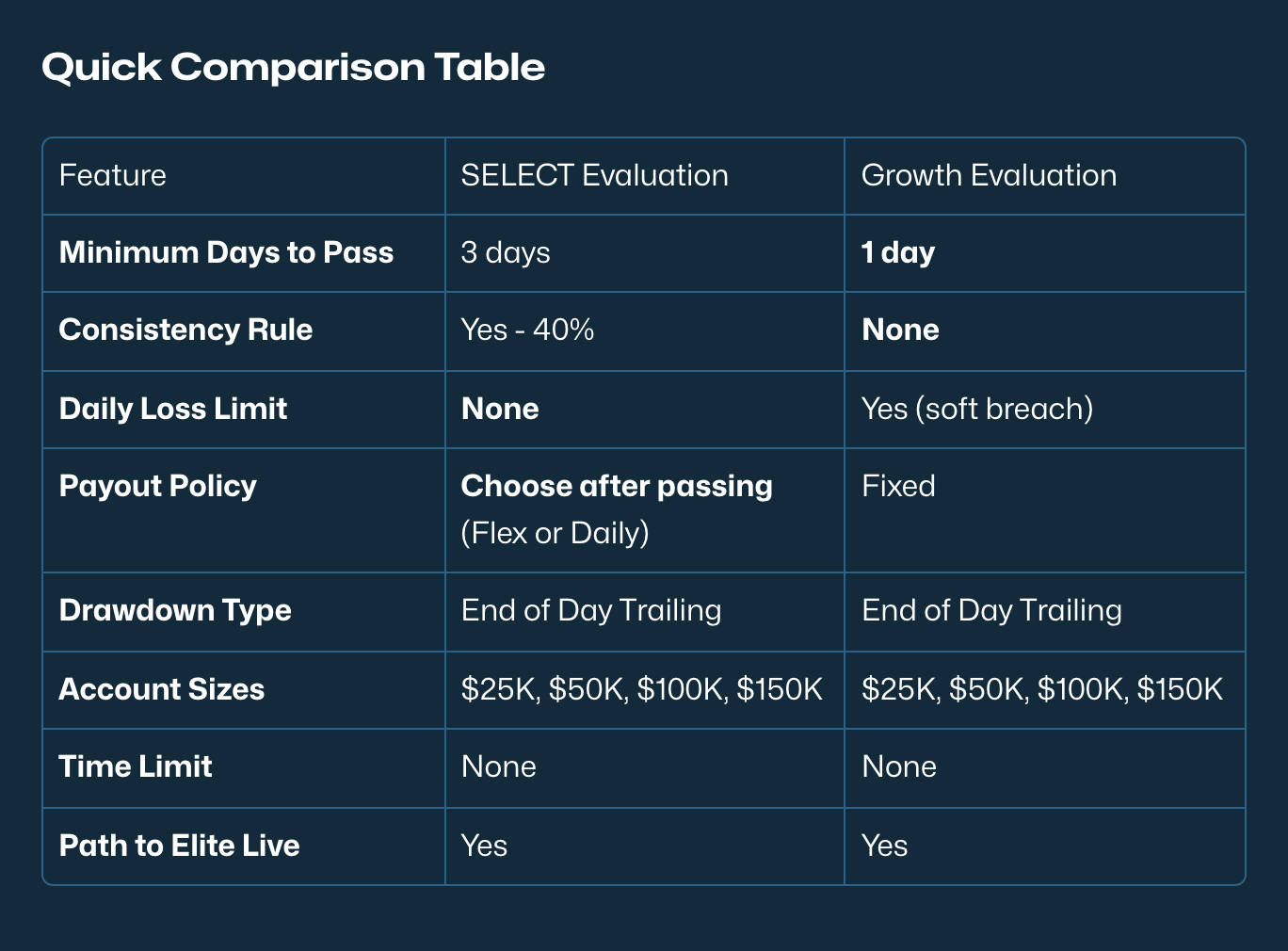
Growth is the cheapest and quickest way in, and the most conditional way out: a 35% consistency rule and a minimum balance gate every withdrawal.
Select costs $10 more, takes two days longer, and removes both of those. It is the best-designed of the three.
Lightning buys immediacy. You pay roughly 3x, accept the tightest consistency rule, and lose the safety net of a reset.
Our verdict (William G.)
For most traders the answer is Select, and the $10 premium over Growth is the best ten dollars in this lineup. The plan people buy for the wrong reason is Lightning: skipping a one-to-three-day evaluation is rarely worth 3x the price, the strictest consistency rule and no reset. Buy Lightning because you have a reason to be funded today, not because the evaluation looks intimidating.
The four questions that actually decide it
1. Will you actually sit an evaluation?
Be honest here, because this is the only question Lightning wins. A Growth evaluation can be passed in one trading day and a Select evaluation in three. If you will sit either of them, Lightning is a poor use of $246 extra on a 25K.
2. Can you live with a consistency rule on every payout?
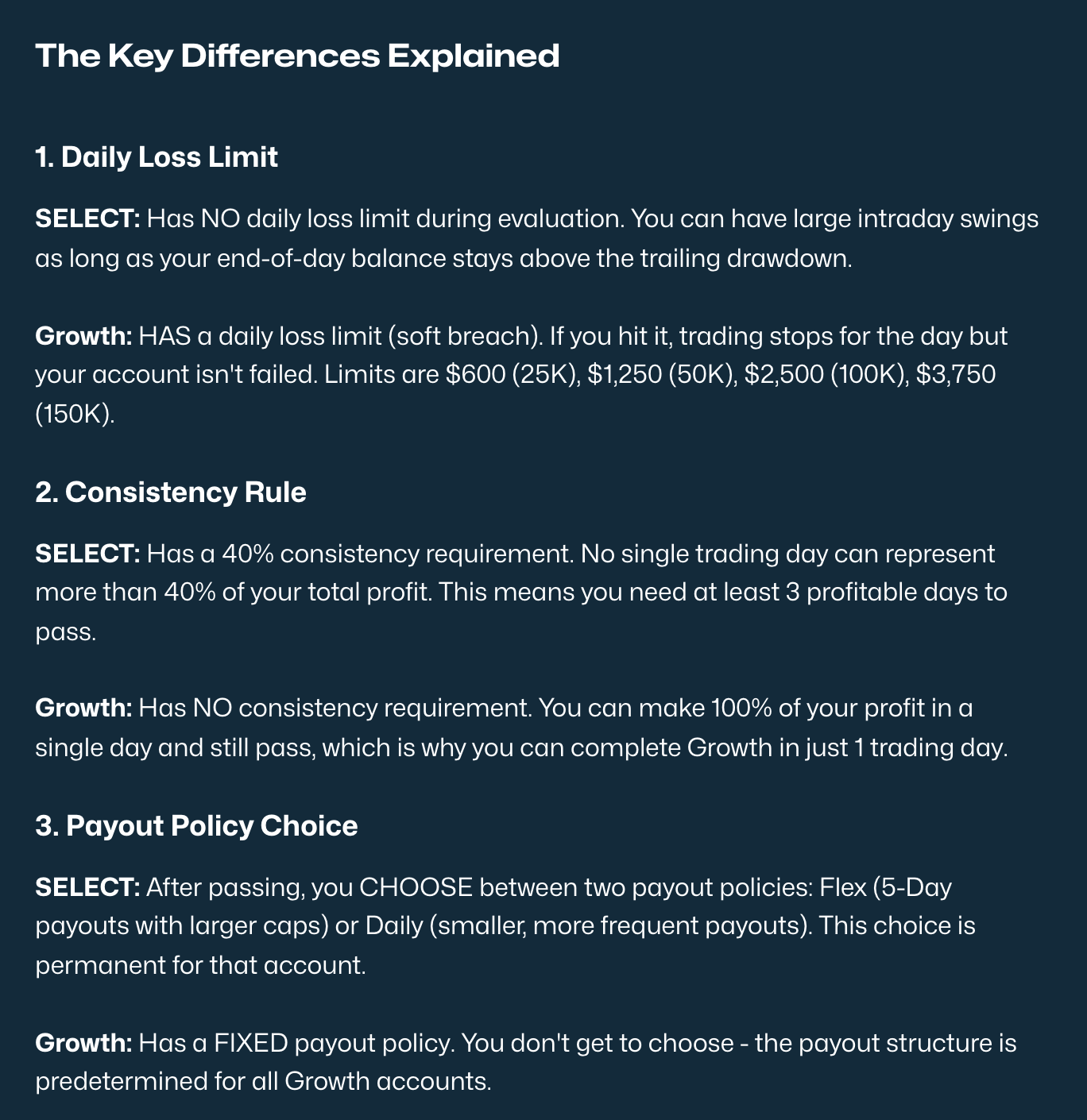
This is where most of the long-run difference sits. A consistency rule caps how much of your total profit may come from your best single day, and a lower percentage is stricter.
Once funded, Select has none at all. Growth applies 35% to every request. Lightning starts at 20%, the tightest number Tradeify runs, easing to 25% on your second payout and 30% from the third. If you have one strong session a week, Lightning will hold your money longer than either evaluation plan.
3. How quickly do you need the cash?
Only Select offers a daily payout path, and only Select lets you choose it. Growth requires 5 qualifying days of $100 or more per cycle. Lightning sets no minimum trading day count at all, but its 20% consistency rule means no single day may carry more than a fifth of your profit, so a first payout still takes roughly five profitable sessions. If cash rhythm matters, Select Daily is the only real option, at the cost of a daily loss limit.
4. What happens if you fail?
This is the question almost nobody asks before buying, and it separates the three plans more sharply than any rule does. It gets its own section below.
Three differences no comparison mentions
Every drawdown locks, but Select locks earliest and on demand
This is the detail most comparisons get wrong, in both directions. All three plans use an end-of-day trailing drawdown, and on all three the funded drawdown eventually stops trailing: Tradeify’s rule page states that on simulated funded accounts the drawdown “locks in place once you profit beyond the drawdown amount by $100” and then “becomes a fixed floor that never moves up again”.
So the question is not whether it locks. It is when. On a 25K all four paths lock at the same $26,100. The gap opens on the larger sizes, where Select locks first and Lightning last:
Select has one more advantage the others do not: requesting a payout locks the drawdown immediately, whether or not you have reached the trigger balance. Because Select Flex has no minimum balance, you can take a first modest payout early and freeze your floor on demand. On Growth and Lightning you have to trade your way to the trigger.
Only Select shrinks your position size when you pass
Growth and Lightning give you the same contract limits from start to finish. Select does not, from the 50K up. Its funded accounts use progressive scaling that starts below the evaluation limit and earns its way back. The 25K is the exception: it starts at the evaluation limit and scales past it.
On a 150K Select the drop is 12 minis to 3. It is a genuine trade-off against Select’s other advantages, and it is the one thing Growth does better for a size-dependent strategy.
Lightning cannot be reset
Growth and Select evaluations can both be reset for a fee if you fail. Lightning cannot be reset at all. Tradeify’s pricing reference is unambiguous: “No resets are available — if the account fails, a new one must be purchased.”
That single line changes the risk profile of the most expensive account in the lineup, and it is almost never mentioned in comparisons. One caveat for completeness: older Lightning accounts predating the new dashboard carry legacy wording about retaining their parameters “including on reset”. For anything bought today, the pricing reference is the current rule.
What failing each account really costs
Prop firm pricing is quoted per purchase, but almost nobody passes on the first attempt every time. The number that matters is what three shots cost you.
Three attempts at a 25K
| Plan | First purchase | Each retry | Three attempts |
|---|---|---|---|
| Growth | $99 | $60 reset | $219 |
| Select | $109 | $65 reset | $239 |
| Lightning | $345 | $345, full repurchase | $1,035 |
List prices from Tradeify’s pricing reference; reset fees taken live from tradeify.co, where the Select 25K reset is currently $65 while the pricing reference still lists $60. Promotional codes cut the purchase price but not the reset fee, which narrows the gap: with the code live at the time of writing, three Growth attempts run about $179 against roughly $621 on Lightning, still around 3.5x.
Read that table fairly, because you are not comparing identical purchases. Failing a Growth or Select attempt costs you an evaluation, something you had not yet converted into anything. Failing a Lightning costs you a funded account you already owned, which is a bigger thing to lose. That is precisely the point: Lightning front-loads the access and the risk. You are funded on day one, and there is no cheap second chance behind you.
At 4.7x the cost of three Growth attempts, Lightning only makes sense if you are confident enough that you do not expect a second attempt. If you are that confident, the one-day Growth evaluation was probably not going to stop you either.
Your first payout on a 25K, plan by plan
Rules read the same on a pricing page and behave very differently in an account. Here is the identical journey, first payout on a 25K, run through all three.
Growth. Pass by making $1,500. Then, in the funded account, build to a balance of $26,500, which is another $1,500, across 5 qualifying days of at least $100 each, keeping your best day under 35% of total profit. Maximum request: $1,000. You receive $900.
Select Flex. Pass by making $1,500 across at least 3 days under a 40% rule. Then trade 5 winning days of at least $100 each. There is no minimum balance, so you can request as soon as those days are done: 50% of your profit, capped at $1,250. Requesting also locks your drawdown.
Lightning. No evaluation: you are funded on purchase. Reach a profit goal of $1,500 with your best day under 20% of the total, the tightest rule here. Maximum request: $1,000. You receive $900.
Two things stand out. Growth asks for $1,500 twice, once to pass and once inside the funded account, and still caps you at $1,000. Lightning asks for $1,500 once, which is the real value of its price premium, but under the strictest consistency rule and with the same $1,000 ceiling. Select is the only one where the amount you may withdraw scales with what you actually made rather than sitting at a flat cap.
What all three Tradeify plans share
The differences get the attention, but a lot of the experience is identical whichever you buy, and most of it is in your favour.
A 90% profit split on every plan, which is among the strongest in futures.
End-of-day trailing drawdowns everywhere, so intraday swings never move the limit upward. The limit itself is still enforced in real time: touch it during the session and the account fails immediately.
One-time purchases with no activation fee and no monthly subscription, on all three.
A cap of 5 active simulated funded accounts per household, shared across the three plans combined rather than 5 of each.
Identical Elite criteria, so the plan you choose does not change your path to live capital.
Because the split, the drawdown type and the live path are shared, the decision genuinely reduces to the four questions above. There is no plan here that pays you more per dollar earned.
Which Tradeify account for which trader
You want regular payouts and hate rule friction: Select, on the Flex path. No consistency rule, no minimum balance, and a drawdown that locks.
You want money weekly rather than monthly: Select, on the Daily path. It is the only daily payout option Tradeify sells, and you accept a daily loss limit for it.
You want the cheapest possible test, fast: Growth. No consistency rule in the evaluation and a one-day minimum, for $99. Just go in knowing the funded side is the most conditional of the three.
Your strategy needs full size immediately: Growth. It is the only evaluation plan that does not cut your contracts when you pass.
You have a specific reason to be funded today: Lightning, with your eyes open on the 20% first-payout rule and the absence of any reset.
Or skip the choice entirely
6 hours 18 minutes.
That is the Phidias record from buying the evaluation to receiving a payout. With Express to Live the entire cycle, buy, pass, get funded, get paid and convert to a real LIVE account with our brokerage partner, can happen the same day.
Every question on this page is a trade-off between speed, rules and cost, and all three Tradeify answers end in the same place: a simulated funded account, with real capital available only through Tradeify Elite, which the firm states is a selection rather than an automatic threshold.
Phidias Express to Live removes the trade-off. There is no consistency rule and no minimum trading days on the evaluation, the drawdown is static so it never trails at all, $500 on the 25K, and your first payout converts the account into a real LIVE account where withdrawals are daily and uncapped. Conversion is a product rule, not a committee decision, and the whole cycle can run in a single day.
Frequently asked questions
What is the best Tradeify account?
Select, for most traders. It is the only plan with no consistency rule once funded, the only one offering a daily payout path, and the only one where requesting a payout locks your drawdown immediately. Growth is better only if you need the cheapest, fastest pass or full contract size immediately.
What is the difference between Tradeify Growth and Select?
Growth passes in 1 day with no consistency rule but has a daily loss limit, then applies a 35% consistency rule and a minimum balance to every payout. Select takes 3 days under a 40% rule with no daily loss limit, then has no consistency rule at all once funded. Select costs about $10 more on a 25K.
Can you reset a Tradeify Lightning account?
No. Tradeify’s pricing reference states that no resets are available on Lightning and that a failed account must be replaced with a new purchase. Growth and Select evaluations can both be reset for a fee.
Is Tradeify Lightning worth the extra cost?
Only if you truly will not sit an evaluation. On a 25K it is roughly 3x the price of an evaluation that can be passed in one to three days, it carries the tightest consistency rule at 20% on the first payout, and it cannot be reset, so three attempts cost $1,035 against $219 on Growth.
Which Tradeify account pays out fastest?
Select on the Daily path, the only daily payout option Tradeify offers. Growth needs 5 qualifying days of $100 or more per cycle; Lightning sets no minimum day count, though its 20% consistency rule effectively requires about five profitable sessions. Daily comes with a daily loss limit and, on the 100K and 150K, a tighter drawdown than the Flex path.
Which Tradeify account has no consistency rule?
Growth has none during the evaluation and Select has none once funded. No plan is free of it at both stages. Lightning carries one at every payout, starting at the strictest level in the lineup, 20%.
How many Tradeify accounts can you hold?
Up to 5 active simulated funded accounts per household, and that ceiling is shared across Growth, Select and Lightning combined, not 5 of each.
Do all three Tradeify plans lead to live capital?
Yes, through Tradeify Elite, on identical criteria: 3 payouts on one account or 10 in total. Tradeify states these are minimum requirements for consideration, not automatic qualification, and that most traders are not moved to live immediately on reaching them.
Useful resources
Tradeify: Pricing Reference, prices and reset fees for all three plans, and the source for Lightning having no resets.
Tradeify: Select vs Growth, the firm’s own comparison of its two evaluation types.
Phidias Express to Live, the same-day path from evaluation to a real LIVE account.
Related guides
Which Tradeify Platform Should You Choose? 2026, the three broker connections and the checkout choice you cannot undo.
Tradeify Review 2026, the full breakdown of the firm, its three plans and its live program.
Tradeify Select Account 2026, the permanent Daily vs Flex choice and the drawdown that locks.
Tradeify Growth Account 2026, the rules and costs, and why the payout threshold sits above the cap.
Tradeify Lightning Funded 2026, whether paying a premium to skip the evaluation is worth it.
Tradeify Payout Rules 2026, every payout condition across the three plans.
Tradeify Discount Code: the rate, the use cap and the end date, read from their own banner.
Tradeify Rules: every rule across Growth, Select and Lightning, in one place.
About the author
William G.
William G. is a futures trader and prop firm analyst at Phidias Propfirm. He tests competitor rule sets against their own published documentation, and writes about what actually happens between passing an evaluation and being paid. Every figure in this comparison is taken from Tradeify’s own pricing page and help center, checked in August 2026.