Apex Consistency Rule, 2026
Your total profit must be at least double your best trading day before Apex lets you request a payout. That is the 50% consistency rule, and it locks your withdrawal, not your evaluation.
Here is exactly how the 50% rule works, the calculator formula, the reset, the evaluation exception, the legacy 30% version, and the firm with no consistency rule at all.
Want a payout that is never tied to how evenly you trade? Here is Phidias Express to Live. First, how Apex’s rule works.
What is Apex’s consistency rule?
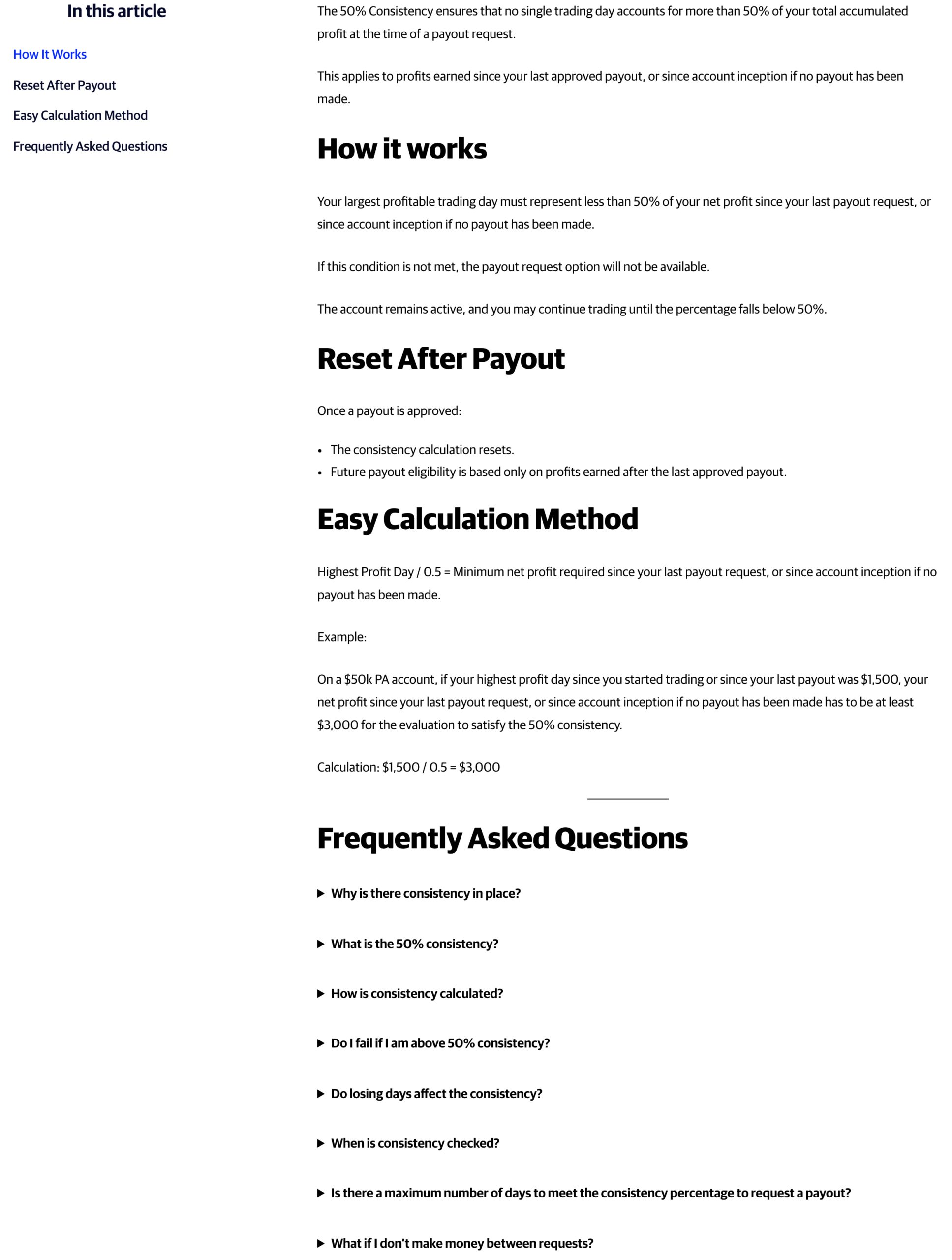
Apex’s consistency rule is a 50% cap on your single best day. No one trading day may account for 50% or more of your total profit since your last approved payout (or since account inception if you have never taken one). It applies to payout requests on a funded Performance Account, not to passing the evaluation. If your best day is too large a share, the payout button simply does not appear until the rest of your results catch up. It resets after every approved payout. Legacy accounts still use the older 30% version.
Interactive
Apex 50% consistency calculator
Minimum total profit to request
—
Enter your highest day to see the target (it is double your best day).
Apex consistency in 30 seconds
The threshold: your biggest day must be under 50% of your profit since the last payout. In plain terms, total profit must be at least 2× your best day.
Where it applies: only when you request a payout on a Performance Account. The evaluation has no consistency rule.
If you fail it: nothing breaks. The account stays active, the payout option is just hidden until you trade your way back under 50%.
Our verdict (William G.)
The 50% rule is fairer than the old 30%, and it is only a payout gate, not an evaluation trap. But it still punishes the one thing many good traders do well: make their month on a couple of big days. If your edge is the big move, a firm with no consistency rule on the static path, like Phidias Express to Live, never hides your payout.
The 50% rule: how it works
The rule looks at one number: your largest single profitable day since your last payout. That day must represent less than 50% of your total net profit over the same window. Apex checks it at the moment you try to request a payout.
If your best day is 50% or more of the total, the payout request option is not available. Nothing else happens: the account is not failed or paused. You simply keep trading, and as your other days add profit, the big day’s share shrinks below 50% and the option unlocks.
Worked example: since your last payout you are up $1,000, and your best day was $600. That day is 60% of the total, above the line, so you cannot request. Trade the total up to more than $1,200 and the $600 day drops under 50%, unlocking the request.
The consistency calculator: highest day ÷ 0.5
Apex publishes a one-line formula for the exact profit you need. Take your highest profit day and divide by 0.5:
Highest profit day ÷ 0.5 = minimum profit to request
Dividing by 0.5 is the same as multiplying by 2, so the target is always double your best day.
Run it across account sizes and it is easy to eyeball:
Apex’s own example uses a 50K account: a highest day of $1,500 means you need at least $3,000 in total profit before the 50% consistency is satisfied.
It resets after every payout
The consistency window is not lifetime. Once a payout is approved, the calculation resets, and your next payout is judged only on the profit earned after that last approved payout. A big day in a previous window does not follow you into the next one.
That matters for planning: the cleanest time to have an outsized day is right after a payout clears, because you then have a fresh window to spread more profit around it before the next request.
There is no consistency rule on the evaluation
This is the part most traders get wrong. The consistency rule does not apply to the Apex evaluation. You can pass the eval hitting your profit target in a single big day if you want, with no consistency check at all. That is genuinely one of Apex’s more generous eval rules.
The rule only shows up later, on the funded Performance Account, and only when you go to withdraw. So the mental model is: easy to get funded, then a 50% gate on getting paid. Do not confuse the two, or you will trade the eval too cautiously for no reason. The constraint that actually ends eval accounts is not consistency, it is the intraday trailing drawdown.
Legacy accounts: the old 30% rule
If you bought an Apex account before March 1, 2026, it runs on the legacy ruleset, and its consistency threshold is 30%, not 50%. On the 30% rule, your best day must be under 30% of total profit, so the target is your highest day divided by 0.3 (roughly 3.3× your best day, versus 2× on the new rule).
In practice the move from 30% to 50% is a real loosening: a $1,500 day needed about $5,000 of total profit under the old rule, but only $3,000 under the new one. New accounts get the friendlier 50% version.
How to satisfy the 50% rule
You do not beat the rule, you plan around it. A few habits keep the payout button available:
1. Spread your profit. Several solid days beat one huge day. The more evenly your gains land, the lower your best day’s share.
2. Do not make your month in one trade. A single monster day resets your minimum-to-request to double that day. Bank it, then keep grinding to bring the average up.
3. Time the big day after a payout. The window resets on approval, so an outsized day early in a fresh window has the most room to be balanced out.
4. Use the formula before you request. Highest day ÷ 0.5. If your total is below that, you already know the button will be hidden.
Useful, but notice what they are: a set of habits to manage a rule about how you make money, not just how much. The alternative is an account that does not have the rule.
How Phidias compares
Be fair to Apex first: the 50% rule is only a payout gate, the evaluation is free of it, and 50% is far kinder than the old 30%. Where Phidias differs is that it does not put a consistency rule on your withdrawals at all on the static path.
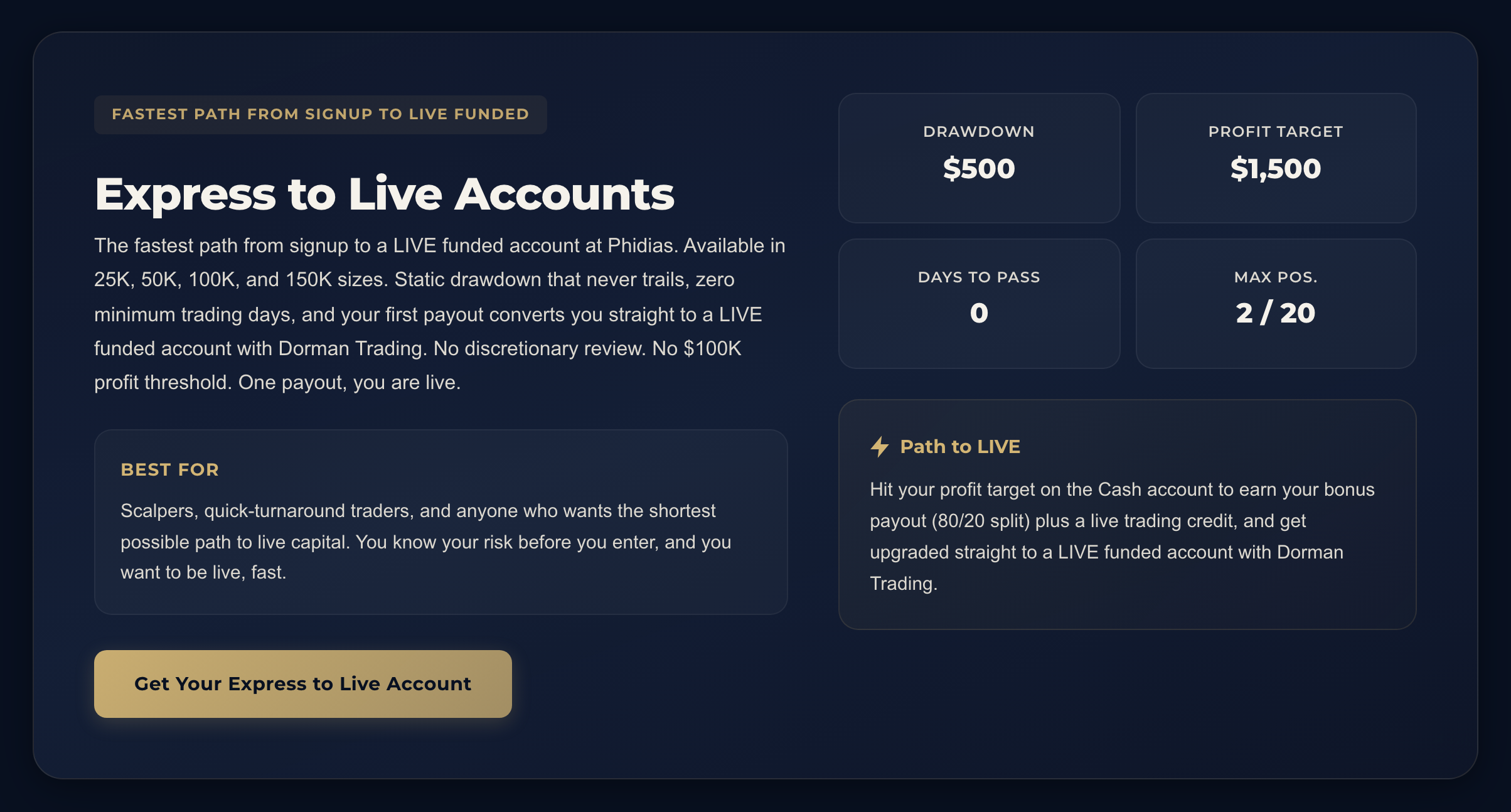
The trade is simple. Apex asks you to trade evenly to unlock a capped, simulated payout. Phidias lets you trade however your edge works and withdraw from real capital, with no consistency gate on the static path.
Apex consistency rule: frequently asked questions
Does the Apex evaluation have a consistency rule?
No. There is no consistency rule on the evaluation. You can hit your profit target in a single day. The 50% rule only applies to payout requests on a funded Performance Account.
What happens if I am above 50% consistency?
Nothing breaks. Your account stays active and you keep trading. The payout request option is simply hidden until your best day falls below 50% of total profit since your last payout.
How is Apex consistency calculated?
Take your highest profit day and divide by 0.5 to get the minimum total profit you need. For example, a $1,500 best day needs at least $3,000 in total profit since your last payout.
Do losing days affect Apex consistency?
The rule is measured on net profit since your last payout, so losses reduce your total and can push your best day’s share back above 50%. The check is on your best profitable day against that net total.
Does Apex consistency reset after a payout?
Yes. Once a payout is approved, the calculation resets and future eligibility is based only on profit earned after that last approved payout.
Is there a maximum number of days to meet consistency?
No. There is no deadline. The account stays active and you can take as long as you need for your other days to bring the best day’s share under 50%.
The bottom line
Apex’s consistency rule is a 50% cap on your best day, applied only to payout requests on funded accounts, reset after each payout, and softened from the old 30%. The math is one line: total profit must be at least 2× your best day. The evaluation itself is free of it.
If your edge is the big move, or you simply do not want a payout tied to how evenly you trade, Phidias Express to Live has no consistency rule on the static path and pays from real capital.
Sources and official references
• Apex: 50% Consistency Requirement (official help center): the rule, the reset, and the Highest Day ÷ 0.5 calculation.
• Apex: EOD Payouts: how consistency sits alongside the other payout requirements.
• Dorman Trading: the NFA-registered broker behind Phidias LIVE accounts.
• Phidias accounts: Express to Live terms and payout conditions.
About the author
William G. is a futures prop-trading analyst at Phidias. He tests prop firms hands-on, reads the fine print in every help center and rulebook, and translates payout, drawdown and funding mechanics into plain English for traders deciding where to put their capital.
Last reviewed 2026.
Related Apex guides
Apex Payout Rules: the caps, the Safety Net, and the 6-payout ceiling the consistency rule sits inside.
Apex Cost: every fee and the real total to a payout.
Apex Trailing Drawdown Explained: the intraday floor that decides whether you ever reach a payout.
Apex Trader Funding 4.0 Explained: the full breakdown of every account and rule.
Risk disclosure: Futures trading involves substantial risk of loss and is not suitable for all investors. Past performance is not indicative of future results. Apex consistency thresholds, calculation methods, and account rules reflect publicly available information from Apex Trader Funding as of July 2026 and are subject to change. Verify current terms on apextraderfunding.com before committing capital.