How to Pass Apex, 2026
The minimum time it takes to pass an Apex evaluation. There is no minimum-days rule and no consistency rule on the eval, so the moment you hit the profit target without touching the drawdown, you are funded.
Here is the profit target by account size, the only two rules that matter, a safe plan to hit the target, and what happens the moment you pass.
Want a simpler path to real capital? Here is Phidias Express to Live. First, exactly how to pass Apex.
How do you pass Apex Trader Funding?
To pass an Apex evaluation you must do exactly two things: reach the profit target for your account size, and never let your balance touch the drawdown. There is no minimum number of trading days and no consistency rule during the evaluation, so you can pass in as little as one session. You get a 30-day window, and once you pass you have 7 calendar days to activate your funded account.
Interactive
Apex profit target calculator
Total points to hit your target
—
Across the whole evaluation, at this size and contract count. Spread it over several sessions to protect your drawdown.
Apex profit target by account size
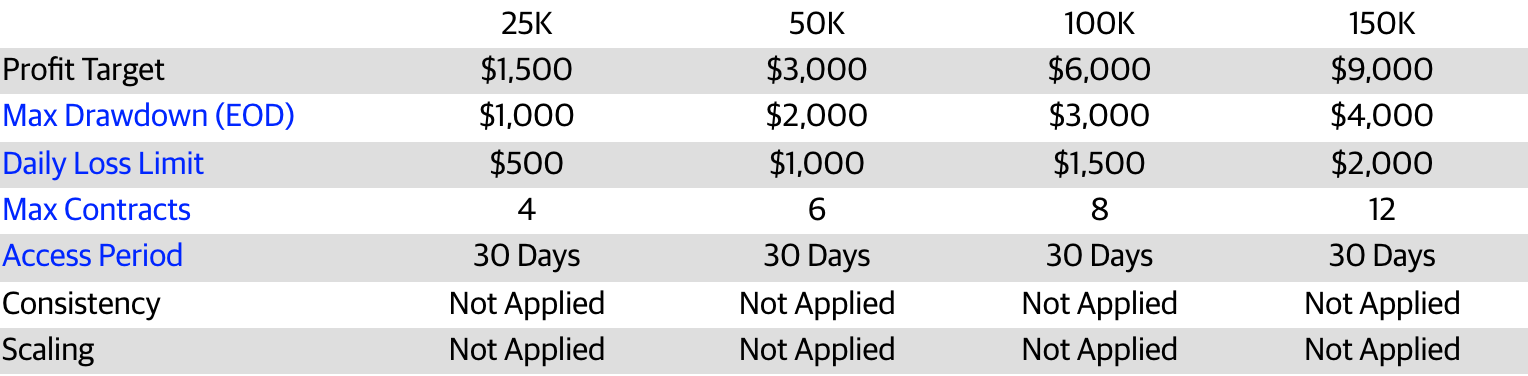
The profit target is the finish line. These are the current EOD evaluation parameters, straight from the Apex help center.
Passing Apex in 30 seconds
Two rules only: hit the profit target, never touch the drawdown. That is the whole test.
No friction rules: no minimum days, no consistency rule, no scaling during the eval. You can pass in one day.
The catch: the drawdown is what actually fails accounts, and after you pass, the harder rules (consistency, payout caps) begin.
Our verdict (William G.)
Passing Apex is the easy part. With no minimum days and no consistency rule, the eval is one of the friendliest to clear. The real work is surviving the drawdown to get there, and then the payout rules after. Do not rush the target in one day and hand the account back to the trailing floor.
Step 1: Pick your account size and target
Start with the size whose target you can hit comfortably. The 25K is the cheapest and has the smallest target ($1,500), but also the tightest drawdown ($1,000) and the fewest contracts (4). Bigger accounts give more room and more contracts, at a higher price and a larger target.
Most traders learning the rules should start on a 25K or 50K: a $1,500 or $3,000 target is reachable in a handful of clean sessions, and the smaller buffer teaches discipline before you scale up.
Step 2: The only two rules that pass or fail you
Rule one: reach the profit target. Your account balance simply has to reach starting balance plus the target. Nothing about how you get there is judged during the eval, no consistency, no minimum days.
Rule two: never touch the drawdown. This is the one that ends accounts. Your balance, including open trades, may never touch the drawdown threshold. If it does, your positions are liquidated and the evaluation is failed. Apex offers an EOD drawdown (recalculated at the close) and a harsher intraday version that trails your peak in real time. Understand exactly which one you have, because it decides how much room you really have. We break the mechanic down in the Apex trailing drawdown guide.
Step 3: A safe plan to hit the target
You do not need heroics. You need to reach the target without ever risking the whole buffer:
1. Trade small relative to the drawdown. On a 25K with a $1,000 floor, risking $300 on one trade puts a third of your account on a single idea. Keep per-trade risk to a small fraction of the drawdown.
2. Aim for a slice of the target per day. Hitting 20 to 30% of the target on a good day gets you funded in a few clean sessions without forcing it.
3. Bank green days, do not give them back. On an intraday trailing account, an unbanked spike pulls the floor up behind you. Take profit rather than round-tripping it.
4. Stop when you are up. The fastest way to fail is to keep trading after you have made your day. Hit your slice, close the platform.
Can you pass Apex in one day?
Yes. There is no minimum trading day requirement on new accounts, so the moment your balance reaches the target without breaching the drawdown, the evaluation is passed, even if that happens on day one.
Should you? Usually not. Hitting a $1,500 or $3,000 target in a single session means trading large relative to your buffer, which is exactly how the drawdown catches you. Passing in two to five sessions is far safer and costs you nothing extra, since you have 30 days.
Note on legacy accounts: Apex accounts bought before March 1, 2026 ran on the old ruleset, which required a 7-day minimum before you could pass. New accounts removed that entirely. If a guide tells you to trade at least seven days, it is describing a legacy account.
What actually fails most eval accounts
It is almost never the target. Traders fail because they breach the drawdown: one oversized trade, one revenge session, or on an intraday account, giving back an unbanked spike that had already trailed the floor up. The target is generous; the floor is unforgiving.
So the whole game of passing is really drawdown management, not profit generation. Protect the floor and the target takes care of itself.
After you pass: activate within 7 days
Passing gets you a funded Performance Account, but you must activate it within 7 calendar days. That is when the account’s monthly or one-time fee applies and the harder rules switch on:
• The 50% consistency rule now governs your payouts. See the Apex consistency rule guide.
• Your withdrawals follow the payout caps and the 6-payout ceiling. See the Apex payout rules guide.
In other words, the eval is the gentle door. The rules that decide how much you actually take home start the day you activate.
A faster path: how Phidias compares
Be fair to Apex: its eval is cheap and genuinely easy to pass. Where the two differ is what you must survive to get there, and what waits on the other side.
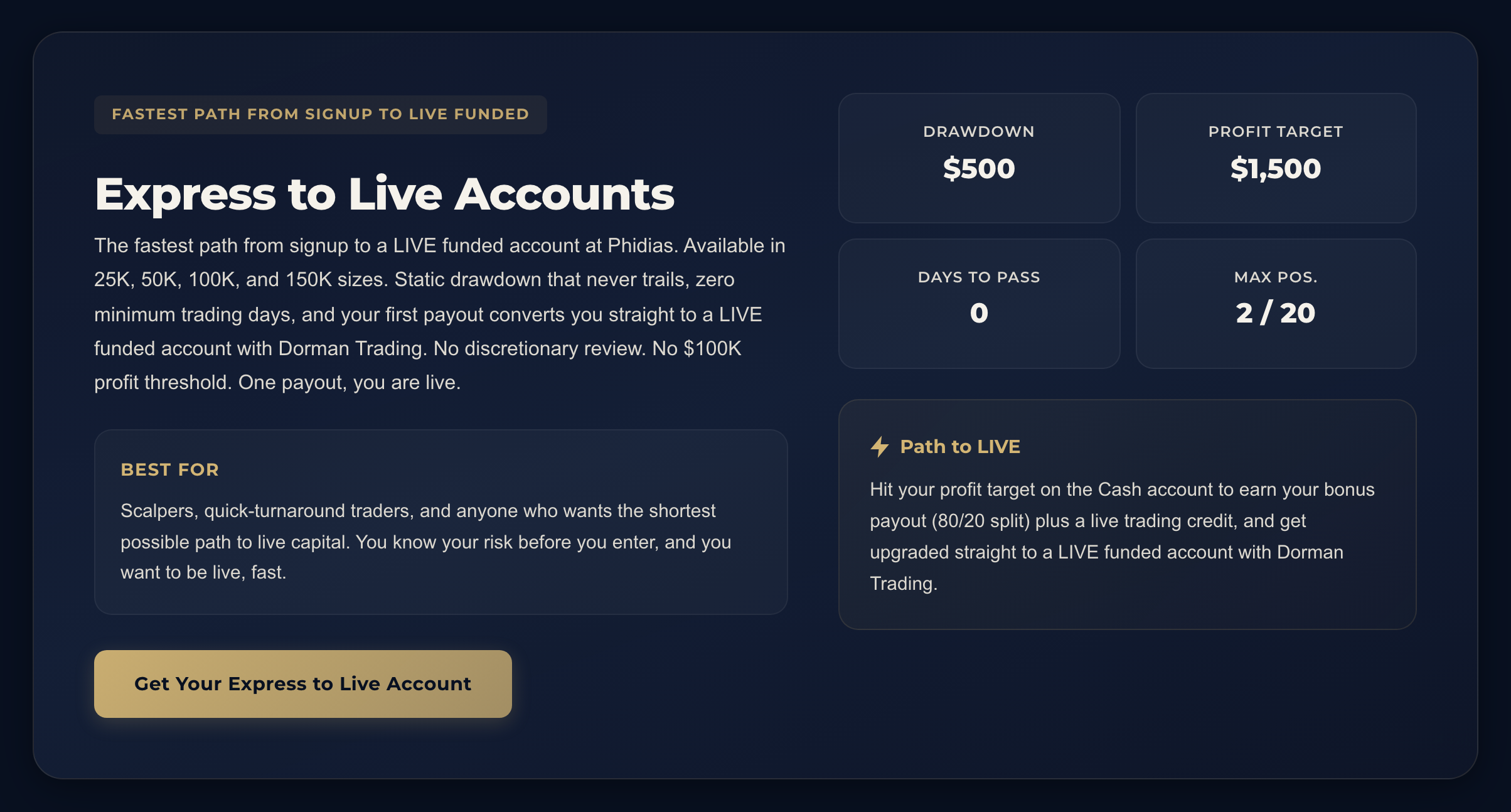
The eval bar is low at both firms. The difference is that Phidias gives you a static floor to pass under and real capital on the other side, with no consistency gate on the static path.
How to pass Apex: frequently asked questions
How long does it take to pass Apex?
As little as one trading day. There is no minimum-days rule on new accounts, so you pass the moment you hit the profit target without breaching the drawdown. You have a 30-day window to do it.
Can you pass Apex in one day?
Yes, but it usually means trading large relative to your buffer, which is how the drawdown catches you. Passing over two to five sessions is safer and costs nothing extra.
Is there a consistency rule on the Apex evaluation?
No. The consistency rule does not apply during the evaluation. You can hit the target in a single big day. The 50% consistency rule only applies later, to payout requests on the funded account.
What happens if you hit the drawdown during the eval?
Your open positions are liquidated and the evaluation fails. To continue you buy a new evaluation. The drawdown, not the target, is what fails most accounts.
How many contracts can you trade in the evaluation?
By account size: 4 (25K), 6 (50K), 8 (100K), 12 (150K) on the EOD evaluation. Position size is fixed during the eval; tier-based scaling only applies on the funded account.
What do you do after you pass Apex?
You have 7 calendar days to activate your Performance Account. Once active, the 50% consistency rule and the payout caps apply, so plan for those before you start withdrawing.
The bottom line
Passing Apex is simple: hit the profit target for your size ($1,500 to $9,000) without touching the drawdown, with no minimum days and no consistency rule. The skill is not making profit, it is protecting the floor on the way to the target.
If you would rather pass under a static floor and land on real capital with no consistency gate, Phidias Express to Live is the simpler path.
Sources and official references
• Apex: EOD Evaluations (official help center): profit targets, drawdown, contracts, 30-day access, and the passing rules.
• Apex: EOD Performance Accounts: what activates after you pass.
• Dorman Trading: the NFA-registered broker behind Phidias LIVE accounts.
• Phidias accounts: Express to Live evaluation and static drawdown.
About the author
William G. is a futures prop-trading analyst at Phidias. He tests prop firms hands-on, reads the fine print in every help center and rulebook, and translates payout, drawdown and funding mechanics into plain English for traders deciding where to put their capital.
Last reviewed 2026.
Related Apex guides
Apex Trailing Drawdown Explained: the floor you must not touch while passing.
Apex Consistency Rule: the 50% rule that starts once you are funded.
Apex Trader Funding 4.0 Explained: the full breakdown of every account and rule.
Risk disclosure: Futures trading involves substantial risk of loss and is not suitable for all investors. Past performance is not indicative of future results. Apex evaluation profit targets, drawdown amounts, contract limits, and access periods reflect publicly available information from Apex Trader Funding as of July 2026 and are subject to change. Verify current terms on apextraderfunding.com before committing capital.