Apex Trader Funding Cost, 2026
Apex charges no monthly fee, and that is the headline. The real cost is the eval, the activation fee most people forget, and a brand-new eval every time you fail, because there are no resets.
Here is every fee, the coupon game, a calculator for your real total, and how it compares to a firm that bundles everything into one payment.
Want one payment, no activation fee, and no resets to worry about? Here is Phidias Express to Live. First, what Apex really costs.
How much does Apex Trader Funding cost?
New Apex accounts have no monthly fee. You pay two one-time fees: the evaluation fee when you buy the challenge, and a PA activation fee (typically around $69 to $149) once you pass. Eval prices vary by size, drawdown type and vendor, and Apex runs near-constant coupons, so the sticker price is rarely what you pay. The catch is that there are no resets: fail or run out the 30 days, and your next attempt is a brand-new eval fee.
Interactive
Apex real cost calculator
Enter the eval price and activation fee you actually see at checkout. Prices vary by vendor and change with coupons.
Real total to a funded, active account
—
Apex cost in 30 seconds
Fee 1, the eval: a one-time charge, deeply discounted by coupons, that buys 30 days of access. No subscription, nothing to cancel.
Fee 2, activation: a one-time ~$69 to $149 paid when you pass, before you trade a funded dollar. Easy to forget.
The hidden cost: no resets. Every failed or expired eval is another eval fee, so your real cost depends on how many tries it takes.
Our verdict (William G.)
Apex looks cheap because the coupon price on the eval is tiny. The true cost is that plus the activation fee, times however many evals you burn through, since there are no resets. It is still affordable, but count the whole path, not the sticker. A firm that bundles the eval and funded account into one payment with no activation fee, like Phidias, is often cheaper to actually get paid from.
Cost 1: the evaluation fee
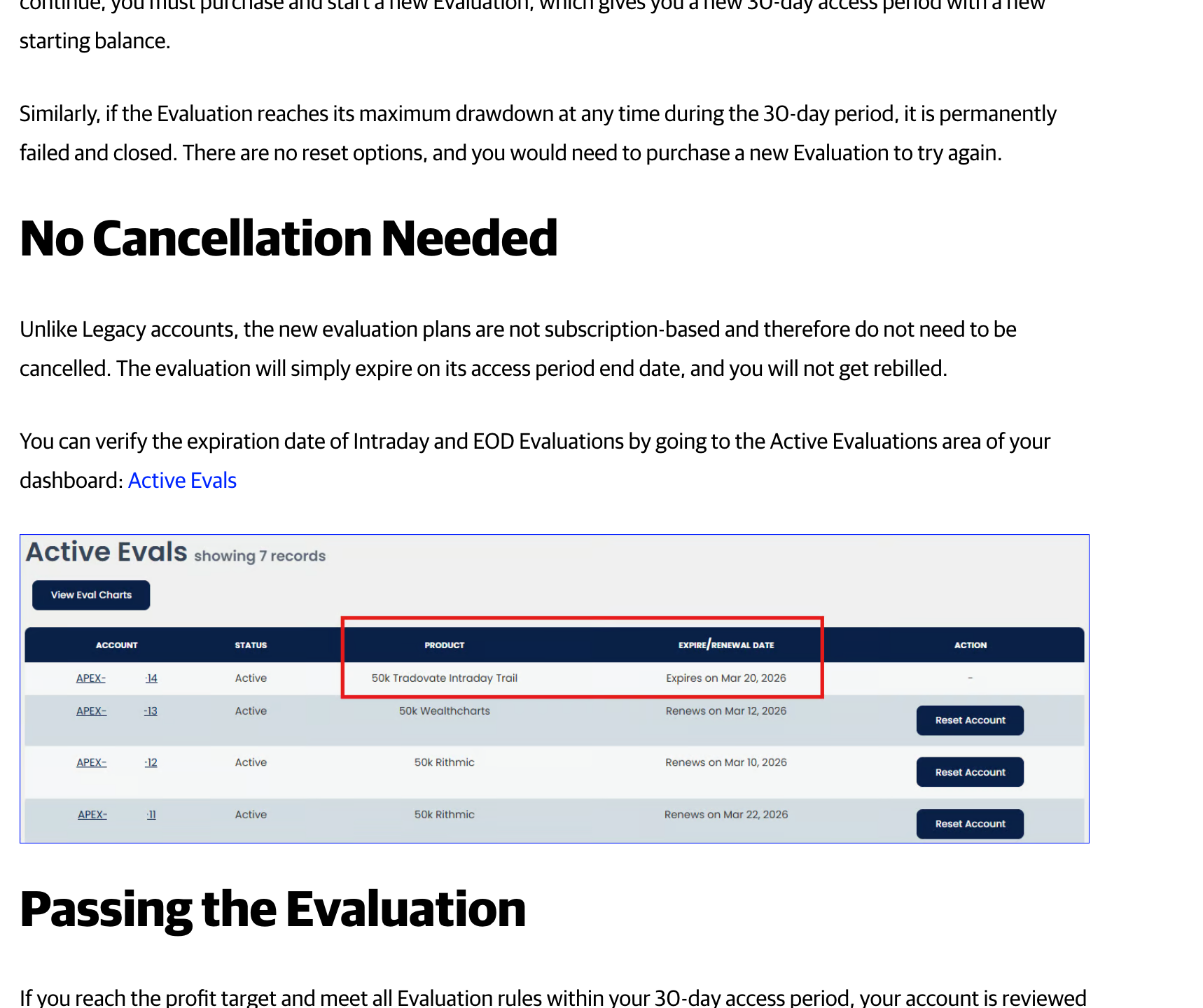
The evaluation is a one-time fee that gives you 30 calendar days of access to hit the profit target. It is not a subscription and does not renew or need cancelling. When the 30 days end, the eval simply expires.
List prices run from roughly $150 to over $1,000 depending on account size and whether you pick the cheaper Intraday or the pricier EOD drawdown. But almost nobody pays list: Apex runs coupons of 50% to 90% off nearly all the time, so the eval you actually buy is often in the $20 to $60 range. Always apply a current code at checkout.
Cost 2: the activation fee (the one people forget)
Passing does not make the account free to run. Once your eval is marked as passed, you have 7 calendar days to pay a one-time PA activation fee to turn it into a live Performance Account. Miss the window and the opportunity expires.
The activation fee is typically around $69 to $149, scaling with account size, and the EOD drawdown type costs a little more than Intraday. It is a one-time payment per account, non-refundable and non-transferable, and it is not a subscription. Confirm the exact fee for your size and type at checkout, since Apex sets it per plan.
Cost 3: every retry (there are no resets)
This is the cost that quietly adds up. New Apex evals cannot be reset. If you breach the drawdown or run out the 30 days without passing, the account is closed and your balance does not carry over. To try again, you buy a brand-new evaluation, with a new 30-day window and a new starting balance.
Legacy vs new: older legacy accounts (bought before March 1, 2026) run on monthly billing and can be reset. The new one-time-payment accounts trade the monthly bill for a no-reset model, so cheap-per-eval can still get expensive if it takes you several tries.
What about commissions and data fees?
Two smaller costs are easy to forget. First, trading commissions: Apex charges a per-contract fee on every round-turn trade. It is small per trade, but it eats into scalps and adds up fast on high-frequency strategies, and the exact rate depends on the contract you trade.
Second, market data. Level 1 (top-of-book) data is included in your fee, but Level 2 / Depth of Market data is an optional extra you pay for and manage through your platform (Rithmic, Tradovate). Neither is large, but both belong in your real-cost math alongside the eval and activation fees.
The coupon game
Apex is famous for aggressive discounts. A promo code taking 50% to 90% off the eval is live almost constantly, which is why the list price is close to theater. The number that matters is the discounted eval price you see at checkout with a current code applied.
Factor the real, discounted price into the calculator above, not the list price. The coupon makes a single successful attempt genuinely cheap; it is the retries and the activation fee that decide your true total.
The real total to your first payout
Put it together for a 25K EOD account, using round, discounted numbers:
So the “$30 eval” is really closer to $150 by the time you are funded and active, and more if it takes extra tries. Then remember what that account is: a simulated account whose payouts are capped and cut off after six. A 25K PA pays a lifetime maximum of $6,000 across all payouts. Read the full Apex payout rules before you count the profit.
How Phidias compares on cost
Be fair to Apex: with a coupon, a single eval is cheap, and there is no monthly bill. Where Phidias is simpler is that it removes the two costs that surprise people, the activation fee and the retries.
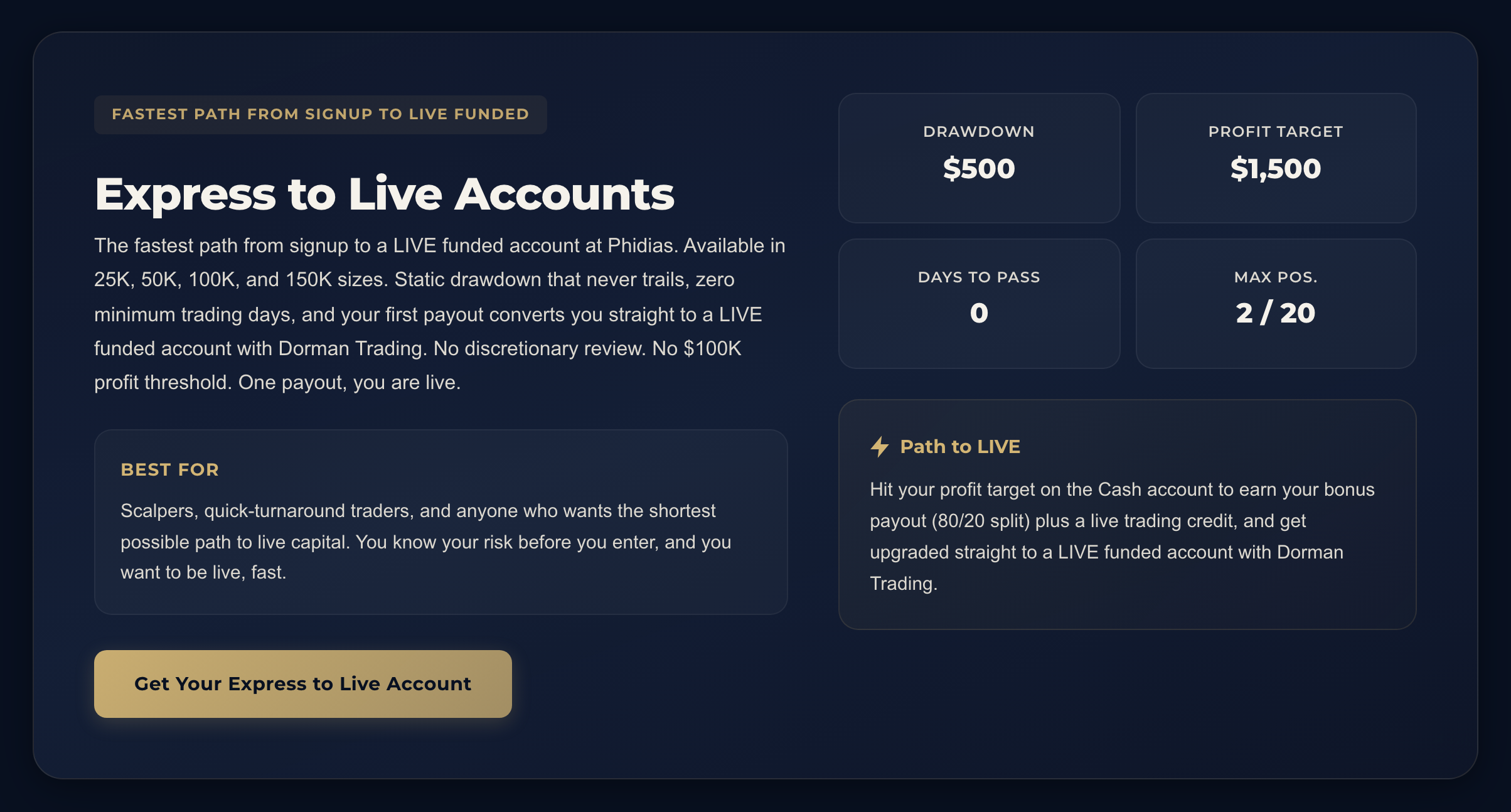
On paper both are cheap. In practice, Phidias’s single bundled payment near $55, with no activation fee and no reset trap, is often the lower real cost to actually reach a payout, on real capital.
Apex cost: frequently asked questions
How much does Apex Trader Funding cost?
Two one-time fees: a discounted eval fee (often $20 to $60 with a coupon) and a PA activation fee of roughly $69 to $149 when you pass. There is no monthly fee on new accounts.
Does Apex charge a monthly fee?
Not on new accounts. New Apex evaluations and Performance Accounts are one-time payments with no recurring billing. Only legacy accounts (bought before March 1, 2026) still run on monthly subscriptions.
What is the Apex activation fee?
A one-time payment made within 7 days of passing to turn your evaluation into a funded Performance Account. It is typically $69 to $149 depending on size and drawdown type, non-refundable, and not a subscription.
Can you reset an Apex account?
New accounts cannot be reset. If you fail or the 30 days expire, you buy a new evaluation. Only legacy accounts can be reset. This no-reset model is the hidden cost of the cheap one-time pricing.
Does Apex have coupons?
Almost always. Apex runs promo codes of 50% to 90% off the eval nearly year-round, so you should never pay the full list price. Apply a current code at checkout.
What is the cheapest Apex account?
The 25K Intraday evaluation is the cheapest, with the smallest eval fee and the lowest activation fee (typically around $69). It also has the tightest drawdown, so cheap does not mean easy.
The bottom line
Apex has no monthly fee, but its real cost is the discounted eval, plus a $69 to $149 activation fee, times however many evals you burn through, since there are no resets. Budget for the whole path, not the coupon price.
If you would rather pay once, with no activation fee, no reset trap, and land on real capital, Phidias Express to Live bundles it into a single payment near $55.
Sources and official references
• Apex: Evaluation Plan Fees and Access (official help center): one-time fee, 30-day access, no subscription, no reset.
• Apex: PA Activation Process and Deadline: the one-time activation fee and 7-day window.
• Dorman Trading: the NFA-registered broker behind Phidias LIVE accounts.
• Phidias accounts: Express to Live one-time pricing and terms.
About the author
William G. is a futures prop-trading analyst at Phidias. He tests prop firms hands-on, reads the fine print in every help center and rulebook, and translates payout, drawdown and funding mechanics into plain English for traders deciding where to put their capital.
Last reviewed 2026.
Related Apex guides
How to Pass Apex: fewer failed evals means a lower real cost.
Apex Payout Rules: what that cost actually buys you in payouts.
Apex Trader Funding 4.0 Explained: the full breakdown of every account and rule.
Risk disclosure: Futures trading involves substantial risk of loss and is not suitable for all investors. Past performance is not indicative of future results. Apex evaluation prices, activation fees, coupon discounts and billing terms reflect publicly available information from Apex Trader Funding as of July 2026 and vary by account size, drawdown type and vendor; they change frequently. Verify current pricing at checkout on apextraderfunding.com before purchasing.