Vest Markets: real or simulated? 2026
What actually happens to your trades at Vest Markets, who pays your payout, and how Vest makes its money, quoted from its own pages.
Verified on Vest Markets’ documentation, sales page, FAQ and Prop Trading Terms of Service on November 10, 2026.
Vest Markets funded accounts are simulated. Its documentation promises “Real Vest capital. Not simulated”, but the Prop Trading Terms of Service that bind you say all accounts, Instant included, are simulated. Your trades are Trade Ideas that Vest may hedge with its own money or only record, and payouts come from Vest’s general corporate funds.
Updated on 11 November 2026
In short
- Binding answer: simulated. The prop terms (last updated November 12, 2026) say no real trading capital, assets, margin or collateral are credited to you.
- Marketing answer: “Real Vest capital” in the docs, “The capital behind it is real” in the FAQ.
- Your trades: non-binding Trade Ideas. Vest may record them without executing, or hedge them with its own capital on Vest Exchange, its affiliated venue.
- Who pays you: Vest, from its corporate funds. Fees are part of its revenue, and it does not claim payouts come from profitable live trading.
- How the payout moves: Claim Profit to your Primary Account in 24 hours, then a USDC withdrawal to your wallet.
- How Vest makes money: account fees, trading rebates it keeps, its own trading and hedging, and exchange fees.
- The CME alternative: at Phidias, funded accounts are simulated too, but on Express to Live your first payout converts the account to LIVE.
Are Vest Markets funded accounts real or simulated?
Simulated, according to the only Vest document that binds you. The Prop Trading Terms of Service open with an “IMPORTANT PROGRAM DISCLOSURE”: “All Accounts, including Instant Funded Accounts, are simulated.” The next sentence says no real trading capital, assets, margin or collateral are credited or entrusted to you.
The same terms define an Account as “a separate simulated account record” used to record virtual balances, and say it is “not a brokerage, exchange, deposit, or custodial account.” Fees buy access to program services, “not assets or a live trading account.”
So does Vest Markets put its own money behind your account? Under the contract, no. The long answer is more interesting, because Vest’s own marketing says yes, and the gap between the two tells you how the business works.
This page goes deeper than our Is Vest Markets legit? guide, which covers ownership, backers and incidents, and our Vest Markets rules breakdown, which covers drawdown and loss limits.
Why does Vest Markets say “Real Vest capital”?
Because its sales pages and its contract do not say the same thing. The documentation sells the account. The terms set what is owed. Here is what each page says, read on November 10, 2026:

The same sales page says “You own it” in its FAQ and “participants do not trade live capital” in its footer. When the two disagree, the terms decide. They also say that statements made on social media, Discord or in marketing materials give you no rights.
Why Google shows “best markets”. Search suggestions sometimes show “best markets” in place of “vest markets”: if you searched “how does best markets make money”, you most likely meant Vest Markets. The answer is further down this page.
What does “Live” mean at Vest Markets?
At Vest, “Live” is a stage of the program, not a live trading account. Pass the evaluation, or buy an Instant account, and the dashboard shows a Live Funded Account. The terms still call that account a simulated record.
One detail shows the gap. The FAQ says that in the Evaluation Phase “The fees are simulated along with the rest of the account, so nothing is collected”, and that once you are Live, fees “stop being simulated and are collected against your account balance.” The terms say the opposite: simulated commissions and funding charges are “performance inputs”, “not separately payable live trading commissions or a debt you owe.”
Vest's FAQ
Prop Trading Terms (binding)
The only Vest account that holds your own money is the Primary Account: the regular exchange account you deposit USDC into. Funded Accounts “cannot receive deposits”. Money becomes yours when Vest credits a claim to your Primary Account, not before.
How does Vest Markets pay payouts?
In two steps, and only the second one touches a blockchain. First, from your Live Funded Account, you submit a Claim Profit request. You may need to close open positions or orders first.
Your split, 80% or 90% on an evaluation account or 95% on Instant according to Vest’s docs, is credited to your Primary Account in 24 hours. Vest says there is no minimum to claim, no cap on frequency and no cap on the amount, and that a claim is irrevocable once initiated.
Second, you withdraw USDC from the Primary Account to an external wallet. Vest’s withdrawal page says “There is currently a 24 hour processing period for all platform withdrawals”. Its FAQ says something else: withdrawals are processed instantly until your rolling 24 hour total reaches $50,000, after which a request waits 24 hours. The minimum withdrawal is 1 USDC.
Vest does not publish a total paid to traders or a count of paid traders, so the flow above is what Vest describes, not something anyone can audit from outside.
Where do Vest Markets payouts come from?
From Vest’s own company money, not from your trades. This is the clause that answers the question most directly. Section 6(d) of the prop terms:

Compensation is paid from our general corporate funds, not from assets held for your benefit. Program fees form part of our general revenues and may be used to pay operating expenses, including Program compensation; we do not represent that payouts are funded by profitable live trading.
Vest Prop Trading Terms of Service, Section 6(d)
Read it slowly. Your payout is a contractual payment from Vest under its program formula, with your simulated profit and loss as an input. Vest says fees may help pay it. It also commits not to make your compensation depend on “our receipt of fees from later participants”, and not to earmark fees as a contest prize pool.
Your fees
Part of Vest's general revenues, may help pay compensation
Corporate funds
Not assets held for your benefit
Program formula
Your simulated profit and loss is one input
Your payout
80%, 90% or 95% split (Vest's docs), credited to your Primary Account
Payouts can also pause. Vest may “temporarily withhold affected compensation” during a reasonable, good faith eligibility, error or prohibited conduct review, with an explanation of any material reduction or denial and a review request at [email protected].
See CME futures accounts at Phidias
How does Vest Markets make money?
Vest names its revenue sources in its own terms, disclosures and docs. We found no revenue figures on its pages, so this is the list, not the split:
- Account fees. “Program fees form part of our general revenues”, and Vest “may generate revenue from fees for access to the Program, including Instant Funded Accounts and any Evaluation Process.”
- Rebates it keeps. Vest “may receive access fees and third-party trading incentives or rebates, which we retain and do not include in your performance metrics or payouts.”
- Its own trading. Vest may trade or hedge “for our own accounts and at our own risk using our own capital”, and “All actual gains and losses on those transactions are for our or our Affiliates’ own accounts.”
- Exchange fees. On the Vest Exchange side, maker fees are 0 and taker fees run from 0.15 bp on FX to 1 bp on most markets.
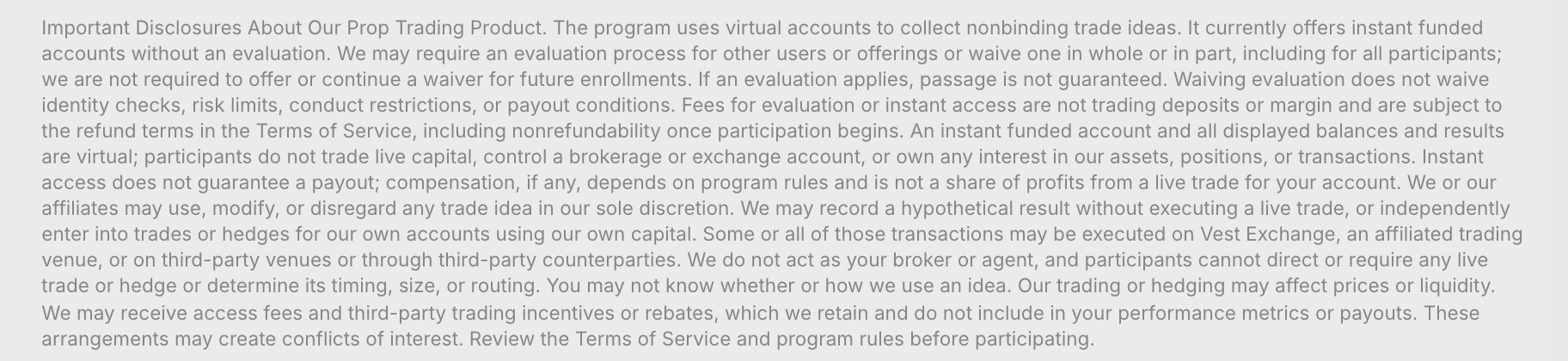
The terms add that Vest has “a financial interest in the fees we retain and the compensation we pay”, that it “control[s] the simulation settings and review of Program results”, and that it has “no obligation to prioritize your interests over our own.” Vest states that conflict openly, and you agree to it by using the program.
What happens to your trades at Vest Markets?
Each trade is a Trade Idea, and Vest decides what to do with it. The terms define Trade Ideas as “any virtual trade selections, signals, strategies, or other inputs that you submit through the Program.”
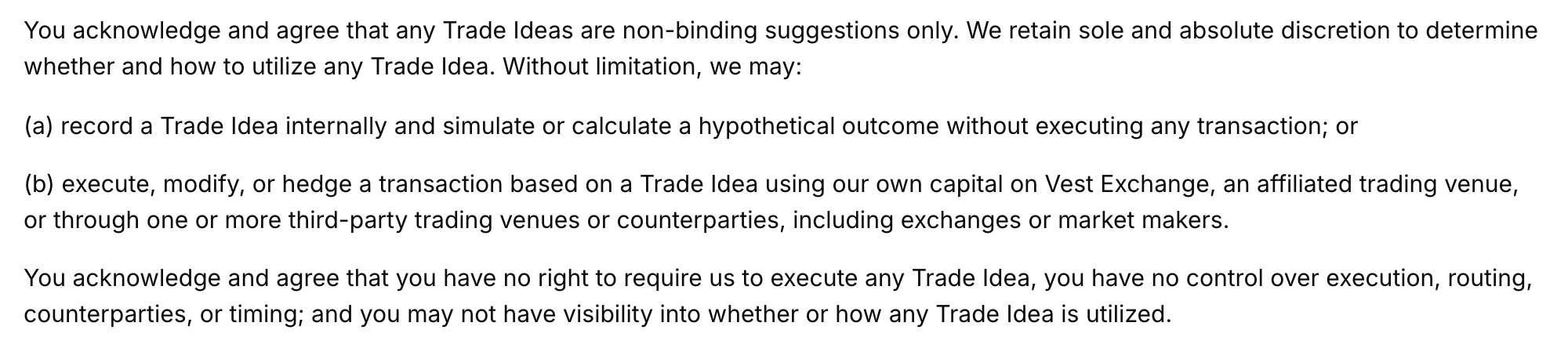
Vest may record a Trade Idea and calculate a hypothetical outcome without executing any transaction. Or it may execute, modify or hedge a transaction based on it, with its own capital, on Vest Exchange, an affiliated trading venue, or through third party venues and market makers.
You have no right to require execution, no control over routing or timing, and “you may not have visibility into whether or how any Trade Idea is utilized.” On any trade or hedge Vest chooses to make, the gains and losses are Vest’s own. Your result is computed from the simulation.
Your trade becomes a Trade Idea. What may Vest do with it?
Option (a)
Record it only
Calculate a hypothetical outcome without executing any transaction
Option (b)
Execute, modify or hedge it
With its own capital, on Vest Exchange or third party venues; the gains and losses are Vest's
In both cases
Your result
Computed from the simulation; you may not see which option was used
Does Vest Markets trade against you?
The terms allow Vest to act contrary to your Trade Ideas, and promise it will not worsen your fills because you are profitable. Both are in writing, with limits.
What Vest reserves: it may “use, modify, aggregate, disregard, or act contrary to Trade Ideas”, its hedging “may affect market prices or liquidity” on Vest Exchange or elsewhere, and its simulation can model “favorable or unfavorable slippage”, partial fills, rejected or unfilled orders, execution latency and price impact. A modeled effect may apply whether or not any live trade exists.
What Vest promises: it “will not selectively worsen a user’s fills or results merely because the user is profitable, fabricate an error or violation, or manipulate settings or results in bad faith to cause failure or avoid paying compensation otherwise due.” But the same clause permits different treatment based on instrument, timing, size, liquidity, strategy, account type or identified abuse, and says identical outcomes across accounts are not promised. Reference prices are not guaranteed fill prices either.
Our read: these clauses are a contract, not an audit. Nobody outside Vest can see how simulation variables are set on a given account, so the protection is only as good as Vest’s good faith and your ability to dispute it in Panama arbitration.
Is a simulated funded account a scam?
No. It is the industry standard, and it is honest when the firm says so. Most prop firms, futures and perpetuals alike, fund you with a simulated account and pay you from the company. Our guide to whether prop firms use real money explains the model.
Phidias is no exception. Our evaluation and CASH funded accounts are simulated, and our rules say it. The questions worth asking any firm are simpler than the marketing:
- Does the marketing match the contract? At Vest, it does not.
- Where do the prices come from? A public exchange, or the firm’s own venue.
- Is there a step after simulated? A LIVE account, written into the rules, or nothing.
When does a funded account become a LIVE account?
At Vest Markets, never: every account stays simulated under the terms, whatever the dashboard calls it. At Phidias, on Express to Live, it is a product rule: your first payout converts the account to a LIVE account.
On the CASH account, once you reach the profit target, the “Switch to Live” button triggers the fixed bonus payout and the conversion. The account then trades CME futures as a LIVE account, with a LIVE credit set by size:
Once LIVE, payouts are available every day with no payout cap. Before that, the speed is already the point: payout on Day 1 is possible on every Express to Live size, 90% of payouts are processed in under 30 minutes, all within 24 hours, and our record from purchase to payout is 6 hours 18 minutes.
More than 50,000 traders have been funded at Phidias. If perpetuals are your market, our guide to perpetual futures prop firms compares Vest with its rivals, and the Vest Markets review covers its prices. If you trade NQ and ES, our static drawdown prop firms guide and the Phidias rules show the full Express to Live mechanics.
Test: Vest Markets or a CME path to LIVE?
Four questions on what you want from a funded account, what you trade and how you want to be paid. No email.
30 second check
Vest Markets or a CME path to LIVE?
Vest Markets real or simulated: frequently asked questions
Does Vest Markets give you real money to trade?
No. Vest Markets’ prop terms, last updated November 12, 2026, say all accounts, Instant Funded Accounts included, are simulated and that no real trading capital, assets, margin or collateral are credited to you. Your trades are Trade Ideas that Vest may hedge with its own money, or only record.
Are Vest Markets Instant accounts simulated?
Yes, per the terms. Vest’s FAQ says an Instant account is Live from the moment your payment clears, but the prop terms call it “a virtual Program designation, not an account containing assets funded for your benefit or authorizing you to execute live trades.”
How does Vest Markets make money?
From what it writes itself: account fees (“Program fees form part of our general revenues”), third party trading incentives or rebates tied to your Trade Ideas, its own trading and hedging with its own capital, and taker fees on the Vest Exchange side. Vest publishes no revenue figures.
Where do Vest Markets payouts come from?
From Vest’s general corporate funds. The prop terms say program fees may be used to pay compensation and that Vest does “not represent that payouts are funded by profitable live trading.” A payout is a contractual payment by Vest, not your share of a live trade.
How long does a Vest Markets payout take?
Two steps. Claim Profit credits your 80%, 90% or 95% split to your Primary Account in 24 hours, with no minimum and no frequency cap. Then a USDC withdrawal to your wallet: 24 hour processing per Vest’s withdrawal page, instant up to $50,000 per rolling 24 hours per its FAQ.
What are Trade Ideas at Vest Markets?
Trade Ideas are what Vest’s terms call your trades. They are non-binding suggestions: Vest may record one and calculate a hypothetical outcome without executing anything, or execute, modify or hedge it with its own capital on Vest Exchange or third party venues. You may not know which.
Does Vest Markets trade against you?
Vest’s terms allow it to use, disregard or act contrary to your Trade Ideas, and say its hedging may affect prices. They also promise it will not selectively worsen a user’s fills merely because the user is profitable, or manipulate results in bad faith, while allowing different treatment by strategy, size or account type. There is no public data to check either way.
Are Phidias funded accounts simulated too?
Yes. Phidias evaluation and CASH funded accounts are simulated, and we say so plainly. The difference is the next step: on Express to Live, your first payout converts the account to a LIVE account, with a LIVE credit of $500 on the 25K up to $2,000 on the 150K.
Related guides
Read it yourself
The verdict
“Simulated funded accounts are normal, ours included, and Vest’s contract is unusually explicit about how its program works. The problem is the marketing that says the opposite. If you trade NQ and ES, pick a firm whose rules spell out the step to a LIVE account, and read the terms before the sales page.”
William G., CMO at Phidias Propfirm
William G., CMO at Phidias Propfirm. Writes about prop firm rules, costs and payouts from the operator’s side.
Last reviewed 2026. Vest Markets facts verified on Vest’s own pages on November 10, 2026. The primary sources are linked above. Not financial advice: trading futures and perpetuals involves substantial risk of loss.