Is Vest Markets legit? 2026
Who really backs Vest Markets, who runs it, how it pays, and which of its claims hold up at the source.
Verified on Vest Markets’ documentation, sales page, FAQ and both terms of service, and on Vest Labs’ own March 2025 press release, on November 7, 2026.
Vest Markets is legit in the sense that matters first: it is a real, operating company, not a disappearing scam. Vest Exchange Inc., a Panama corporation, is named in its terms, it publishes incident reports and it describes a USDC payout flow. But it names no regulator, and its own prop terms say every account, Instant included, is simulated.
Updated on November 9, 2026
In short
- Operator: Vest Exchange Inc., a Panama corporation. Footer: Vest Labs Inc. Disputes go to arbitration in Panama.
- Backers: Vest lists Coinbase, Jane Street, Selini and others. Jane Street is also in Vest’s March 2025 press release. Coinbase is not, and we found no confirmation from Coinbase.
- CEO: Vest Labs’ press release names Justin Ma as CEO. Vest’s website names nobody.
- Regulation: none named on any Vest page.
- Real or simulated: the docs say “Real Vest capital”. The binding terms say all accounts are simulated and payouts come from Vest’s corporate funds.
- Track record: three documented incidents in 2026, the largest on April 15 (about 10% of active accounts, full rollback).
- If you trade NQ or ES: Phidias Express to Live runs on CME futures, and your first payout converts the account to LIVE.
Is Vest Markets legit or a scam?
Not a scam, by the usual definition. A scam takes your money and disappears. Vest Markets has a named operating company, published terms updated as recently as November 12, 2026, a public documentation site, dated incident reports and a smart contract audit by OtterSec.
That does not make every claim on its marketing true. The useful question is narrower: which Vest Markets claims survive a check at the source? Here is the scorecard we built from Vest’s own pages.
Our full Vest Markets review covers the accounts and prices, and our guide to Vest Markets rules covers every rule. This page is only about trust.
Who owns Vest Markets?
Vest Exchange Inc., a Panama corporation, is named as the provider in both Vest contracts: the prop terms for the Vest Capital program and the terms of service for the vestmarkets.com website that gives access to the exchange. The site footer reads “© 2026 Vest Labs Inc.”
Vest’s website names no founder or executive. The name comes from Vest Labs’ own press release of March 11, 2025, distributed through Chainwire: it quotes Justin Ma, CEO of Vest Labs. He is most likely the “Justin” people look for with “justin vest exchange”.
The same release says the team includes experts and advisors from firms such as Robinhood, Goldman Sachs, AQR, Point72, Deutsche Bank and Tower Research. The documentation adds that the team has “prior experience in proprietary market making”. Both are Vest describing itself.
Is Vest Markets backed by Coinbase?
Vest Markets says it is. We could not confirm it. Coinbase appears first on the logo wall of the Vest Capital sales page, under “Backed by Industry Leaders”, and in the documentation’s list of investors.

Two things keep it in the unverified column. Vest’s own funding press release of March 2025 lists Jane Street, Amber Group, Selini Capital, QCP Capital and Big Brain Holdings, with no Coinbase. And we found no announcement from Coinbase itself.
Coinbase may have invested later. Vest does not say when, how much, or through which entity. Until Coinbase says it, “backed by Coinbase” is a claim made by Vest, not a fact we can hand you.
Is Vest Markets backed by Jane Street?
Vest names Jane Street in four places: the documentation, the sales page, the homepage and the March 2025 press release announcing a $5 million seed round. Jane Street and Selini are the only two names on all four lists. We found no statement from Jane Street itself.
Here is the full list, because it changes from page to page:
What a backer does and does not mean. An investor buys a stake in Vest Labs, the company. It does not guarantee your account, your balance or your payout. Vest’s prop terms say compensation is paid “from our general corporate funds”, so a payout depends on Vest’s finances, whoever its shareholders are.
Is Vest Markets regulated?
No regulator or licence is named on Vest Markets’ website, documentation, prop terms or exchange terms. What the terms do set out is how disputes work: binding arbitration at the Panama Conciliation and Arbitration Centre, in English, in the Republic of Panama, with a class action waiver.
The prop terms add that “You are not a customer of any exchange, liquidity provider, or counterparty used by us”, and that statements made on social media, Discord or in marketing materials give you no rights. Vest can also change compensation structures or eligibility “at any time in our sole discretion”, with reasonable advance notice of material changes.
That is how most prop firms work, futures firms included: you buy access to a program, not a brokerage account. What differs is where your trades go. At Vest, they are virtual Trade Ideas that Vest may hedge on Vest Exchange, its affiliated venue, or on third party venues, or simply record without executing.
Is Vest Markets real money or simulated?
Its pages disagree, and the binding one says simulated. The documentation promises “Real Vest capital. Not simulated, actual platform capital backing your positions.” The FAQ says “The capital behind it is real.”
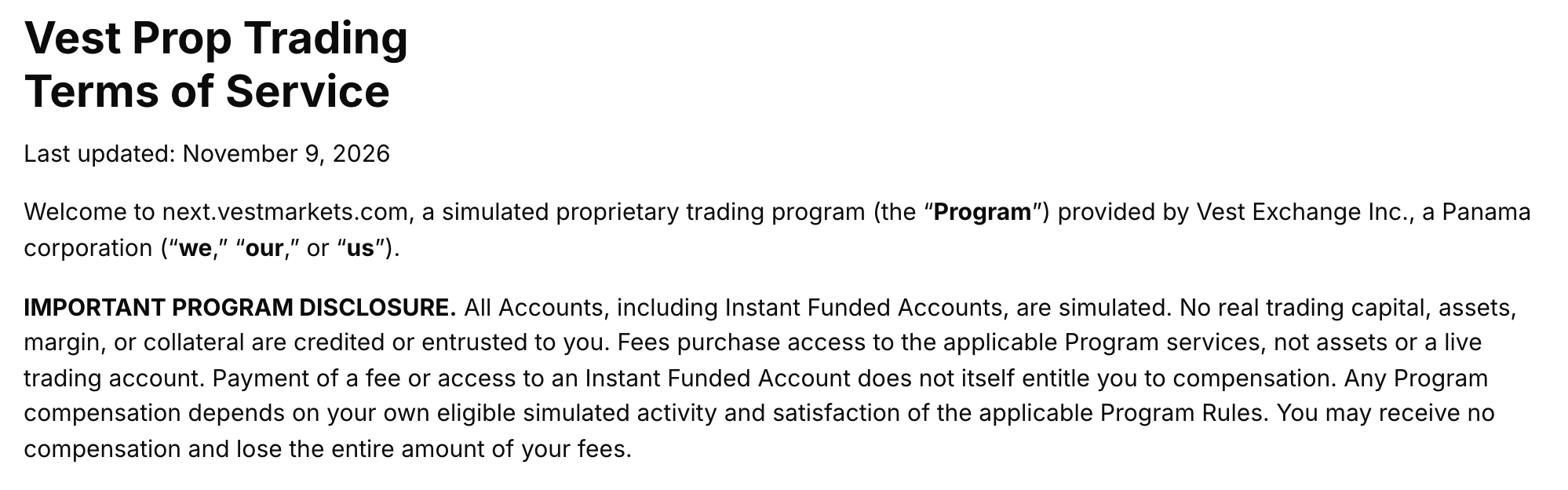
The terms you accept at checkout say the opposite: “No real trading capital, assets, margin, or collateral are credited or entrusted to you.” An Instant account is “a virtual Program designation”. Your trades are “Trade Ideas” that Vest may use, modify or disregard, and may hedge on Vest Exchange, an affiliated trading venue.
And on who pays you: “we do not represent that payouts are funded by profitable live trading.” Program fees form part of Vest’s general revenues and may be used to pay compensation. The sales page disclaimer adds that Vest’s own trading or hedging “may affect prices or liquidity” and that these arrangements may create conflicts of interest.
Vest docs and FAQ (marketing)
Vest prop terms, November 12, 2026 (binding)
To be fair: simulated funded accounts are common in the prop industry, and Phidias funded accounts are simulated too until they convert to LIVE. The problem at Vest is not the model. It is selling “not simulated” while the contract says simulated.
Has Vest Markets had incidents?
Three, all documented by Vest, all on its previous app, trade.vestmarkets.com, since merged into next.vestmarkets.com.
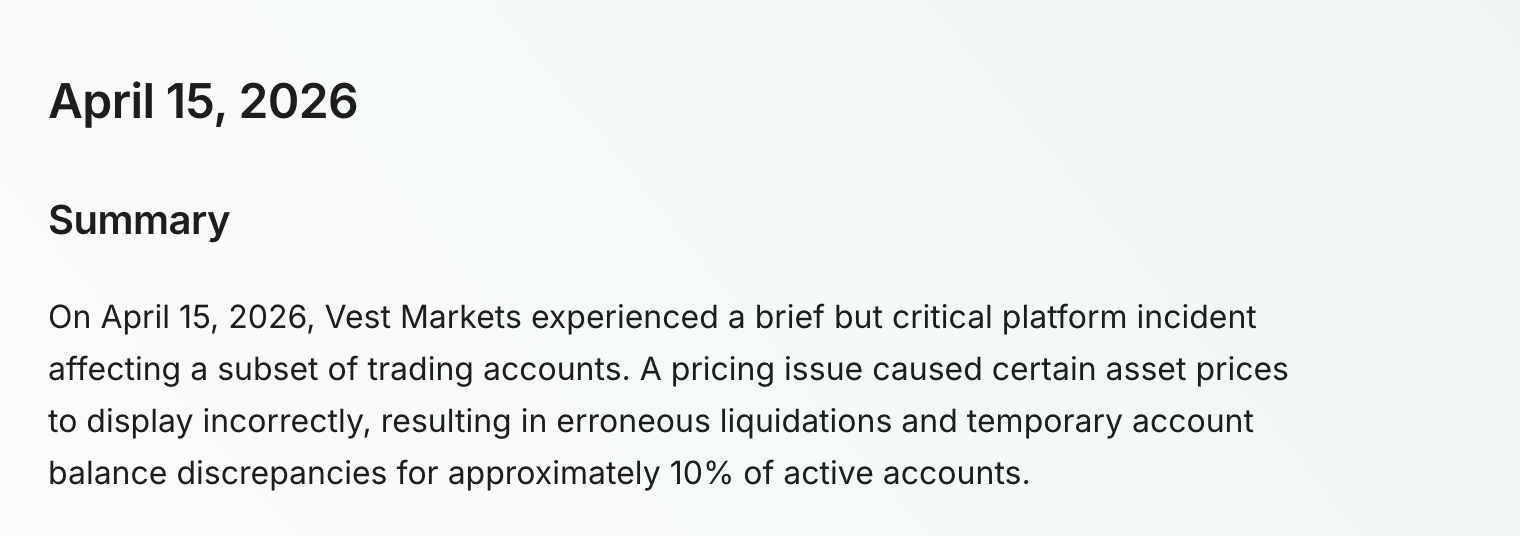
Read both ways. Publishing incident reports and compensating affected users is what a serious operator does. But all three were pricing problems on Vest’s own platform, and your account is marked at that platform’s prices, so the platform is part of the risk.
See CME futures accounts at Phidias
Does Vest Markets actually pay out?
Vest describes a clear two step flow. First, Claim Profit from the Funded Account: your split is credited to your Primary Account in 24 hours, with no minimum, though you may need to close open positions first.
Second, withdraw USDC from the Primary Account to your own wallet, from 1 USDC. Here Vest contradicts itself again: the FAQ says withdrawals are instant until your rolling 24 hour total reaches $50,000, while the withdrawals documentation says “There is currently a 24 hour processing period for all platform withdrawals.” Email and Google accounts withdraw on Base or Arbitrum One, and a sent withdrawal cannot be reversed.
Claim Profit
From the Funded Account, no minimum
Primary Account
Your split credited in 24 hours
USDC withdrawal
From 1 USDC. FAQ: instant up to $50,000 per rolling 24 hours; docs: 24 hour processing
Your wallet
Base or Arbitrum One for email and Google accounts; a sent withdrawal cannot be reversed
What Vest does not publish: a total paid to traders, a count of funded traders, or how often payouts are held. The terms allow Vest to temporarily withhold compensation during “a reasonable, good faith eligibility, error, or prohibited conduct review”.
Refunds are where the pages disagree again: 3 days with no trade placed, per the terms, the documentation and the FAQ, but 28 days in the FAQ data on the homepage. The terms are the contract you accept at checkout.
Can US traders use Vest Markets?
The two Vest contracts do not agree. The prop terms bar citizens and residents of Cuba, North Korea, Iran, Russia, Syria and the Philippines; the United States and the United Kingdom are not on that list.
The exchange terms add the United Kingdom and the United States, territories included. Your claimed profits land in your Primary Account, the regular Vest trading account. Vest does not reconcile the two contracts, so ask its support in writing before you buy. Identity verification can be required “before purchase, access, or payment of compensation”.
How do you check whether any prop firm is legit?
Five questions settle most of it, at Vest or anywhere else:
- Who signs the contract? A named company, and which country.
- What do the terms call the account? Simulated, live, or both.
- Who pays you, from what? Live trading profits or company funds.
- Where do the trades go? A public exchange, or the firm’s own venue.
- Do the marketing and the terms say the same thing? If not, the terms win.
Run those on Phidias and the answers are short. We trade CME futures: NQ, ES, gold and the other contracts listed on CME Group exchanges. Our funded accounts are simulated, and we say so. The difference is what comes next: on Express to Live, your first payout converts the account to LIVE.
Payout on Day 1 is possible on every Express to Live size, and our record from purchase to payout is 6 hours 18 minutes. More than 50,000 traders have been funded at Phidias. If perpetuals are your market, our guide to perpetual futures prop firms compares Vest with the others, and our MyFundedPerps review covers its closest rival.
The full rules sit on our rules page, and our guide to static drawdown prop firms explains why a fixed floor matters.
Test: is Vest Markets the right kind of legit for you?
Four questions on budget, what legit means to you, what you trade and how you want to be paid. No email.
30 second check
Is Vest Markets the right kind of legit for you?
Is Vest Markets legit? Frequently asked questions
Is Vest Markets legit or a scam?
Vest Markets is a real, operating business, not a disappearing scam: Vest Exchange Inc., a Panama corporation, is named in its terms, it publishes incident reports and it describes a USDC payout flow. But no regulator or licence is named anywhere, and its own prop terms say every account, Instant included, is simulated.
Who owns Vest Markets?
Vest Exchange Inc., a Panama corporation, is named as the provider in both Vest Markets terms of service: the prop program and the exchange website. The site footer reads Vest Labs Inc. A March 2025 press release from Vest Labs names Justin Ma as CEO of Vest Labs. Vest’s own website names no founder or executive.
Is Vest Markets backed by Coinbase?
Vest Markets says so: Coinbase is listed on its sales page and in its documentation. We could not verify it from a primary source. Coinbase is absent from Vest’s own March 2025 funding press release, and we found no announcement from Coinbase itself, so treat it as a claim made by Vest.
Is Vest Markets backed by Jane Street?
Vest Markets names Jane Street as an investor on its website, in its documentation and in its March 2025 press release about a $5 million seed round. We found no statement from Jane Street itself. An investor in Vest Labs is backing the company, not guaranteeing your account or your payouts.
Is Vest Markets regulated?
No regulator or licence is named on Vest Markets’ website, documentation or terms. The prop program is run by a Panama corporation, disputes go to binding arbitration in Panama, in English, with a class action waiver, and the terms say you are not a customer of any exchange Vest uses.
Is Vest Markets real money or simulated?
Both, depending on which Vest page you read. Its documentation says “Real Vest capital. Not simulated”, but its prop terms, last updated November 12, 2026, say all accounts are simulated and that payouts come from Vest’s general corporate funds. The terms are the binding document.
Does Vest Markets actually pay out?
Vest Markets describes a two step payout: Claim Profit credits your split to your Primary Account in 24 hours, then you withdraw USDC to your own wallet, from 1 USDC. Its FAQ calls withdrawals instant up to $50,000 per rolling 24 hours, its docs say 24 hour processing. Vest publishes no total paid to traders.
Has Vest Markets had problems?
Yes, and it documents them. On April 15, 2026, a pricing error hit about 10% of active accounts and about 90 orders were wrongly liquidated before a full rollback. Vest also reports an ES pricing bug on June 8 and an EWY bug on June 30, 2026, both on its previous app.
Related guides
Read it yourself
- Phidias accounts and prices
- Phidias rules (Express to Live)
- Vest: Prop Trading Terms of Service
- Vest: exchange Terms of Service
- Vest docs: About Vest Markets (investors)
- Vest docs: Vest Capital overview
- Vest: Vest Capital sales page
- Vest: FAQ
- Vest docs: incident reports
- Vest docs: audits
- Vest docs: withdrawals
- Vest docs: refund policy
- Vest Labs press release, March 11, 2025 (via Chainwire)
The verdict
“Vest Markets is a real company with named investors, and it publishes its incidents in writing. But a logo wall is not a guarantee, and its contract says simulated where its marketing says real. Test it small if perpetuals are your market. If you trade NQ and ES, trade them where they actually list.”
William G., CMO at Phidias Propfirm
William G., CMO at Phidias Propfirm. Writes about prop firm rules, costs and payouts from the operator’s side.
Last reviewed 2026. Vest Markets facts verified on Vest’s own pages on November 7, 2026. The primary sources are linked above. Not financial advice: trading futures and perpetuals involves substantial risk of loss.