Tradeify account limits, 2026
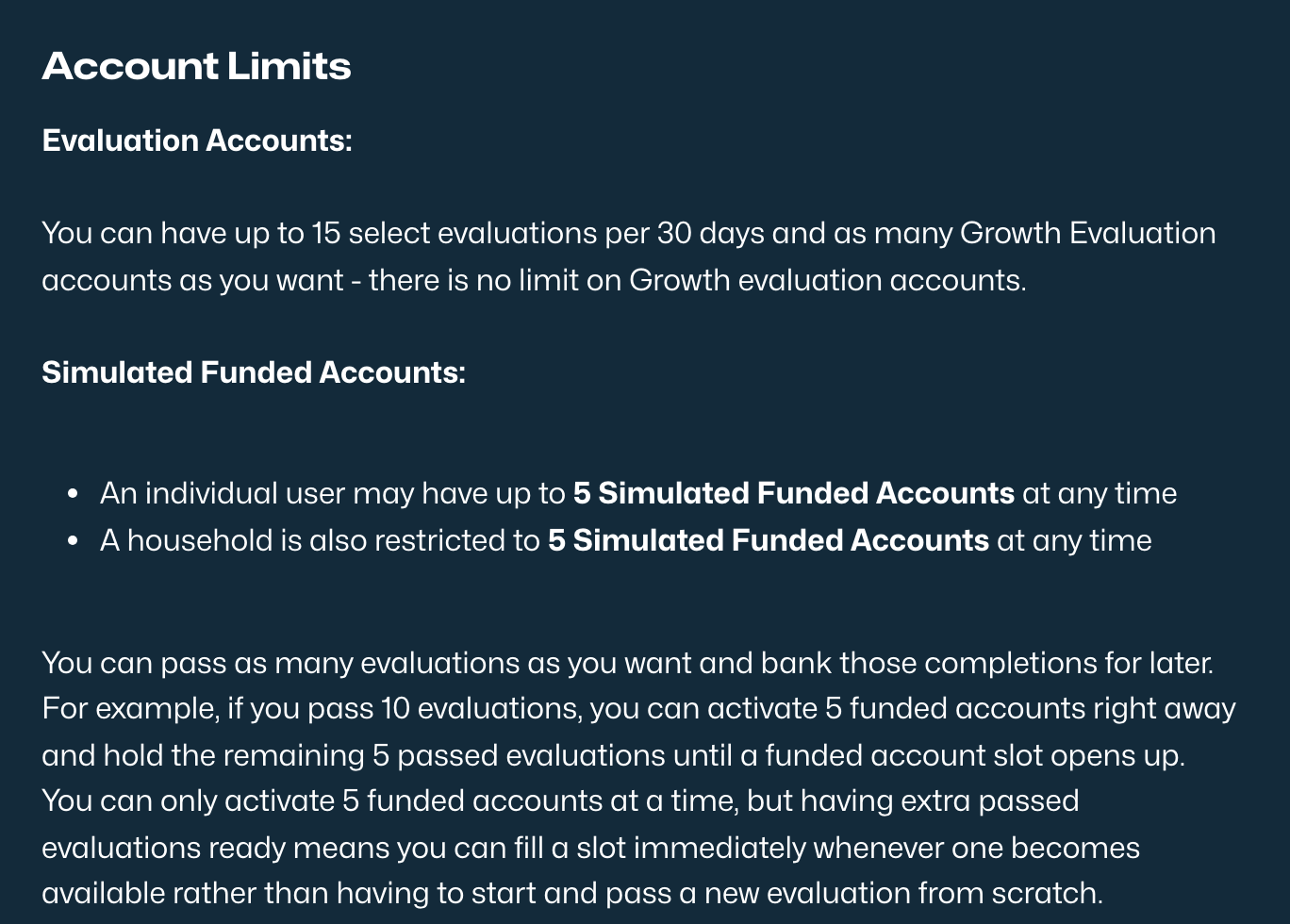
Tradeify’s cap of 5 simulated funded accounts is not per trader. It is per household, so two traders under one roof share a single allowance.
Here are the real limits, what does not count, and how to bank a pass for later.
Want to run up to 15 accounts at once instead of 5? Here is Phidias Express to Live. First, the Tradeify rules.
How many Tradeify accounts can you have?
You can hold up to 5 simulated funded accounts at any one time, in any mix of Growth, Select and Lightning. The cap applies per individual and per household. Evaluations are far more generous: Growth evaluations are unlimited, and you may buy up to 15 Select evaluations per 30 days. Failed or expired accounts do not count toward the funded limit, and you can pass more evaluations than you have slots and hold them in reserve.
From Tradeify’s help center, checked August 2026.
Tradeify account limits in 30 seconds
Funded is the bottleneck: 5 accounts, in any combination of the three plans, and that is the number that caps your income.
Evaluations are not: Growth evaluations are unlimited, so you can keep testing without touching the funded cap.
The catch nobody reads: the 5-account cap is per household, not per person.
Our verdict (William G.)
Five funded accounts is a reasonable allowance and the unlimited Growth evaluations are genuinely generous. My issue is the household clause. If you and your partner both trade, you do not have ten slots between you, you have five, and Tradeify says so explicitly. That is the kind of rule you want to discover before you buy, not after.
The Tradeify limit is per household, not per trader
Most prop firms cap accounts per person. Tradeify caps them per person and per household, and it does not leave the point ambiguous.
Its help center states that “an individual user may have up to 5 Simulated Funded Accounts at any time” and, separately, that “a household is also restricted to 5 Simulated Funded Accounts at any time”. It then adds that “all funded accounts across all users in the same household count toward the 5-account limit”.
The firm’s own worked example removes any doubt:
Tradeify’s scenario 3: “Two people in same household each have 3 Funded accounts.”
Not allowed. Six accounts across two traders breaches a limit that belongs to the household, not to either of them.
This matters more than it sounds. Trading couples, siblings, flatmates and parent-and-child pairs all hit it. The five slots are a shared resource, and there is no published mechanism for splitting them fairly. Tradeify also does not publish how it defines a household.
Evaluations are exempt. Tradeify confirms that in the same example: both people in that household “can have unlimited Evaluation accounts”. It is only the funded stage, the one that pays, that is rationed by address.
Evaluations play by completely different rules
The funded cap gets all the attention, but the evaluation rules are where Tradeify is unusually relaxed, and they differ sharply by plan.
Growth evaluations are unlimited. Tradeify’s wording is direct: you can hold “as many Growth Evaluation accounts as you want – there is no limit on Growth evaluation accounts”. At $99 for a 25K, that makes Growth the cheap way to keep attempts running in parallel.
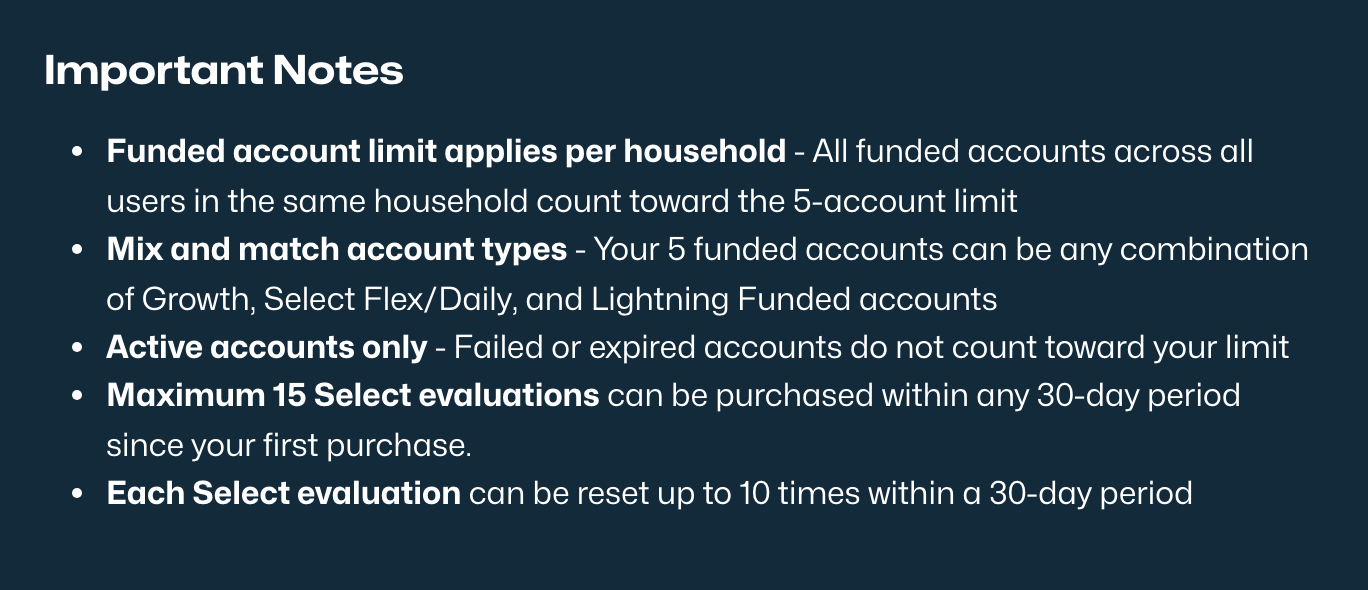
Select evaluations are capped at 15 per 30 days, measured as a rolling window since your first purchase, and each one can be reset up to 10 times within a 30-day period.
The asymmetry is worth planning around. If your strategy is to run several evaluations at once and convert whichever clears first, Growth is the plan built for that, and it is also the cheapest and fastest to pass.
How to bank a passed Tradeify evaluation
Here is the part almost nobody knows, and Tradeify documents it openly: a passed evaluation does not have to be activated immediately.
Because activation is a separate step you trigger yourself, you can pass more evaluations than you have funded slots and hold the surplus in reserve. In Tradeify’s words: “if you pass 10 evaluations, you can activate 5 funded accounts right away and hold the remaining 5 passed evaluations until a funded account slot opens up.”
Why banking a pass is worth doing
A funded account that breaches leaves a slot empty. Without a banked pass, refilling it means buying an evaluation and passing it again, which costs money and, more importantly, days.
Tradeify charges no activation fee, which makes a discount on the purchase price a discount on the whole path to funded. What that is worth, plan by plan, is in our guide to the Tradeify discount code.
With a banked pass, the slot refills the same day. Since Growth evaluations are unlimited and can be cleared in a single session, keeping one or two passes in reserve is the cheapest insurance available on the platform.
One caution: this is a queue, not a workaround. The five-account ceiling still applies, and a banked pass sitting idle earns nothing. It buys speed of replacement, not extra capacity.
And a banked pass is not indefinite. Tradeify states that an evaluation purchase “gives you a set period to activate” and that missing that window may mean buying a new evaluation. It does not publish how long the window is, so treat a reserve pass as something to use, not to store.
30-second quiz
Which Tradeify account is right for you?
What counts toward the Tradeify limit
Counts: every active simulated funded account, in any mix of Growth, Select Flex, Select Daily and Lightning, held by anyone in your household.
Does not count: failed or expired accounts. Tradeify is explicit that only active accounts apply, so a breach frees the slot immediately.
Also does not count: evaluations of any kind, whether in progress or passed and waiting, and Tradeify Level Up runs, which Tradeify says do not count against your funded account limit.
You are free to mix plans across your five. Tradeify confirms your funded accounts “can be any combination of Growth, Select Flex/Daily, and Lightning Funded accounts”, so nothing stops you running, say, three Growth accounts alongside two Select Flex accounts to get both a daily payout path and the cheaper entry.
The rule that catches multi-account traders
If you are reading this because you intend to run several accounts, this is the section that matters most, and it is the one almost no scaling guide mentions.
Tradeify prohibits hedging across your accounts, not just within them. In its own words: you cannot hold opposing positions “on the same instrument or on two products from the same Product Group, whether those positions sit in a single account or are spread across several of your accounts.”
The trap is that it is broader than most people assume. It is not only about being long and short the same contract.
All three of these are violations
Long ES on account A + Short ES on account B. Same instrument, two accounts.
Long ES on account A + Short NQ on account B. Different instruments, but both are Equity Index products.
Long MES on account A + Short NQ on account B. A micro leg against a mini leg still counts. Tradeify states that “contract size is irrelevant”.
There is one narrow mercy. Tradeify’s automated check breaches an account only when all three conditions hit at once: opposing positions, a hedge held for more than 10 seconds, and more than $150 of profit generated from it. That window exists so an accidental opposing position can be flattened without penalty, not as permission to hold a hedge briefly on purpose, and cross-account or correlated-product cases are reviewed separately by the risk team.
That second example is the one that catches honest traders. Being long the S&P on one account while short the Nasdaq on another is an ordinary discretionary decision, and on Tradeify it is a hedging violation, because both instruments sit in the same Product Group.
The consequences are severe and worth quoting in full. A hedging violation results in “every account involved being set to violation status, forfeiture of any profits generated during the period of the violating activity, and possibly a permanent ban from Tradeify.” The rule applies to evaluations, simulated funded accounts and Elite Live accounts alike.
The practical takeaway for anyone scaling: your five accounts are not five independent books. Treat them as one position sheet. And reaching into a different Product Group is not a safe harbour either: Tradeify treats a long Equity Index position against a long Volatility position as offsetting despite the two sitting in separate groups, and states that the list “is not exhaustive” and that it may treat “any other position it determines to be offsetting” as a hedge.
If you plan to run those accounts with a copier or a bot, Tradeify has specific conditions for both, including proof that a bot is yours alone. Our Tradeify copy trading rules walk through them.
What 5 Tradeify accounts can actually pay out
Account limits only matter because of what they cap. Since every Tradeify payout is capped per request, five accounts sets a hard ceiling on what can leave the platform in one cycle. Here is that ceiling, calculated from Tradeify’s published caps.
You receive 90% of whatever you request, so the real figures land at $4,500 and $22,500 respectively. And every one of those five accounts must satisfy its conditions independently, which Tradeify confirms: “each account is treated independently.” What those conditions are varies by plan. Growth needs 5 qualifying days, a 35% consistency check and a minimum balance. Select Flex needs 5 winning days but has no consistency rule and no minimum balance. Lightning has no minimum trading days but the tightest consistency rule and a profit goal to clear. Five accounts is five sets of rules, and they are not the same five.
That is the honest read on scaling at Tradeify. More accounts genuinely means more income, but each one adds compliance work rather than simply multiplying a single result.
Three times the ceiling
15 accounts, not 5.
Phidias allows up to 5 accounts per product family, across Express to Live, Fundamental and Premium, for 15 running at once. One trader ran 10 at once, 5 Fundamental and 5 Premium, for a single $37,500 payout. On Express to Live specifically, two traders each ran 5 accounts and paid out $5,000 apiece, the same day.
The ceiling is the whole point of a multi-account strategy, and this is where the two firms diverge most sharply. Tradeify gives you 5 slots shared with your household. Phidias gives you 5 per product family, 15 in total.
The difference compounds with everything else. On Phidias Express to Live the evaluation carries no consistency rule and no minimum trading days, the drawdown is static so it never trails, $500 on the 25K, and your first payout converts the account into a real LIVE account where withdrawals are daily and uncapped. Multiply that by up to fifteen accounts and the arithmetic stops resembling a capped simulated ladder at all. The full cycle, buy to payout, has been completed in 6 hours 18 minutes.
Frequently asked questions
How many funded accounts can you have with Tradeify?
Five at a time, in any combination of Growth, Select Flex, Select Daily and Lightning. The cap applies per individual and per household, and only active accounts count.
Is the Tradeify account limit per person or per household?
Both. An individual may hold 5, and a household is also restricted to 5 in total. Tradeify’s own example states that two people in the same household holding 3 funded accounts each is not allowed.
How many Tradeify evaluations can you have?
Growth evaluations are unlimited. Select evaluations are capped at 15 per 30 days, and each Select evaluation can be reset up to 10 times in a 30-day period.
Do failed Tradeify accounts count toward the limit?
No. Tradeify counts active accounts only, so failed or expired accounts free their slot immediately and do not block a replacement.
Can you hold a passed Tradeify evaluation without activating it?
Yes, and it is a genuinely useful tactic. Activation is a separate step you trigger yourself, so you can bank passed evaluations and activate one the moment a funded slot opens, instead of starting a fresh evaluation from scratch.
Can you mix Tradeify account types?
Yes. Your five funded accounts can be any combination of Growth, Select Flex, Select Daily and Lightning. Nothing requires them to be the same plan or the same size.
Can you hedge between two Tradeify accounts?
No, and the rule is wider than most people expect. Opposing positions on the same instrument or on any two products from the same Product Group count as hedging, even across separate accounts and even if one leg is a micro. Long ES on one account and short NQ on another is a violation. The penalty is violation status on every account involved, forfeiture of profits from that period, and possibly a permanent ban.
How many Tradeify accounts can you activate in one day?
On Growth, up to 5 funded accounts per day, with the limit resetting every 24 hours UTC. Any further qualified accounts wait until the next day. The overall ceiling of 5 active funded accounts still applies on top of it.
How much can you withdraw across 5 Tradeify accounts?
It depends on plan and size, because every payout is capped per request. Five Growth 25K accounts on a first payout cap out at $5,000 per cycle; five Select Flex 150K accounts reach $25,000. You receive 90% of what you request, and each account must satisfy its own conditions.
Useful resources
Tradeify: How Many Simulated Funded Accounts Can I Have at Once?, the official limits, household rule and worked scenarios.
Tradeify: Pricing Reference, prices and reset fees for every plan.
Phidias Express to Live, the same-day path from evaluation to a real LIVE account.
Related guides
Tradeify Review 2026, the full breakdown of the firm, its three plans and its live program.
Tradeify Growth vs Select vs Lightning 2026, which of the three accounts to actually buy.
Tradeify Payout Rules 2026, every payout condition and cap across the three plans.
Tradeify Level Up 2026, the 10-level static drawdown ladder, its $89 attempts and where the $34,250 of rewards really sits.
Which Tradeify Platform Should You Choose? 2026, the broker connection that is locked at checkout.
About the author
William G.
William G. is a futures trader and prop firm analyst at Phidias Propfirm. He tests competitor rule sets against their own published documentation, and writes about what actually happens between passing an evaluation and being paid. Every limit in this guide is taken from Tradeify’s own help center, checked in August 2026.