Apex vs FTMO, 2026
Apex funds US futures traders. FTMO funds forex and CFD traders. They are not really competitors, they are for different markets.
Here is the honest head-to-head, and where a futures trader should actually be looking.
Trade futures and want real, live capital? Here is Phidias. First, how Apex and FTMO compare.
Apex Trader Funding vs FTMO: which is better?
It depends on what you trade, because they are not the same product. Apex is a US futures firm: cheap one-time evaluations, a trailing drawdown, and a 100% split with per-payout caps. FTMO is a forex and CFD firm with no futures: a two-phase (or one-phase) challenge, a more forgiving static drawdown, an 80% split, and it refunds your fee with the first payout. If you trade futures, FTMO is not really an option. If you trade forex, Apex is not. And both are simulated, so neither is real capital.
Apex vs FTMO in 30 seconds
Pick Apex if: you trade US futures, want a cheap one-time evaluation, and a fast first payout.
Pick FTMO if: you trade forex or CFDs, prefer a more forgiving static drawdown, and like that the fee is refunded with your first payout.
Either way: both are simulated. Neither puts you on real capital, and for futures on real money the answer is neither.
Our verdict (William G.)
Comparing Apex and FTMO is really comparing futures against forex. FTMO is a strong forex firm with a fairer static drawdown and a fee refund; Apex is a cheap, fast futures firm with a punishing trailing floor. If you trade futures, FTMO is off the table, and the real question becomes Apex versus a firm that funds futures on real capital.
30-second quiz
Which Phidias account fits you best?
The big one: futures vs forex
Before any rule-by-rule comparison, settle the question that decides everything: what do you trade? Apex funds US futures, the ES, NQ, CL, GC and the micros. FTMO funds forex pairs and CFDs (indices, metals, commodities, crypto CFDs), and does not offer futures at all.
That single fact settles most of this matchup. A futures trader cannot use FTMO to trade futures, and a forex trader cannot use Apex to trade forex. Both firms now accept US traders (FTMO opened to US clients in 2025 through a collaboration with OANDA), so availability is no longer the divider. The market you trade is.
Drawdown: trailing vs static
This is where FTMO is genuinely kinder. Apex uses a trailing drawdown that follows your peak (intraday) or your end-of-day balance, and never moves back down. FTMO uses a static model: a maximum loss of 10% measured from your initial balance that does not trail, plus a maximum daily loss (3% on the 1-step, 5% on the 2-step).
A fixed 10% floor is easier to trade under than a floor that chases your unrealized profit. If you have been burned by a trailing threshold, that difference is real. We explain exactly how Apex’s version works in the Apex trailing drawdown guide. The catch is that FTMO’s profit target is also higher, which brings us to the evaluation.
Evaluation and targets
Apex runs a one-step evaluation with a roughly 6% profit target (for example $1,500 on a 25K), no minimum days, and you can pass in a single session. See how to pass Apex.
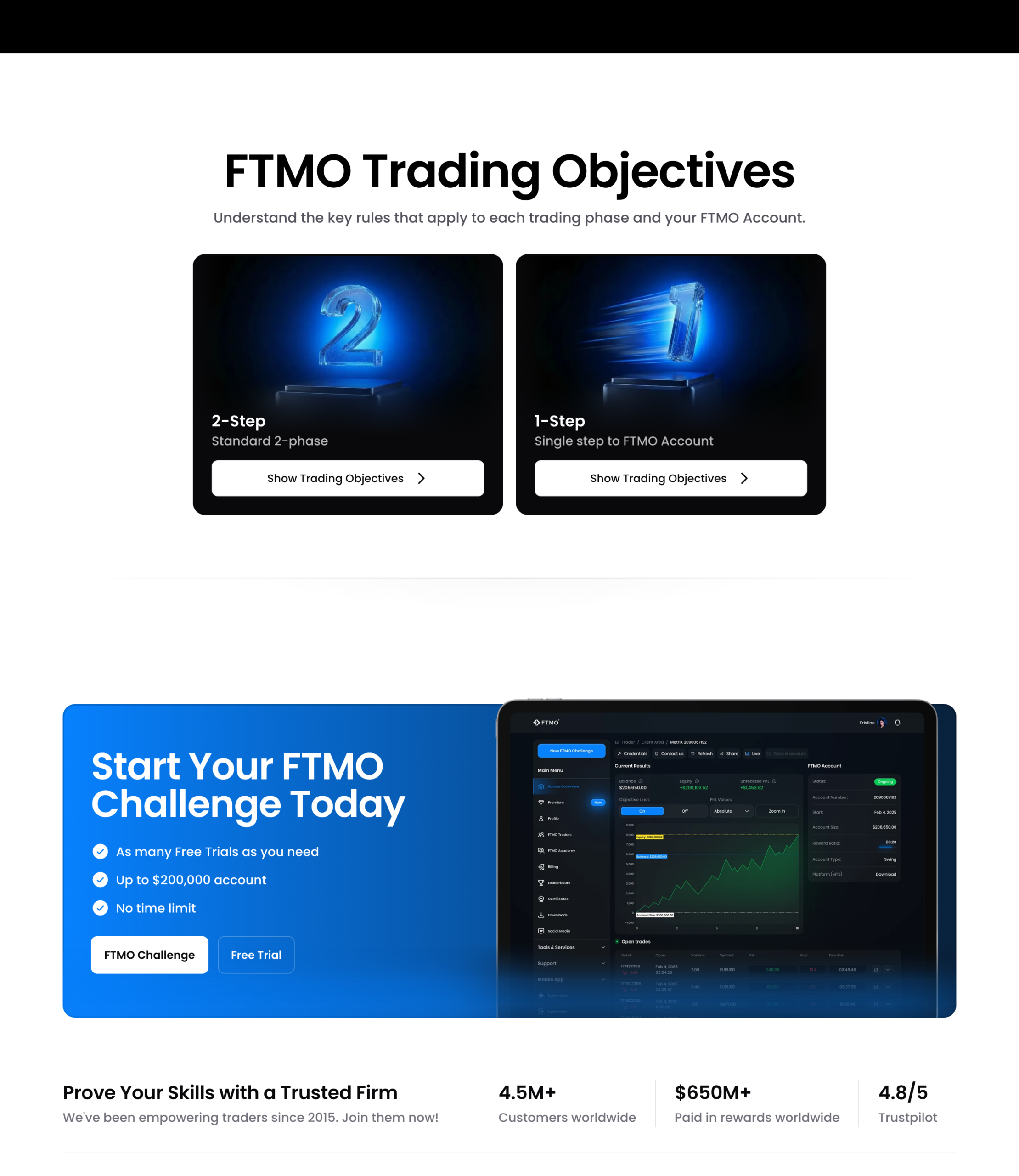
FTMO asks for more. Its target is 10%. On the popular 2-step path you clear a 10% Challenge, then a 5% Verification, with a minimum of 4 trading days per phase before you reach a funded account; there is also a 1-step option at a 10% target. Neither has a time limit anymore. So Apex is faster and lower to clear, while FTMO’s two phases are more work but end in a more forgiving funded account.
Payouts, split and the fee refund
Split: Apex pays a 100% split, but caps each payout and closes the account after 6 payouts. FTMO pays 80%, rising to 90% with its scaling plan, with no 6-payout ceiling. See the Apex payout rules guide.
The fee: Apex’s evaluation and activation fees are not refunded. FTMO refunds your challenge fee with your first payout, which softens the higher price.
Consistency: both have one. Apex uses a 50% rule at payout; FTMO applies a Best Day Rule (your best day must stay under roughly 50% of your positive-day profit). Neither lets you make your account on a single day.
What they share: both simulated
For all their differences, Apex and FTMO share the most important thing: both are simulated-funding firms. Your funded account trades in a simulation, your payout is a reward paid at the firm’s discretion, and neither converts to a real, live brokerage account in your name. Whether you pick futures or forex here, you are renting a simulation, not trading real capital.
For futures traders: Apex vs Phidias
If you trade futures, FTMO is not in the running, and the real comparison is Apex against a firm that funds futures on real capital.
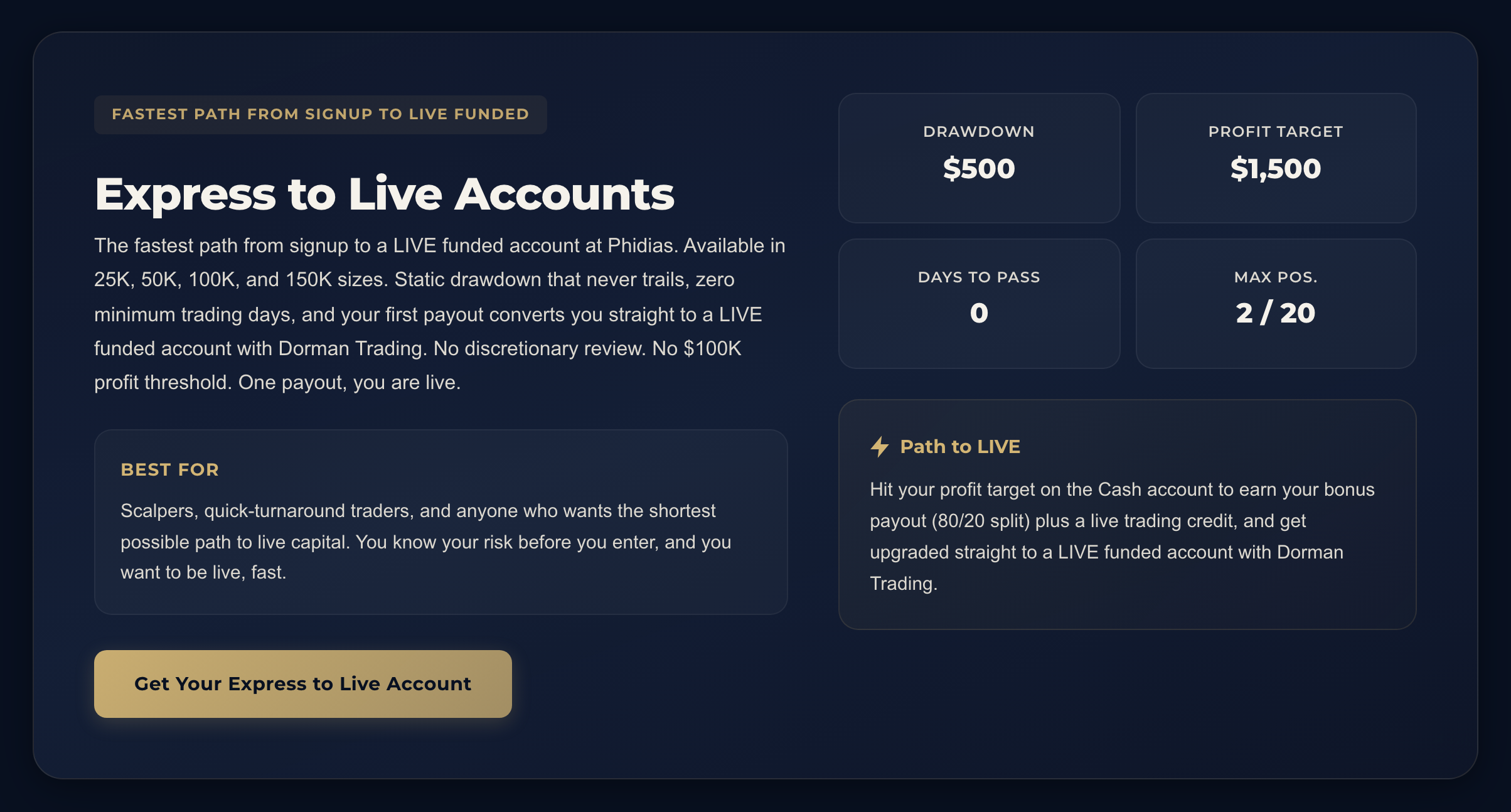
FTMO earns its reputation in forex, and its static drawdown and fee refund are real strengths. But if your market is futures and your goal is real money, neither Apex nor FTMO gets you there. Phidias does. The quiz above points you to the right account, and our Apex alternative guide makes the full case.
Apex vs FTMO: frequently asked questions
Is Apex or FTMO better?
They serve different markets, so it depends on what you trade. Apex is better for US futures, with cheap one-time evals and fast payouts. FTMO is better for forex and CFDs, with a more forgiving static drawdown and a refunded fee. Both are simulated.
Does FTMO offer futures?
No. FTMO funds forex and CFDs (indices, metals, commodities, crypto CFDs), not exchange-traded futures. If you want to trade futures like the ES or NQ, Apex or Phidias is the right place, not FTMO.
Does FTMO accept US clients?
Yes, as of 2025. FTMO reopened to US traders through a collaboration with OANDA. Apex has always accepted US traders. So both are available in the US.
Which has the harder drawdown, Apex or FTMO?
Apex. Its trailing drawdown chases your peak and never moves down, which is tougher than FTMO’s static 10% max loss measured from your starting balance. FTMO’s drawdown is the more forgiving of the two.
Are Apex and FTMO real money?
No. Both are simulated-funding firms: the funded account trades in a simulation and payouts are discretionary. Neither converts to a live brokerage account. Phidias Express to Live does, on your first payout, for futures.
The bottom line
Apex vs FTMO is really futures vs forex. FTMO is a strong forex firm with a fairer static drawdown and a fee refund; Apex is a cheaper, faster futures firm with a trailing floor and a 100% split. Pick by the market you actually trade.
But both keep you in a simulation. If you trade futures and want real capital, Phidias Express to Live is the option neither of them offers. Take the quiz above to find your account.
Sources and official references
• FTMO: Trading Objectives (official): max daily loss, max loss, profit targets and the Best Day Rule.
• FTMO: How It Works: the challenge, verification and split.
• Apex Trader Funding (official): eval specs, drawdown, payout rules and fees.
• Phidias accounts: Express to Live static drawdown and the LIVE conversion.
About the author
William G. is a futures prop-trading analyst at Phidias. He tests prop firms hands-on, reads the fine print in every help center and rulebook, and translates payout, drawdown and funding mechanics into plain English for traders deciding where to put their capital.
Last reviewed 2026.
Related Apex guides
Apex Trailing Drawdown: the trailing floor, and why FTMO’s static model is gentler.
How to Pass Apex: the targets and rules on the futures side.
Apex Trader Funding 4.0 Explained: the full breakdown of every account and rule.
Risk disclosure: Futures and forex trading involve substantial risk of loss and are not suitable for all investors. Past performance is not indicative of future results. Apex and FTMO account specs, drawdown, targets, splits and payout terms reflect publicly available information from each firm as of July 2026 and are subject to change; verify current terms on apextraderfunding.com and ftmo.com before purchasing. This article is informational and not financial advice.