Vest Markets rules 2026
Every Vest Markets rule, path by path: 1-Step, 2-Step, Instant and the Custom Account, with the places where Vest’s own pages disagree.
Verified on Vest Markets’ documentation, sales page, account builder, FAQ and prop terms of service on November 9, 2026.
Vest Markets sells three account types: a 1-Step or 2-Step evaluation, or an Instant account. Each has a static max drawdown: 6% on standard evaluations, equal to the fee on Instant. A 3% or 4% daily loss limit is optional on 1-Step, fixed at 3% on 2-Step. No minimum days, no consistency rule, and any breach closes the account for good.
Updated on November 10, 2026
In short
- Max drawdown: static, never trails. 6% on standard evaluations (7% or 8% in the Custom Account), 2% to 4% on Instant (always equal to the fee).
- Daily loss limit: 3%, 4% or none on 1-Step, fixed 3% on 2-Step, chosen at purchase and kept once Live. Never on Instant. Resets at 20:00 ET.
- 1-Step: 10% or 20% target, 80% or 90% split. 2-Step: 10% then 5%, 3% daily limit, 80% split.
- Custom Account: a slider builder with options that go beyond the documentation (targets from 5% to 20%, a drawdown up to 8%, a daily loss limit up to 5%, a split from 70% to 95%).
- No minimum days, time limit or consistency rule. News, scalping and holding overnight are allowed.
- But: automatic position cuts around NFP, CPI, PPI and FOMC and from Friday 4:10 PM ET.
- If you trade NQ or ES: Phidias Express to Live has no daily loss limit at all, runs on CME futures, and your first payout converts the account to LIVE.
What are the Vest Markets rules?
The rules follow your account type, not your phase. Vest’s documentation says whatever applies during the evaluation “carries through unchanged once you’re Live”. So the choice you make at checkout is the rulebook you trade under for the life of the account.
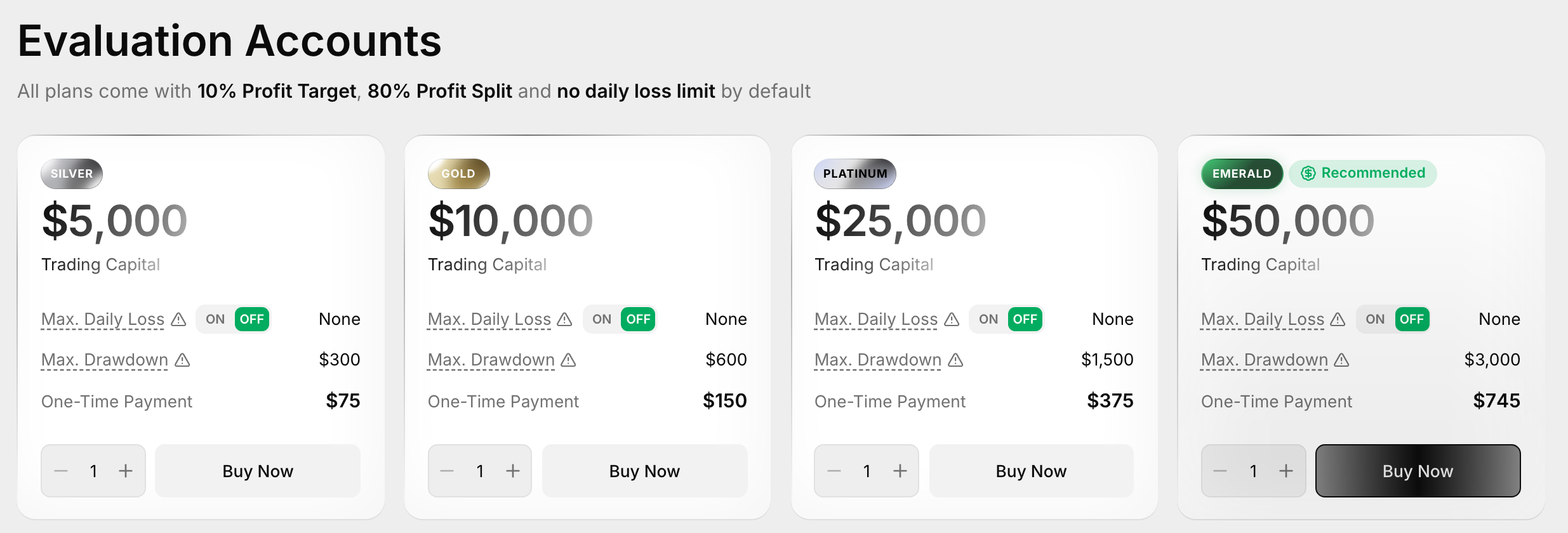
The sales page goes further than the docs: a $50,000 Emerald evaluation with a $3,000 drawdown and a $50,000 Instant account with a $2,000 drawdown. The docs warn that “the live pricing pages are the source of record”, so check the page on the day you buy. Prices and the trust question sit in our Vest Markets review; this page is only about the rules.
What are the Vest Markets evaluation rules?
Two evaluations, one drawdown. In the documented grid, both use a 6% static max drawdown, “regardless of which Profit Target, Daily Loss Limit, or split you chose”. What changes is the target, the daily limit and the price.
1-Step: four choices, 36 configurations
You pick a size (Silver $5,000, Gold $10,000, Platinum $25,000), a profit target of 10% or 20%, a daily loss limit of 3%, 4% or none, and a split of 80/20 or 90/10. That is 12 combinations per size, 36 in the documented grid.
The trade off is visible in the price. The cheapest documented 1-Step is $25 on $5,000: 20% target, 3% daily limit, 80% split. The most expensive is $450 on $25,000: 10% target, no daily limit, 90% split. You pay to remove the daily limit and to raise your split.
2-Step: cheaper, one more hurdle
The 2-Step is fixed: 10% of capital, then a further 5%, a 3% daily loss limit, an 80% split and the same 6% drawdown. It costs $15, $35 or $90 for $5,000, $10,000 or $25,000, against $40, $80 and $210 for the closest 1-Step (10% target, 3% limit, 80% split).
The catch is the daily limit. On a 2-Step you cannot remove it, so the cheapest path is also the one with the most ways to lose the account.
What are the Vest Markets Instant account rules?
One rule. Vest’s FAQ puts it plainly: “There is one: Max. Drawdown”, a fixed loss allowance equal to your payment. No profit target, no daily loss limit, a 95% split, and the account is Live from purchase.
Simple, but tight. A 4% drawdown on $25,000 is $1,000 of room, and it is checked on equity, so an open loss counts the moment it appears.
Does Vest Markets have a daily loss limit?
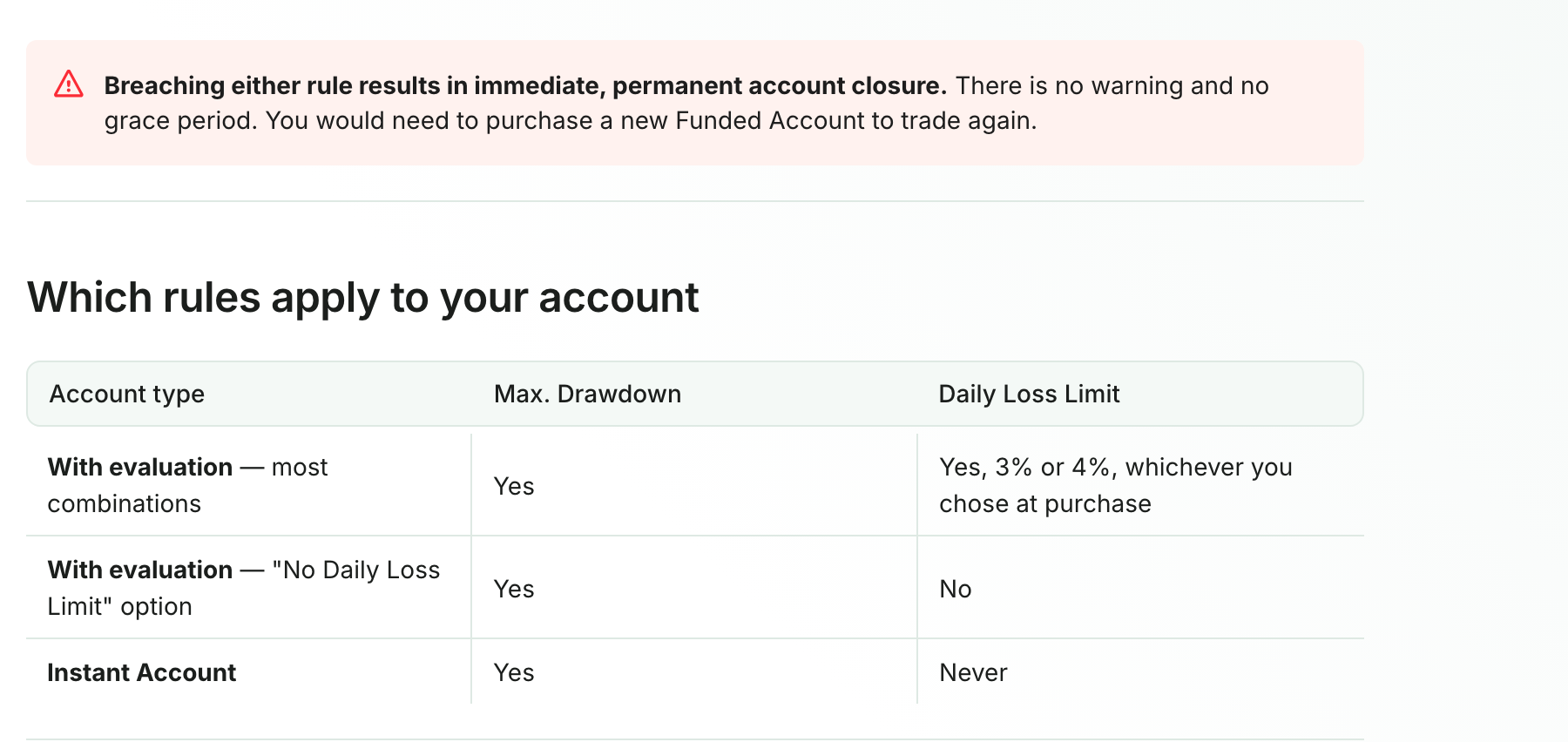
Only if you choose one, and never on Instant. On 1-Step it is 3%, 4% or none, chosen at purchase (the 2-Step has a fixed 3%), and it stays with the account once it goes Live. Here is how Vest computes it, from its Loss Limits page:
- Reset at 20:00 ET every day.
- The reset balance includes reserved collateral but excludes unrealized PnL.
- Daily floor = reset balance × (1 minus the rate), plus non-trading transfers since the reset.
- Your equity, open PnL included, is checked against that floor all day.
- A withdrawal lowers the floor by its full amount; a credit raises it.
Vest’s own example: a $25,000 Platinum with a 4% limit has a $24,000 daily floor. An open position showing $2,000 of profit does not raise it. If the realized balance is $27,000 at the next reset, the new floor is $25,920.
What a daily loss limit really does. It does not prevent the loss: it locks it in. Hit the floor and the account closes while the position may have been minutes from turning, and you will never know. The usual argument for it is fair: it stops a tilted trader from digging deeper, and on Vest it lowers the price. But on Vest a breach is permanent: there is no next day. At Phidias, no account has a daily loss limit: Express to Live, Fundamental and Premium all list it as None, and the Express to Live drawdown is static.
Is the Vest Markets drawdown trailing or static?
Static. The max drawdown is a fixed floor, set once as a percentage of starting capital. “Profits don’t raise it.” “Losses don’t lower it further.” It is checked on equity, intraday or otherwise.
Where Vest’s pages disagree is the exact touch. The Loss Limits documentation says “equality alone does not breach a limit”. The FAQ says the account closes if total account value “touches or drops below that fixed floor”, and gives the example of a Platinum closing at “$23,500 or lower”. Treat the floor itself as the breach: that is the reading that cannot surprise you.
See CME futures accounts at Phidias
What is a Vest Markets bespoke account?
Vest calls it a Custom Account. The sales page says “A daily loss limit is optional with a Custom Account”, and a “Create Custom Account” button opens a builder: pick a size, pick 2-Step, 1-Step or Instant, then set the 1-Step rules on four sliders while the price updates.
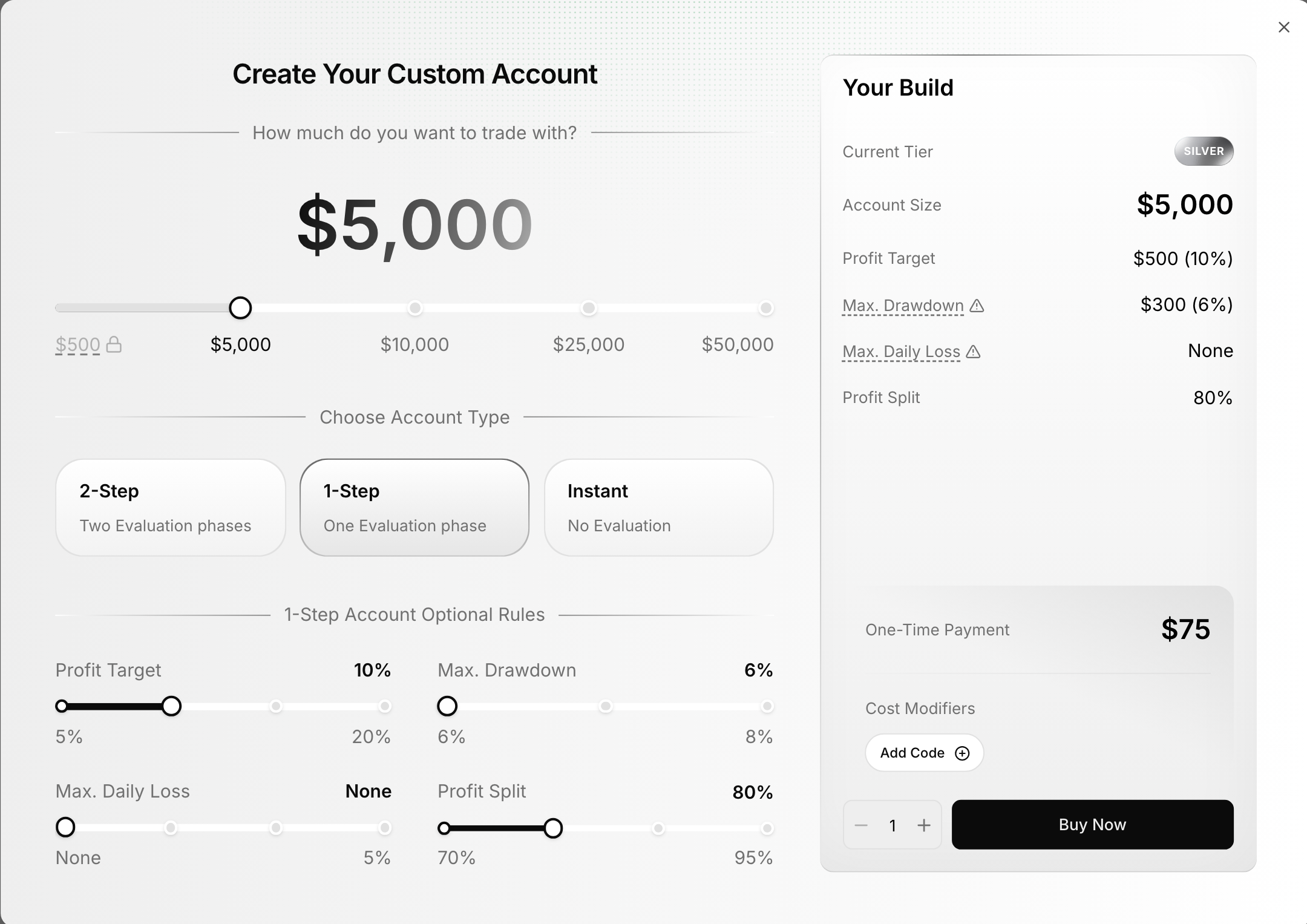
The builder offers more than the documentation. On 1-Step, the sliders run: profit target 5%, 10%, 15% or 20%; max drawdown 6%, 7% or 8%; daily loss limit none, 3%, 4% or 5%; split 70%, 80%, 90% or 95%. The docs list only 10% or 20%, 6%, 3% or 4%, and 80% or 90%. Sizes go up to $50,000 on 1-Step and 2-Step, where the docs stop at $25,000.
Here is what each setting does to the price, one slider moved at a time from the default (10% target, 6% drawdown, no daily limit, 80% split):
The logic is consistent: an easier target, a wider drawdown or a higher split costs more; a daily loss limit or a lower split costs less. The 2-Step at $50,000 is $175 in the builder: 10% then 5%, a $3,000 drawdown and a 3% daily limit. Every price above matches Vest’s documented grid where the two overlap.
Read the summary panel before you pay: it states the target, drawdown and daily loss in dollars for the exact build you chose.
Does Vest Markets allow news trading?
Yes, with an automatic brake. The FAQ says you are “free to open and hold positions before, during, and after any news release”. The Temporary Leverage Limits page adds the catch: from 5 minutes before to 1 minute after NFP, CPI, PPI and FOMC, positions on ES, NQ, RTY and YM and on FX are limited to 5x, gold and silver to 3x, and a single stock to 1x around its earnings.
Positions more than 2% above the limit are cut to it. If your account is more than 1% below its starting capital, they are closed in full instead. A position is not cut if it is within 2% of the limit, or if the account is not in drawdown and can cover the margin the lower limit requires. The limit applies to each position’s own margin, not to the account as a whole.
News window: 5 minutes before to 1 minute after NFP, CPI, PPI and FOMC. Index and FX positions capped at 5x.
Within 2% of the limit
Not cut
Same if the account is not in drawdown and can cover the margin the lower limit requires
More than 2% above it
Cut to the limit
Measured on each position's own margin, not on the whole account
Account more than 1% below its starting capital
Closed in full
The position is closed instead of cut
Does Vest Markets have a consistency rule or minimum trading days?
No to both. Vest’s FAQ: no minimum number of trading days in the evaluation or Live, no time limit, and “no cap on how much of your profit can come from a single day”. Scalping and high frequency approaches are allowed.
One cost hides here: trading fees are simulated during the evaluation but count toward the drawdown and the daily loss limit, like a realized loss. Once Live, they are charged for real against the account balance.
Can you hold Vest Markets positions overnight?
Yes. No rule forces you to close at a set time, and the daily loss limit keeps running overnight. Two Friday rules apply to non-crypto markets:
- From Friday 4:10 PM ET, index and FX positions are limited to 5x and gold and silver to 3x until the market reopens, with the same cuts as around news.
- Then the markets lock: ES, NQ and commodities from Friday 5:00 PM ET to Sunday 6:00 PM ET, single stocks from Friday 8:00 PM ET to Sunday 8:00 PM ET, and FX over the weekend, per Vest’s Markets page. Vest’s FAQ gives Friday 8:00 PM ET for all non-crypto positions: plan on the earlier time.
Vest's Friday schedule for non-crypto positions
Friday 4:10 PM ET
Temporary limits start
Index and FX positions capped at 5x, gold and silver at 3x, with the same cuts as around news
Friday 5:00 PM ET
ES, NQ and commodities lock
Positions cannot be managed until the reopen
Friday 8:00 PM ET
Single stocks lock
Vest's FAQ gives this time for all non-crypto positions
Sunday 6:00 PM ET
ES, NQ and commodities reopen
Per Vest's Markets page
Sunday 8:00 PM ET
Single stocks reopen
Per Vest's Markets page
How many Vest Markets accounts can you have?
Three Vest pages, three answers. The prop terms are the agreement you accept at checkout:
Whatever the count, the terms forbid using another person or entity to get around it, and the FAQ gives taking opposite sides of the same market on different accounts as an example of the abuse it prohibits. API trading is not available on any Vest Capital account, and XRP cannot be traded on them. Vest’s FAQ also excludes HYPE, while its cross margin table still lists HYPE at 5x on funded accounts.
What gets a Vest Markets account closed?
A breach of either loss limit, at any moment: “no warning and no grace period”, and you would need to buy a new account. The prop terms add a list of prohibited uses that can suspend access or payouts during a review:
- Manipulating prices, funding rates or oracles, wash trading or spoofing.
- Trading to profit from the market impact of Vest’s own hedging.
- Misusing multiple accounts, or exploiting technical errors, latency, risk limits or payout calculations.
- Using a VPN to get around the terms’ restrictions.
Profits are claimed on demand: your split, fixed at purchase, is credited to your Primary Account in 24 hours, with no minimum and no cap on frequency. Who pays those claims, and from what, is covered in is Vest Markets legit?
Vest Markets rules vs Phidias Express to Live
Credit where it is due: a Vest evaluation gives you a 6% drawdown, more room in percentage than our Express to Live ($500 on 25K, $1,000 on 150K), and Vest lets you hold overnight, which Express to Live does not. The differences that matter for a futures trader are elsewhere.
Payout on Day 1 is possible on every Express to Live size, and our record from purchase to payout is 6 hours 18 minutes. The full list is on our rules page, and our guide to static drawdown prop firms compares the fixed floors across the market.
If perpetuals are your market, our guide to perpetual futures prop firms puts Vest next to its rivals.
Test: which Vest Markets rules fit how you trade?
Four questions on losing days, evaluations, markets and what you want after you pass. No email.
30 second check
Which Vest Markets rules fit how you trade?
Vest Markets rules: frequently asked questions
What are the Vest Markets rules?
Vest Markets sells three account types: a 1-Step or 2-Step evaluation, or an Instant account with no evaluation. Every account has a static max drawdown: 6% on standard evaluations, equal to the fee on Instant. A 3% or 4% daily loss limit is optional on 1-Step and fixed at 3% on 2-Step. No minimum days, no consistency rule. A breach closes the account permanently.
Does Vest Markets have a daily loss limit?
On 1-Step, only if you choose one: 3%, 4% or none, and up to 5% in the Custom Account builder. The 2-Step has a fixed 3% limit. The choice stays with the account once it goes Live, and Instant accounts never have one. The limit resets at 20:00 ET, and a breach closes the account immediately, with no warning.
Is the Vest Markets drawdown trailing or static?
Static. The max drawdown is set once, as a percentage of starting capital, and never moves: profits do not raise it. It is 6% on standard evaluation accounts (7% or 8% can be bought in the Custom Account builder) and 2% to 4% on Instant accounts. It is checked on equity, unrealized PnL included, at every moment of the day.
What are the Vest Markets evaluation rules?
1-Step: a 10% or 20% profit target, a 3%, 4% or no daily loss limit, and an 80% or 90% split, chosen at purchase. 2-Step: 10% then 5%, a 3% daily loss limit and an 80% split. Both have a 6% static drawdown, no minimum days and no time limit.
What are the Vest Markets Instant account rules?
One rule: a static max drawdown equal to the fee you paid, from $10 on the $500 account to $1,000 on the $25,000 account (2% to 4%). No profit target, no daily loss limit and a 95% split. The account is Live from purchase.
What is a Vest Markets bespoke account?
Vest calls it a Custom Account. A builder on its sales page lets you set the size, the path and, on 1-Step, the profit target, drawdown, daily loss limit and split, each on a slider, with the price updating as you go. Some of those options are not in Vest’s documentation.
Does Vest Markets allow news trading?
Yes. Vest’s FAQ says you can open and hold positions before, during and after any release. But its Temporary Leverage Limits cap index and FX positions at 5x and gold and silver at 3x from 5 minutes before to 1 minute after NFP, CPI, PPI and FOMC.
How many Vest Markets accounts can you have?
Vest’s prop terms allow up to 10 Instant Funded Accounts and up to 100 Evaluation Accounts at once, as separate limits, under one user profile. Its documentation says 10 Live Funded accounts across both paths, and its FAQ says evaluations are not capped. The prop terms are the agreement you accept at checkout.
Related guides
Read it yourself
- Phidias accounts and prices
- Phidias rules (Express to Live)
- Vest docs: Vest Capital overview
- Vest docs: account tiers and pricing
- Vest docs: loss limits
- Vest docs: Temporary Leverage Limits
- Vest docs: claiming profit
- Vest: Vest Capital sales page and Custom Account builder
- Vest: FAQ
- Vest: Prop Trading Terms of Service
The verdict
“Vest Markets’ rules are short, and that is their strength: a static floor, an optional daily limit, no consistency rule. The weak spots are a daily limit that closes the account for good, the automatic cuts around news, and pages that disagree on details as basic as the account limit. If you trade NQ and ES, trade them on CME with no daily limit at all.”
William G., CMO at Phidias Propfirm
William G., CMO at Phidias Propfirm. Writes about prop firm rules, costs and payouts from the operator’s side.
Last reviewed 2026. Vest Markets rules verified on Vest’s own pages on November 9, 2026; Vest changes them often. The primary sources are linked above. Not financial advice: trading futures and perpetuals involves substantial risk of loss.