Market structure, 2026
A BOS breaks a swing with the trend. A CHoCH breaks one against it. The trend before the break decides the label.
Definitions from LuxAlgo’s Smart Money Concepts documentation and source code, a real NQ example, and Phidias account rules. Read on October 27, 2026.
A break of structure (BOS) is a candle close beyond the last swing high or low in the direction of the trend: it signals continuation. A change of character (CHoCH) is the first close beyond a swing against the trend: it warns of a possible reversal. In ICT’s vocabulary, that reversal break is called a market structure shift (MSS).
In short
- BOS: in an uptrend, a close above the last higher high. In a downtrend, a close below the last lower low. The trend continues.
- CHoCH: in an uptrend, the first close below the last higher low. In a downtrend, the first close above the last lower high. The trend may be ending.
- MSS: ICT’s term for what others call CHoCH, according to LuxAlgo, usually read with a liquidity grab and a fair value gap.
- Close, not wick: LuxAlgo’s open-source script labels a break when the candle close crosses the level. A wick through the level that closes back inside is often read as a liquidity sweep.
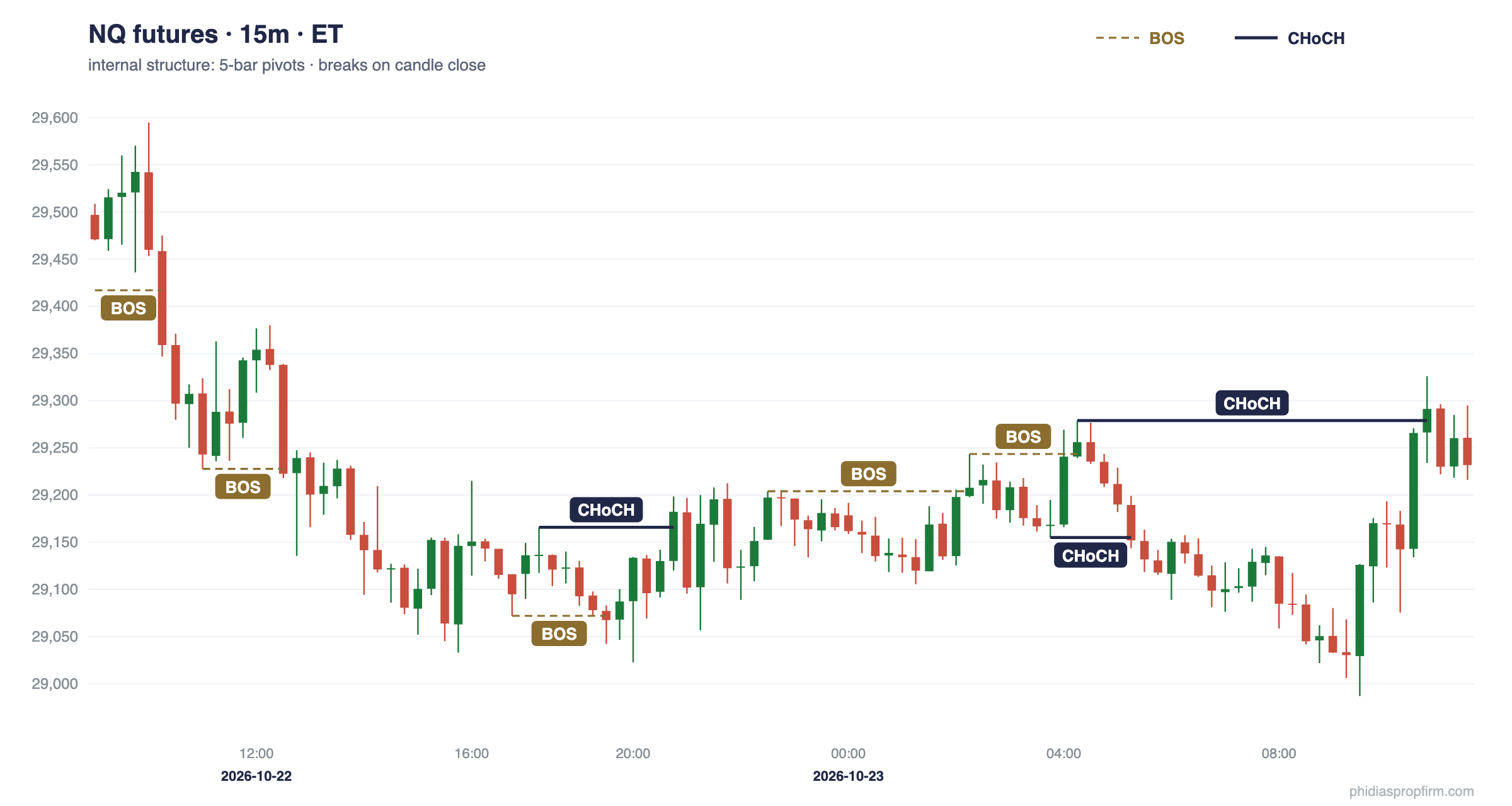
- On real NQ data (October 22 to 23, 2026), internal structure printed three CHoCHs in 14 hours: a CHoCH marks a turn in the swing you read, not a guaranteed new trend.
- On a prop account: Express to Live has a static drawdown, no daily loss limit and no consistency rule: the floor under your structure stop is a fixed price.
BOS vs CHoCH: what is the difference?
Both are the same event: a candle closing beyond a previous swing point. The difference is the trend it breaks. LuxAlgo, whose free Smart Money Concepts script draws both labels automatically, defines them like this: a BOS is structure breaking with the trend, a CHoCH is structure breaking against the trend.
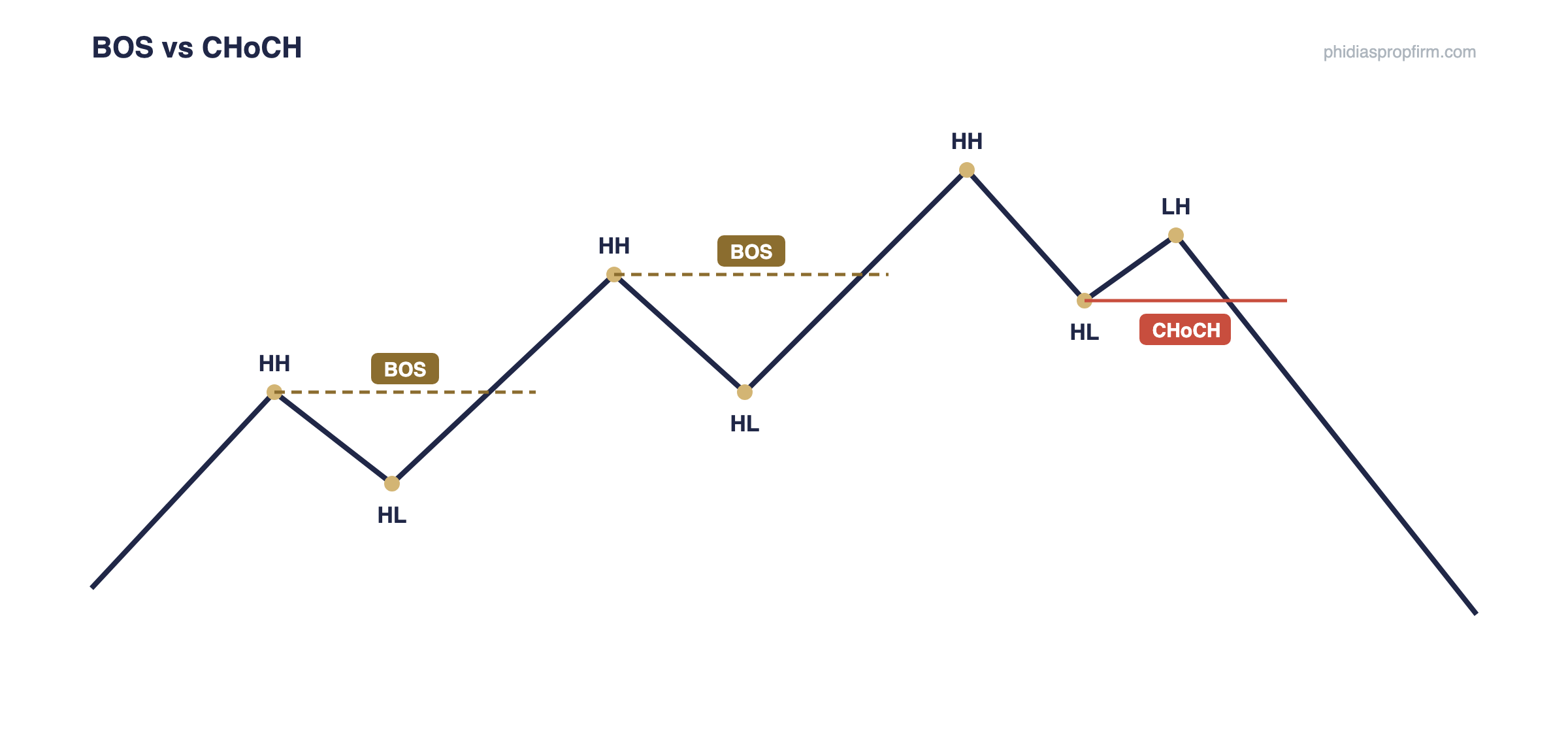
That is why the same price level can be a BOS on one chart and a CHoCH on another: on a 5-minute chart the market may be trending down while the 1-hour chart is still trending up. Always say which timeframe you are reading.
What is a break of structure (BOS)?
A break of structure is a close beyond the last swing point in the direction of the trend. An uptrend prints higher highs (HH) and higher lows (HL). Each time a candle closes above the last higher high, the structure breaks upward and the trend is confirmed. A downtrend is the mirror: lower highs, lower lows, and a BOS on each close below the last lower low.
Traders separate two layers of structure:
- Swing structure: the large highs and lows that define the trend. LuxAlgo’s script uses 50 bars by default to find them.
- Internal structure: the smaller swings inside each move, found with 5-bar pivots in the same script. LuxAlgo draws them with dashed lines and offers an optional filter, off by default, to strip insignificant internal breaks.
A BOS on swing structure says more than a BOS on internal structure. Mixing the two is a frequent reason why two traders label the same chart differently.
What is a change of character (CHoCH)?
A change of character is the first close beyond a swing against the current trend. In an uptrend, it is the first candle that closes below the last higher low. In a downtrend, it is the first close above the last lower high. LuxAlgo calls it the first warning of a potential reversal.
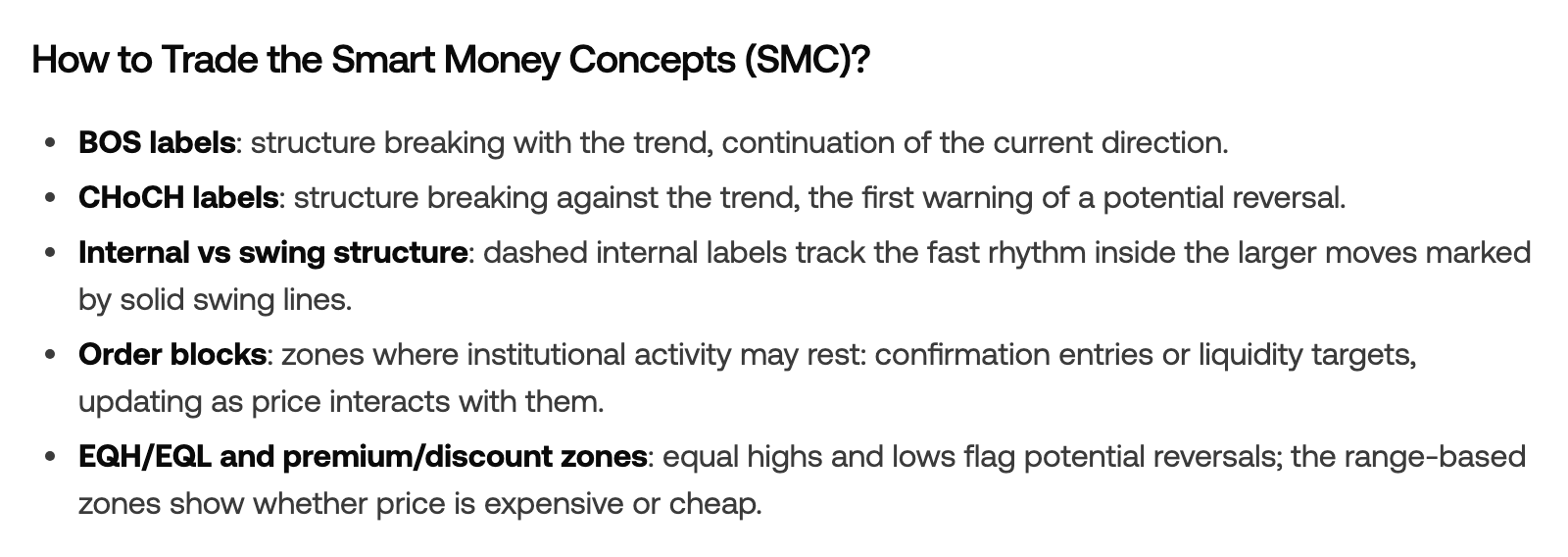
Read the word warning literally. A CHoCH says the last swing that protected the trend has failed, not that a new trend has started. Many traders wait for what comes next: a pullback, then a BOS in the new direction, which turns the warning into a new structure.
CHoCH meaning in one line
CHoCH = the trend’s last protected swing just broke on a close. Everything else (order blocks, fair value gaps, entries) is built on top of that one fact.
CHoCH vs MSS: are they the same?
Yes, in substance. The market structure shift comes from the teaching of Michael J. Huddleston, known as The Inner Circle Trader (ICT). LuxAlgo’s ICT Concepts page describes the MSS as a trend-defying swing break, ICT’s reversal signal, and his term for what others call CHoCH.
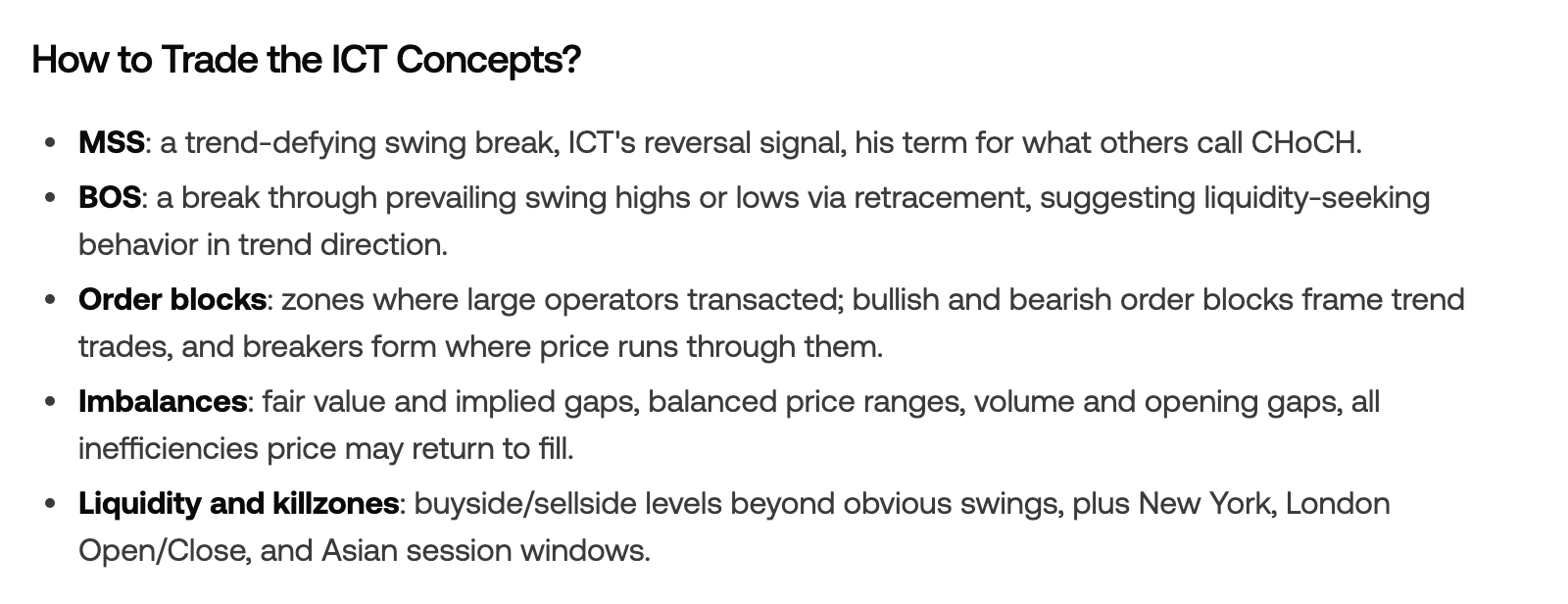
The practical difference is the context around it. ICT traders rarely trade a structure break alone. LuxAlgo describes a typical ICT sequence: sellside liquidity taken, bearish fair value gaps filled, an MSS printed, then a retest of a bullish gap targeting the order block overhead. So in ICT’s model the MSS is one link in a chain, and the entry comes on the retest that follows it.
For the bigger picture of the two schools, see our guide to ICT vs SMC.
Wick or close: what counts as a break?
Use the close. There is no official rule, so conventions vary, but one of the most popular scripts on TradingView (more than 176,000 boosts) is explicit. In the source code of LuxAlgo’s Smart Money Concepts, published on its library page, a bullish break is triggered only when the close crosses above the last swing high, and a bearish break only when the close crosses below the last swing low. On a candle that is still open, the script uses the current price, so a label can appear and disappear before the close: wait for the candle to close.
A wick that pierces a swing and closes back inside is a different event. Traders often read it as liquidity being taken above the high or below the low, the setup our liquidity sweep guide covers. Calling it a BOS is how traders get trapped on the wrong side.
Why structure labels always come late
A swing high only exists once price has moved away from it. In LuxAlgo’s code, a high is confirmed when it is higher than the next 5 bars (internal structure) or the next 50 bars (swing structure by default). On a 15-minute chart, a 5-bar pivot is confirmed 75 minutes after it printed. Every structure label is drawn in hindsight, which is why screenshots of perfect BOS and CHoCH sequences look easier than live trading.
BOS and CHoCH on a real NQ chart
To show how this plays out, we ran the same logic as LuxAlgo’s script (5-bar pivots, breaks on the candle close) on real NQ futures data, 15-minute candles, from October 22, 2026 at 9:00 AM ET to October 23 at 11:30 AM ET.
Two lessons from 26 hours of NQ:
- Each CHoCH marked a real turn in the swing. After the bullish CHoCH at 8:45 PM, NQ rose to 29,279 by 4:15 AM, about 113 points above the broken level. After the bearish CHoCH at 5:15 AM, it fell to 28,987 by 9:30 AM, about 168 points below it.
- None of them started a lasting trend. Internal structure printed three CHoCHs in 14 hours, and the Friday 9:30 AM low sat below Thursday’s low. On 5-bar pivots, a CHoCH tells you the short-term swing turned; whether it becomes a trend depends on the higher timeframe.
This is one window on one market with one setting. It illustrates the definitions; it is not a backtest and says nothing about how often a CHoCH leads to a trend.
How traders use BOS and CHoCH
LuxAlgo summarises the classic approach in one line: set direction from BOS and CHoCH, then seek entries as price returns to an order block, targeting opposing blocks or prior levels. In practice that gives a three-step routine:
- Trend: read swing structure on a higher timeframe. A swing BOS sets the direction you trade.
- Location: wait for a pullback into a zone, often an order block or a fair value gap.
- Trigger and invalidation: on a lower timeframe, an internal CHoCH back in the trend’s direction can time the entry, with the stop beyond the swing that started it.
Honest caveat. LuxAlgo’s own TradingView description of the script says there is no supporting data regarding the validity of these teachings, and that they do not guarantee trading alongside institutional liquidity. Structure is a language for trend and invalidation. Your edge, if any, comes from the rules you test.
Common mistakes
- Labelling every wiggle: internal breaks happen all day. Decide which layer you trade.
- Acting on a wick: a wick through a swing that closes back inside is often a sweep, not a break.
- Trading every CHoCH as a new trend: in the NQ example above, three CHoCHs came in 14 hours.
- Ignoring the timeframe: a CHoCH on 1 minute inside a 1-hour BOS can simply be a pullback.
Trading structure breaks on a prop firm account
Structure trading needs a stop at a fixed place: beyond the swing. The account rules decide whether that stop is enough. On Phidias Express to Live:
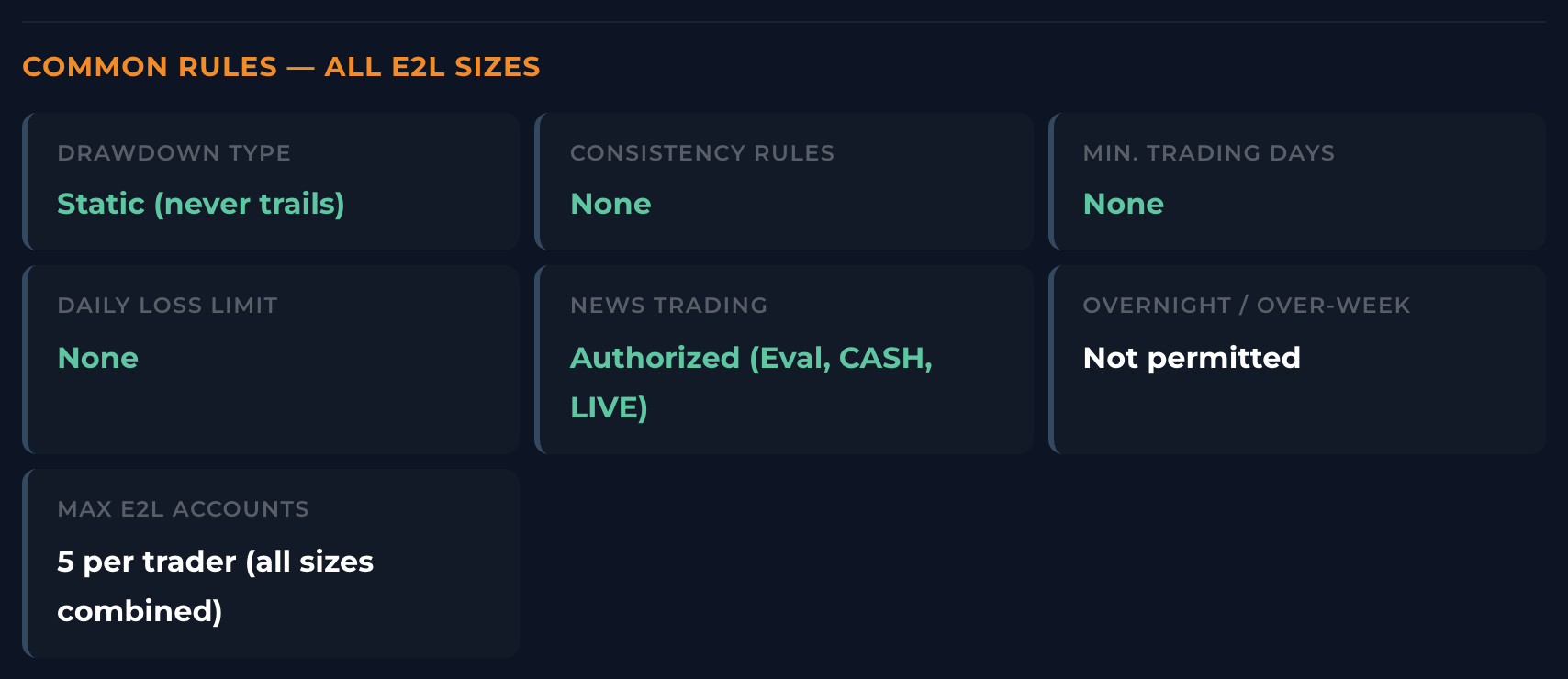
- Static drawdown: it never trails, so a winning BOS trade does not drag your floor up behind you.
- No daily loss limit and no consistency rule: one good structure trade can carry the day without breaking a rule.
- No minimum trading days, and news trading is allowed at every stage.
- Intraday only: positions must be closed before the end of the trading day, which suits internal structure on 1 to 15-minute charts.
Practical tip: a CHoCH entry with a stop beyond the swing has a known distance before you click. With micro contracts you size to that distance instead of the other way around, and because the floor is a fixed price you can count how many stopped-out trades your account can absorb at that size.
Your first payout converts the account to LIVE, and the full cycle can run in a single day: our record from purchase to payout is 6 hours 18 minutes, and 90% of payouts are processed in under 30 minutes. Bought as a one-time payment, the 25K goes from $277 to $69 with code PHIDIAS. Every rule is on our rules page.
Get an Express to Live account
Test: which structure signal fits how you trade?
Three questions. No email.
30 second check
Which structure signal fits how you trade?
BOS vs CHoCH 2026: frequently asked questions
What is the difference between BOS and CHoCH?
A break of structure (BOS) is price closing beyond the last swing high or low in the direction of the current trend, which signals continuation. A change of character (CHoCH) is the first close beyond a swing against the trend, which warns of a possible reversal. Same mechanics, opposite meaning: what decides the label is the trend before the break.
What does CHoCH mean in trading?
CHoCH stands for change of character. In an uptrend it is the first candle close below the last higher low, and in a downtrend the first close above the last lower high. LuxAlgo describes it as structure breaking against the trend, the first warning of a potential reversal. It is a warning, not a confirmed reversal.
Is CHoCH the same as MSS?
Yes, in substance. LuxAlgo’s ICT Concepts page describes the market structure shift (MSS) as a trend-defying swing break, ICT’s reversal signal, and his term for what others call CHoCH. ICT traders usually read the MSS together with other elements, such as a liquidity grab and a fair value gap, rather than on its own.
Is a break of structure the same as a CHoCH?
No. Both are a close beyond a swing point, but a BOS goes with the trend and a CHoCH goes against it. The first break against the trend is labelled CHoCH; once the new direction is established, the following breaks in that direction are labelled BOS.
Does a wick count as a break of structure?
It depends on the convention you use, so pick one and keep it. LuxAlgo’s open-source Smart Money Concepts script labels a break when the close crosses the swing level, so on a candle that is still open the label is only final once it closes. A wick that pierces the level and closes back inside is often read as a liquidity sweep rather than a break.
Which timeframe is best for BOS and CHoCH?
There is no best timeframe, only a consistent one. A common approach is to read the trend from swing structure on a higher timeframe and time entries from internal structure on a lower one. LuxAlgo’s script uses 5-bar pivots for internal structure and 50 bars by default for swing structure.
Is there a BOS and CHoCH indicator on TradingView?
Yes. LuxAlgo’s Smart Money Concepts script is free and open source on TradingView, and it labels internal and swing BOS and CHoCH automatically, along with order blocks, fair value gaps and equal highs and lows. LuxAlgo also lists versions for NinjaTrader and MetaTrader 4/5.
Is trading BOS and CHoCH profitable?
No label is profitable by itself. LuxAlgo’s own TradingView description says there is no supporting data regarding the validity of these teachings. Treat BOS and CHoCH as a way to describe trend and invalidation, then test your rules on a simulated or evaluation account before you size up.
Can you trade BOS and CHoCH on a prop firm account?
Yes, if the rules fit intraday structure trading. On Phidias Express to Live the drawdown is static and never trails, there is no consistency rule, no daily loss limit and no minimum trading days, and positions must be closed before the end of the trading day. Your first payout converts the account to LIVE.
Related guides
Read it yourself
- LuxAlgo: Smart Money Concepts (SMC), definitions and source code
- TradingView: Smart Money Concepts (SMC) [LuxAlgo] open-source script
- LuxAlgo: ICT Concepts (MSS and BOS)
- LuxAlgo: Market Structure CHoCH/BOS (Fractal)
- The Inner Circle Trader (Michael J. Huddleston), official site
- Phidias rules (Express to Live)
The verdict
“BOS and CHoCH are worth learning because they force you to name the trend and the exact price that proves you wrong. Trade the close, not the wick, wait for the BOS after a CHoCH, and practise on an account where the floor does not move when you win.”
William G., CMO at Phidias Propfirm
William G., CMO at Phidias Propfirm, works on futures prop trading rules and payouts every day. Last reviewed 2026.
Definitions as published by LuxAlgo and rules as published by Phidias in October 2026. The NQ example uses Yahoo Finance data and is an illustration, not a backtest. Trading futures involves substantial risk of loss. This article is educational and is not trading advice.