MyFundedFutures plans compared, 2026
On the standard versions the evaluation is identical across all four: 6% to pass, 4% of drawdown on the small sizes, 3% on the large ones.
Then there are two paid add-ons that nobody counts as plans, and each one changes the evaluation itself. Read from their four plan configurations and their individual plan guides on 16 September 2026.
Weighing the alternatives? Phidias Express to Live is the account we build. First, the four plans side by side.
The evaluation is the same on every plan
This is the thing to understand before any comparison table, and MyFundedFutures says it itself: one simple evaluation for all plans.
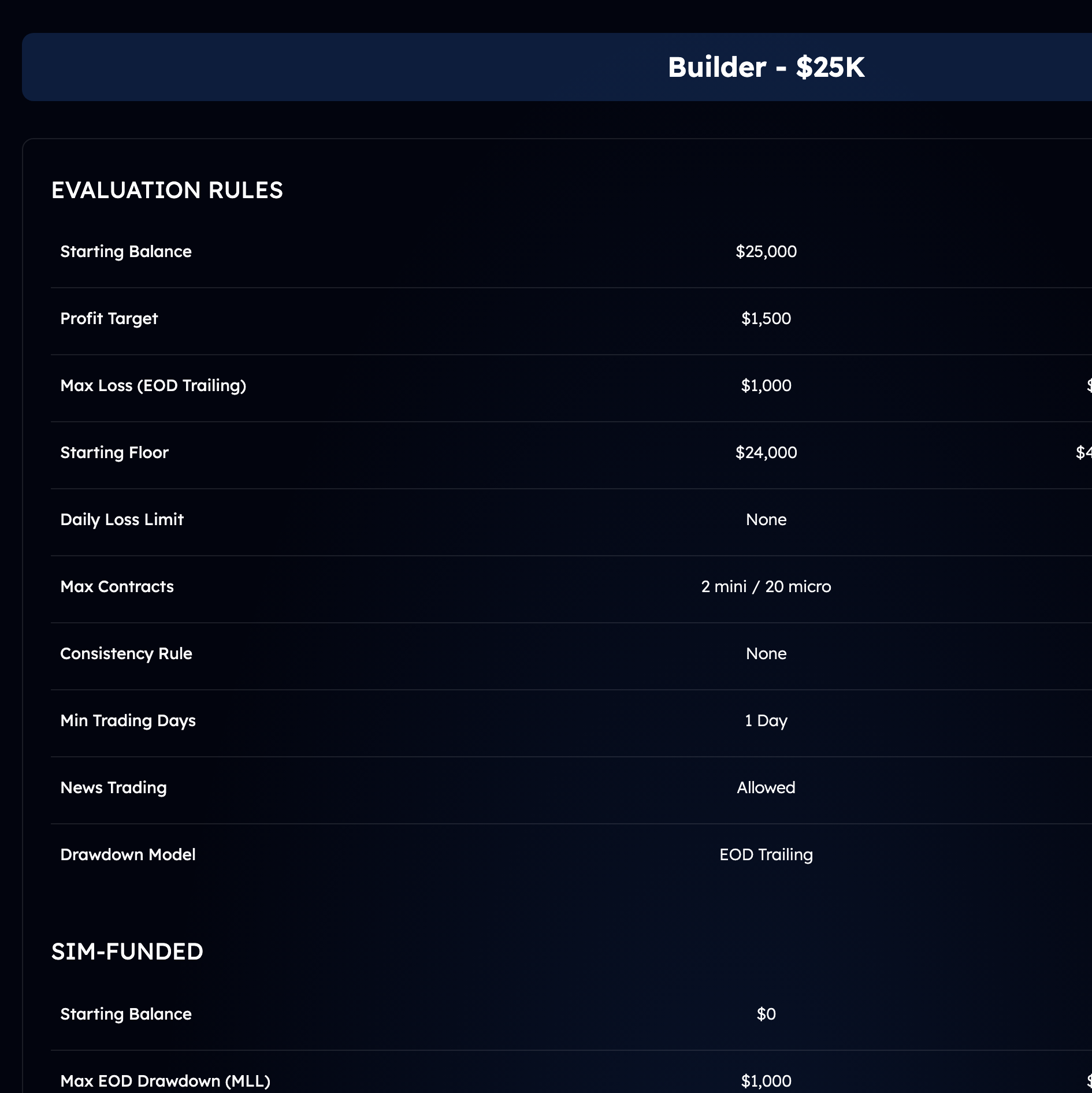
On the standard version of every plan the target is 6% of the account size and the drawdown is 4% on the small accounts and 3% on the large ones. Paying more does not buy an easier evaluation, and paying less does not buy a harder one.
Only two things move at this stage: the minimum trading days and the consistency rule.
Rapid EOD is the hardest, and by some distance: four days minimum and a 30% rule means your best day has to stay under a third of your total. Builder is the fastest, at one day with nothing to clear.
One caveat on that 30%. MyFundedFutures’ own dedicated consistency article says the rule is 50% on the Rapid and Pro plans and never mentions Rapid EOD at all. The 30% appears in the plan configuration and in both Rapid EOD guides. We use 30% because that is what the plan specific documents say, but their general page will tell you something different.
And two things sold as add-ons break the shared evaluation entirely.
The Builder one is worth knowing about because the plan card on their site advertises it rather than the default: Builder 50K is displayed at $125 struck through, not $153. The cheaper Builder is cheaper because it is harder, not because it is on promotion.
The four plans, side by side
Everything below is where the plans actually diverge. Prices are list; the discount is handled further down because it moves.
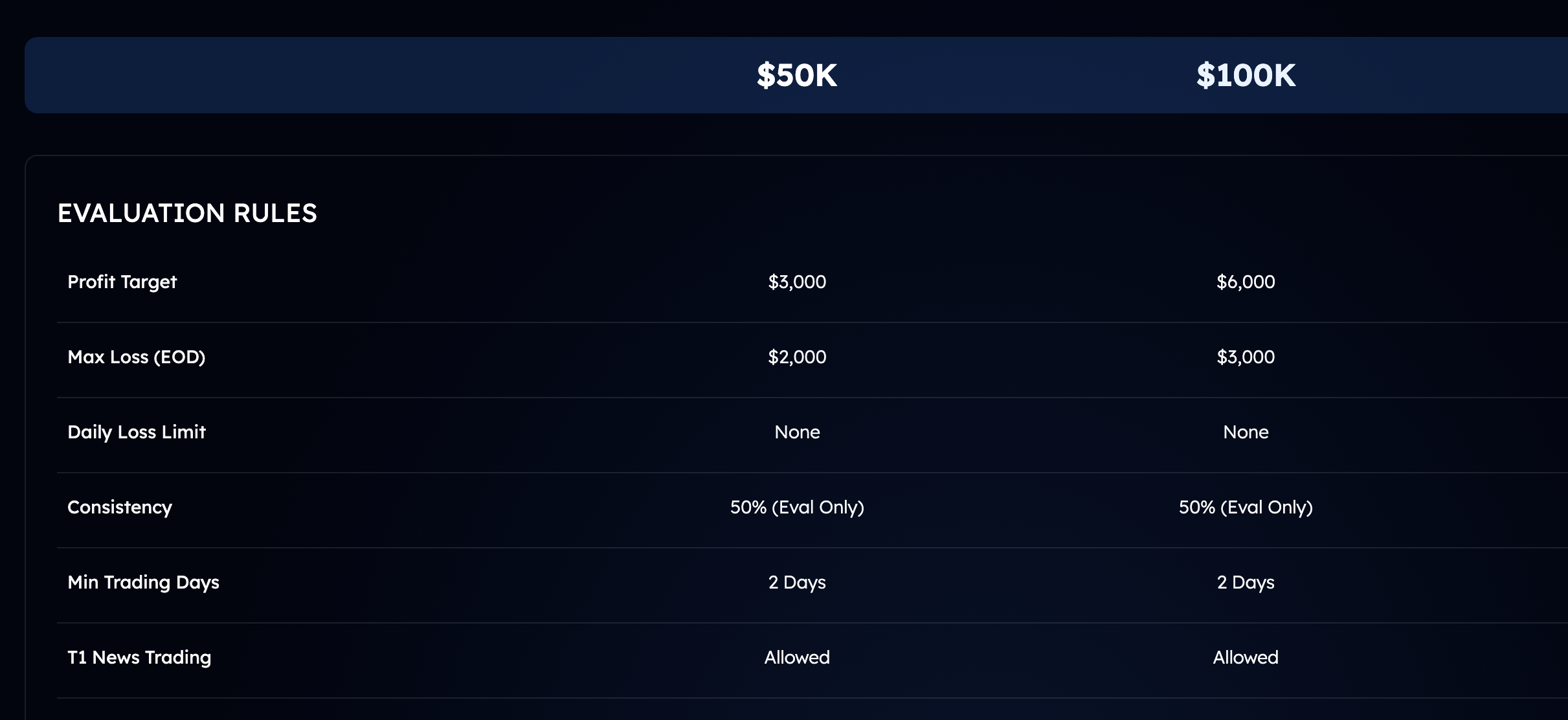
Two columns stand out immediately. Rapid pays 90/10 and gives the most contracts at 25K and 50K. Builder is the cheapest and the only one where you can trade news once funded, and also the only one carrying a consistency rule at that stage.
The contract picture reverses at the larger sizes. Once funded, Pro gives 10 minis on the 100K and 15 on the 150K, against 8 and 10 on Rapid. Pro is the only plan whose allowance rises when you pass, which is why it overtakes.
Two MyFundedFutures pages disagree about the Builder daily loss limit. Its payout policy overview states there are no daily loss limits on Builder, Rapid or Pro plans. The Builder plan guide and the plan configuration both list a $1,000 soft pause at every stage on the 50K. We follow the plan specific documents, as we do elsewhere on this page, and we flag the conflict rather than pick quietly.
Rapid EOD costs the same as Rapid and gives you less of everything but one thing
This is the comparison nobody runs, and it is the clearest result on the page.
Identical price. Forty per cent fewer contracts on the 50K, two minis instead of five, a consistency rule nearly twice as strict, and twice the minimum days. In exchange for exactly one thing: the drawdown stays end of day when you get funded instead of turning into an intraday trail.
That single difference is not small, which is why the plan exists. On standard Rapid, once you are sim funded your maximum loss follows your equity high water mark during the session: give back an open profit and the floor has already moved up behind you. On Rapid EOD it only moves at the close. If that mechanic is what breaks your accounts, Rapid EOD is worth two contracts and two extra days. If it is not, you are paying the same money for a smaller account.
What each plan is actually for
Builder is the entry point and the fastest pass: one trading day, nothing to clear, $153 on the 50K or $125 for the tighter add-on. It is also the strictest plan afterwards. A 50% consistency check at every payout request, a $1,000 soft pause daily loss limit on the 50K, and two limits the comparison tables never show: payouts are capped at $2,000 per cycle on the 50K and $1,000 on the 25K, and you get five simulated payouts in total before the account converts. Note the 25K has no daily loss limit at all, which makes it closer to the old Core plan than its bigger sibling is.
For the Pro plan in full, from the evaluation to the live account, see our MFFU Pro plan guide.
Rapid is the payout plan: 90/10, a request one day after your first trade, nothing to clear once funded, and the largest contract allowance at every size. It is also sold across the full range from 25K to 150K. The price of all that is the intraday drawdown once funded, and a contract allowance that Pro overtakes at the two largest sizes.
Rapid EOD exists for one reason, covered above. It is the right answer for a specific problem and an expensive answer to anything else.
Pro is the large account plan and the only one that scales: 3 minis become 5 on the 50K when you pass, 6 become 10, 9 become 15. It is the slowest to pay by a wide margin, at 14 calendar days and a $1,000 minimum, and it pays 80/20. It is the plan for someone who wants size and is not in a hurry.
Which plan fits you? Four questions on what matters once you are funded, how fast you want to pass, how your winning days are spread and what you would rather not deal with. No email.
30-second check
Which MyFundedFutures plan fits you?
What the four plans cost
Those are list prices, read from the configuration behind MyFundedFutures’ own plan pages. There are no activation fees on any plan, which they state plainly and which matters more than it sounds: a discount here is a discount on the entire path to a funded account, not on one step of it.
On the discount, two numbers rather than one. A bar across every MyFundedFutures page reads “Save 40% On Any Plan With Code CLUB”, followed by “New to MFFU? Get 50% off your first eval.” So the standing code is 40% on 16 September 2026, and a first evaluation is cheaper than the code if you have never bought one. CLUB was itself taking 50% on 10 September, so the rate moves. Check it in ten seconds: open any plan page and compare the struck price with the price shown. That ratio is today’s rate, and every discounted figure on every comparison page, this one included, is a snapshot with a date on it.
The comparison changes again at the live stage
Every figure above describes the simulated stage. The live account is a different product, and the contract allowance is the clearest illustration: on Rapid it falls, from 3 minis to 2 on the 25K, 5 to 3 on the 50K, 8 to 6 on the 100K and 10 to 8 on the 150K.
Pro moves to a range instead of a number, 2 to 4 on the 50K, tracking a live allocation that is itself a range. Rapid EOD does not publish its own figures but its guide says the live transition follows standard Rapid, so 2 and 3 minis. Builder publishes nothing for the live stage.
So a plan comparison built only on the funded stage is telling you about the middle of the journey, not the end of it. That is worth holding on to when any review, including ours, ranks these four.
Where we differ
Four plans on one evaluation is a clean design, and better than most of this sector manages. Nobody at MyFundedFutures is hiding the target or the drawdown, and the fact that they are identical across the range is genuinely trader friendly.
Our disagreement is about what the comparison is for. Choosing between these four means choosing which constraint you would rather carry: an intraday drawdown, a consistency check at every payout, a fortnight between payments, or a smaller position size. It is a menu of trade-offs inside the simulated stage.
At Phidias the question we want a trader asking is a different one: how do I get to a LIVE account, which is where real capital enters the picture and the only stage at which the money stops being simulated. We run three families rather than four plans, Express to Live, Fundamental and Premium, five accounts each and fifteen at once, and the conversion is the product rather than a final step where the contract allowance shrinks.
See Phidias accounts and pricing
MyFundedFutures plans compared: frequently asked questions
How many plans does MyFundedFutures have?
Four: Builder, Rapid, Rapid EOD and Pro. Their homepage states “Four plans” and shows those four. Flex was discontinued on 5 August 2026 and its plan page returns a 404, though its rules are still documented in the help center. Core and Scale were retired around the turn of 2026.
What is the difference between the MyFundedFutures plans?
Not the evaluation, on the standard versions. The profit target is 6% of account size on every plan and the drawdown is 4% on the 25K and 50K and 3% on the 100K and 150K. Two paid add-ons change that: the Pro One Day Add-On raises the target to 8%, and the Builder Add-On tightens the drawdown to 3% on a 50K. What differs is the minimum trading days, the consistency rule, and then everything that happens after you pass: contracts, split, payout frequency and drawdown type.
Which MyFundedFutures plan is cheapest?
Builder, at $105 for the 25K and $153 for the 50K before any code, or $125 for the tighter Builder Add-On at 50K. Rapid and Rapid EOD both list at $145 and $209, and Pro starts at $265 for the 50K. Their site bar offers 40% off any plan with the code CLUB, and separately 50% off a first evaluation for new accounts, both read on 16 September 2026. CLUB was itself at 50% six days earlier, so check the plan page rather than trusting a quoted discount.
What is the difference between Rapid and Rapid EOD?
One thing in Rapid EOD’s favour and four against, at the same price. Both list at $145 and $209. Rapid EOD keeps end of day drawdown once funded, where standard Rapid switches to intraday trailing. In exchange it gives fewer contracts, 2 instead of 3 on the 25K and 3 instead of 5 on the 50K, a stricter 30% consistency rule instead of 50%, and a 4 day minimum instead of 2.
Which MyFundedFutures plan pays the best split?
Rapid and Rapid EOD, both at 90/10, a change dated 12 January 2026. Builder and Pro pay 80/20. That difference is worth more than most of the price gap between the plans: on $10,000 of profit it is $1,000.
Which plan gets you paid fastest?
Rapid and Rapid EOD. Both allow a payout request one day after your first trade, with a $500 minimum. Builder asks for two days and takes $250 on the 25K or $500 on the 50K. Pro is the slowest by a wide margin at every 14 calendar days, with a $1,000 minimum.
Which MyFundedFutures plan has no consistency rule?
Builder has none to pass, and the Pro One Day Add-On has none at all. Otherwise they apply it at opposite ends: Rapid, Rapid EOD and standard Pro check consistency during the evaluation only, at 50%, 30% and 50%, and drop it once funded. Builder is the reverse, with 50% checked at every payout request instead.
Which plan is best for a beginner?
Builder is built for it: one minimum trading day, no consistency rule to pass and the lowest price. The trade is what comes after. Builder is the only plan that checks consistency on every payout, the only one with a daily loss limit on its 50K, and its payouts are capped at $2,000 per cycle on the 50K with five simulated payouts before the account converts.
Does the MyFundedFutures profit target change between plans?
Not on the standard versions: it is 6% of the account size on all four, so $1,500 on a 25K, $3,000 on a 50K, $6,000 on a 100K and $9,000 on a 150K. The exception is the Pro One Day Add-On, which asks $4,000 on a 50K, or 8%, in exchange for passing in a single day with no consistency rule. MyFundedFutures describes the base as one simple evaluation for all plans.
How does Phidias compare to MyFundedFutures?
Phidias runs three account families rather than four plans: Express to Live, Fundamental and Premium, with up to five accounts each and fifteen at once. The structural difference is the destination. At Phidias the simulated stage leads to a LIVE account, which is where real capital enters the picture, and that conversion is the product rather than a final stage where contracts shrink.
More on MyFundedFutures
· The Rapid plan explained: the intraday switch in detail.
· The scaling plan: why only Pro grows, and why Rapid shrinks at live.
· The consistency rule: four different answers, with a calculator.
· What MyFundedFutures really costs: the fees that start once you succeed.
· MyFundedFutures review 2026: the full breakdown.
Useful resources
· The MyFundedFutures plan pages, where the current prices and parameters live
· Traders Evaluation Simplified, their own statement that the evaluation is shared
About the author
William G. is CMO at Phidias Propfirm. He writes the firm’s competitor analyses from primary sources: help centers, terms of service and published policies, never aggregators. Every figure in the comparison above was read on 16 September 2026 from the configuration behind each of the four MyFundedFutures plan pages, one plan at a time, then cross checked against the individual plan guides, which is where the two paid add-ons are documented and the plan configurations are silent on them. The CLUB discount rate at this firm moved ten points in five days, so the dates on this page are part of the information rather than decoration.