Apex Payout Rules, 2026
The most a 25K Apex EOD or Intraday account can ever pay you, across all six payouts, before it closes for good and you start over. Every payout is capped, and the sixth one ends the account.
Apex payout rules in one line: 5 qualifying days, a Safety Net, the 50% consistency rule, a $500 minimum, a cap on every payout and 6 payouts per account, all at a 100% split. Below: each rule in full for EOD, Intraday and Legacy accounts, the max payout by size, the static-account question, and Apex’s invitation-only live program.
Want a first payout that converts your account to LIVE instead of a counter that closes it after six? Here is Phidias Express to Live. First, exactly how Apex pays.
What are Apex’s payout rules?
To request a payout on an Apex EOD Performance Account, you must clear five things at once: at least 5 qualifying trading days, a balance above the Safety Net, the 50% consistency rule, a $500 minimum payout, and the per-payout cap for your account. Approved payouts pay at a 100% split, but each account is limited to 6 payouts, after which it closes.

Apex payouts in 30 seconds
The split is generous: approved payouts pay at a 100% split. You keep the full approved amount.
Apex’s current coupon offers, and the fine print that limits them, are documented in our guide to the Apex Trader Funding coupon code.
But the amount is capped: each payout has a hard ceiling that starts small (as low as $1,000 to $2,500 on payout one) and rises slowly.
And the account ends: after 6 payouts the account closes, and you must qualify for a new one to keep going.
Our verdict (William G.)
Apex’s 100% split is the headline, but the payout is boxed in on all sides: five qualifying days, a Safety Net, a 50% consistency rule, a per-payout cap, and a six-payout ceiling that closes the account. On the funded side, Apex’s own disclosure calls the payouts discretionary rewards from a simulated environment. If you want your first payout to convert the account to LIVE, with uncapped daily payouts from there, Phidias Express to Live is built the other way.
30-second quiz
Will Apex's payout rules actually pay you what you want?
Hoop 1: five qualifying trading days
Before you can request a single payout, your account must record at least 5 qualifying trading days. A day only counts if it clears the minimum daily profit for your account size: $100 on a 25K, $250 on a 50K, $300 on a 100K, $350 on a 150K.
The days do not have to be consecutive, and there is no deadline to complete them. A day where you make $40 on a 25K does not count toward the five. This is why the earliest realistic first payout is roughly a week in, and it is where Apex gets the phrase weekly payouts.
Worked example (50K): you need five separate days that each net $250 or more. Four strong days and one $180 day means you are still one qualifying day short, no matter how large your balance is.
Hoop 2: the Safety Net
The Safety Net is your account’s drawdown limit plus $100, and it stays in place for the entire life of the account. It does not disappear after your first payout. Only profit above the Safety Net is eligible to be withdrawn.
In practice, the “Min balance to request” column above already bakes in three things: your starting balance, the Safety Net, and the $500 minimum payout. On a 25K you need to be at $26,600 before the payout button is even available; on a 50K, $52,600. Drop below that line, even after submitting, and the request is simply denied.
Hoop 3: the 50% consistency rule
Apex applies a 50% consistency rule to payouts. No single winning day may account for 50% or more of your total profit since your last approved payout. If one day is too large a share, the payout option will not appear until the rest of your results catch up.
Worked example: since your last payout you are up $1,000, but $600 of it came on one day. That day is 60% of your profit, above the 50% line, so you cannot request. You would need to grow total profit to more than $1,200 (so the big day falls under 50%) before the option appears.
The rule rewards steady, spread-out gains and blocks the trader who makes their month on one home run. It is the same philosophy as the intraday trailing floor: Apex wants slow and even, not big and lumpy.
Hoop 4: the per-payout caps
This is the rule most traders miss. The 100% split sounds unlimited, but each payout is capped, and the cap starts low and climbs only as you take more payouts. You cannot pull a big number early even if your account is far above it.

Read the 25K column: every payout is capped at $1,000. It never rises. On a 50K, your first two payouts are capped at $1,500 each, whatever your balance. The caps are the real throttle on how fast you can take money out of a funded account.
Hoop 5: the six-payout ceiling and the Apex max payout
Each EOD or Intraday Performance Account is limited to 6 payouts total (Legacy accounts follow other rules, covered below). Once the sixth is approved, the account is closed, regardless of how much profit it still holds. To keep trading, you qualify for another evaluation and start a fresh account from scratch.
Add the caps up and you get the Apex max payout: the most a single account can ever pay before it closes, on EOD and on Intraday.
That is the number that surprises people. A 25K account tops out at $6,000 of withdrawals in its entire life. After that you are buying and passing another evaluation to keep going, which is a real, recurring cost stacked on top of the payout caps.
How to actually request an Apex payout
Once you clear all five hoops, the process itself is straightforward:
1. Set up your payout method. In the Apex dashboard, before you request. US traders are paid by ACH direct deposit; international traders are paid through Plane, Apex’s global payment partner.
2. Request from the dashboard. The option appears only when every requirement is met and your balance is above the Min balance to request.
3. Wait out the timeline. Apex reviews within 2 business days. If approved, funds are sent within 3 to 4 business days, then your bank takes 3 to 7. Most traders see the money in 5 to 11 business days total.
So the “weekly payout” you qualify for on day five does not hit your bank that week. Between the five qualifying days and the multi-day processing window, the first real cash typically lands two to three weeks after you start.
What are the Apex Intraday payout rules?
Apex’s Intraday Performance Account uses the same frame as EOD: a 100% split, 5 qualifying days, the same Safety Net and minimum balance, the 50% consistency rule, a $500 minimum and six payouts before the account closes. Two things change: the profit a day needs to qualify, and the cap ladder from the 50K up.

The trade-off in one line: the Intraday account asks for less per qualifying day and pays a little more over six payouts ($14,500 against $13,000 on a 50K, $21,500 against $20,500 on a 150K), but its drawdown trails during the session rather than at the close. The 25K is identical on both: $1,000 per payout, $6,000 in total. How that intraday floor behaves is in our Apex trailing drawdown guide.
What are the Apex Legacy payout rules?
Legacy accounts are the previous generation of Apex evaluations and Performance Accounts. Apex retired them on 1 March 2026, but in November 2026 its Legacy page still sells Legacy evaluations for a limited time, across 6 balance tiers and 3 platforms. They keep their old rules with no retroactive change, and cannot be converted into the new EOD or Intraday accounts. If you hold one, its payout rules differ on almost every line. Our Apex Legacy account rules guide covers the rest: activation, the PA fee and the trading rules.

The Legacy Safety Net has one tolerance worth knowing: once the balance reaches the threshold, a payout may dip into it by up to $500. Apex’s own example is a 50K at $52,600 that takes the $500 minimum and stops at $52,100.
Watch for mixed messages. Apex’s general Payout Method page, read on 4 November 2026, still says you become eligible for your next payout after “a minimum of eight days, including at least five days with profits of $50 or more”. That is the Legacy rule. The EOD and Intraday payout pages set five qualifying days at $100 to $350. If you trade the new accounts, follow their own payout pages.
What happens after six payouts? Apex’s live program
Apex does have a live program, but you cannot buy your way into it. Its Live Prop Trading Program FAQ calls it an invitation-based step out of the simulated environment, and answers the question “Is moving to live trading automatic?” with a plain no.
Apex says it may start watching a trader after, for example, three consecutive withdrawals from one simulated PA, but it presents these as monitoring guidelines, not qualification rules. The decision stays with Apex.
Read the $0 line twice. A selected trader starts live from a zero balance with a $3,000 end-of-day drawdown, and payouts only open on profit above $3,100. The sim balances do not travel with you: Apex tracks them in a Bonus Vault that its own FAQ says is not real money, paid out as a monthly bonus on your live withdrawals.
The difference with Phidias
On Phidias Express to Live, the move to LIVE is not an invitation. It is a rule of the product: the first payout, a fixed bonus of $1,000 to $4,500 by size, converts the account to LIVE and adds a LIVE credit of $500 to $2,000.
There is no five-day count before it either: Express to Live has no minimum trading days and no consistency rule, so the full cycle can run the same day.
“Simulated” and “discretionary”: what Apex’s own disclosure says
There is one more thing worth knowing before you count on a payout. Apex’s funded accounts are not trading real money in the market. Their own risk disclosure states that the programs are simulated and the payouts are discretionary:
“All activity occurs in a simulated environment using virtual funds; no real capital is at risk… Reward payouts are discretionary and subject to eligibility, compliance, and applicable tax laws.”
Apex Trader Funding, official Risk Disclosure.
This is standard for the simulated-funding model and not unique to Apex. But it is the backdrop to every rule above: you are clearing five hoops to receive a capped, discretionary reward drawn from a simulation, not a withdrawal from a live trading account in your name.
How Phidias payouts compare
Phidias takes the opposite approach on almost every hoop above. Be fair to Apex first: its accounts are cheap and its 100% split on the approved amount is genuinely generous. Phidias Express to Live pays 80/20, below that headline split. What you get for the difference is a first payout that converts the account to LIVE, and no payout cap once it is LIVE.
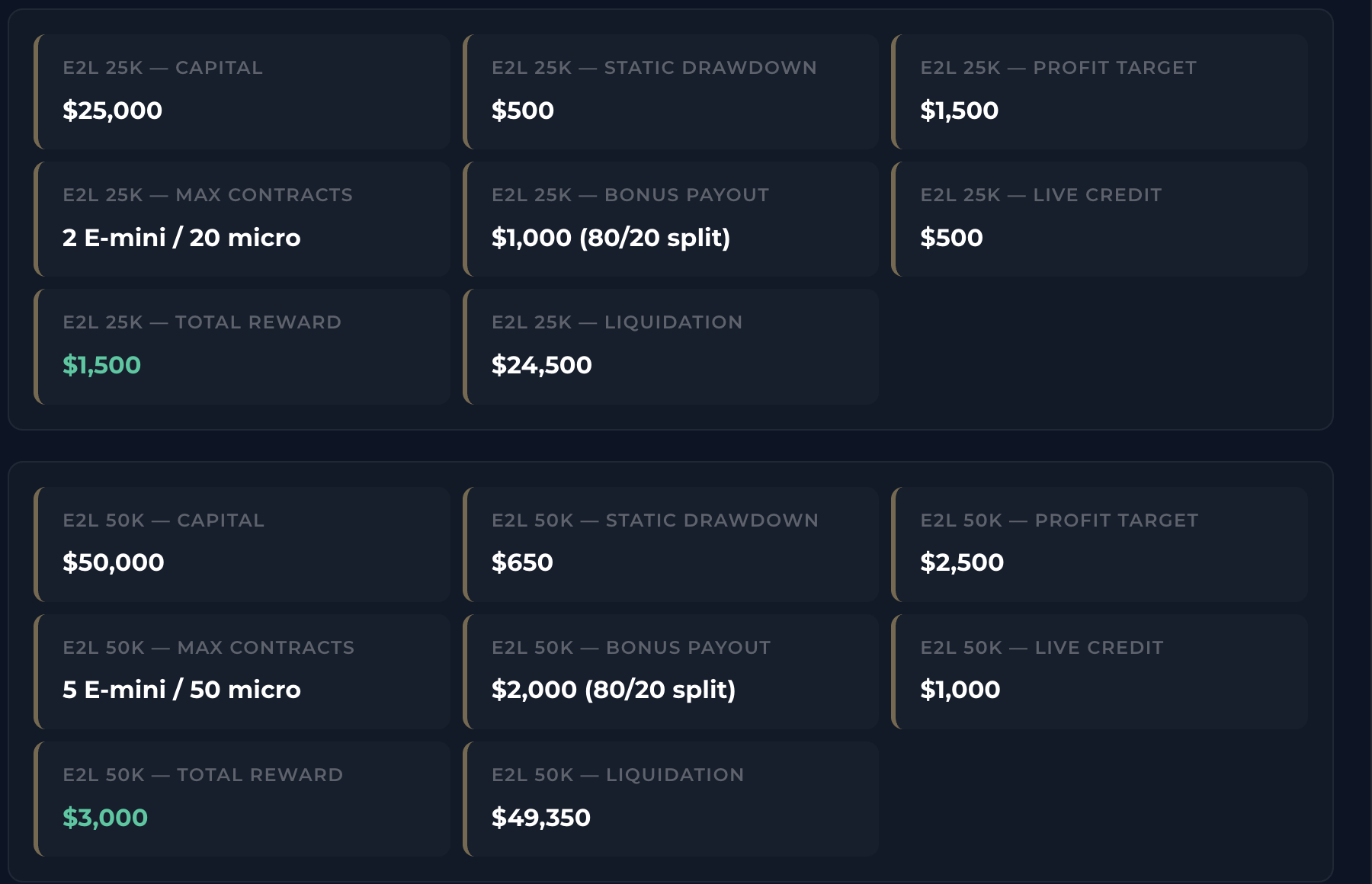
The trade is simple to state. Apex gives you a bigger split on a capped, counted, simulated payout. Phidias gives you a smaller split, a first payout that converts the account to LIVE, and no payout cap once it is LIVE, with 90% of payouts processed in under 30 minutes, always within 24 hours.
Apex payout rules: frequently asked questions
How soon can I get my first Apex payout?
The earliest you can request is after 5 qualifying trading days, each meeting the minimum daily profit for your account size. After you request, most traders receive the money within 5 to 11 business days, so the cash usually lands two to three weeks after you start.
Do the 5 trading days have to be consecutive?
No. The five qualifying days can be spread out however you like, and there is no deadline to complete them. Only days that hit the minimum daily profit count toward the five.
What is the minimum Apex payout?
The minimum is $500 per request, on every account size. Your balance must also be above the “Min balance to request” for your size (for example, $26,600 on a 25K).
How many payouts can I get before my Apex account closes?
Six. Each EOD or Intraday Performance Account is limited to 6 payouts, then it closes and you must qualify for a new evaluation. Every payout is also capped, so a 25K account pays a lifetime maximum of $6,000 across its six payouts.
Why is my Apex payout option not showing?
Usually one of the hoops is not met: fewer than 5 qualifying days, a balance below the minimum balance to request (the Safety Net plus the $500 minimum), or a single day making up 50% or more of your profit since the last payout (the consistency rule). Clear the missing one and the option returns.
Does Apex pay real money?
Apex pays approved payouts by ACH or through Plane, but Apex’s own risk disclosure states the trading happens in a simulated environment with virtual funds and that payouts are discretionary. Apex does run a live program, but only by invitation. By contrast, the first payout on Phidias Express to Live converts the account to LIVE, by rule.
What are the Apex legacy payout rules?
Legacy Performance Accounts pay 100% of the first $25,000 per account and 90% after that. They need 8 trading days with 5 of them at $50 or more, a 30% consistency rule, and a Safety Net on the first three payouts only. The first five payouts are capped between $1,000 and $3,500 depending on size, and from the sixth payout there is no maximum.
Are Apex intraday payout rules different from EOD?
Only in two places. A qualifying day needs less profit on Intraday ($200, $250 and $300 on the 50K, 100K and 150K, against $250, $300 and $350 on EOD), and the cap ladder from the 50K up is slightly higher, for $14,500, $18,500 and $21,500 over six payouts against $13,000, $18,000 and $20,500. The 25K is identical on both, and everything else, from the 100% split to the six-payout limit, is the same.
What is the Apex max payout?
It depends on size and account type. The most a single Apex Performance Account can pay over its six payouts is $6,000 on a 25K, $13,000 on a 50K EOD ($14,500 on Intraday), $18,000 on a 100K EOD ($18,500 Intraday) and $20,500 on a 150K EOD ($21,500 Intraday). Per request, the cap runs from $1,000 to $5,000.
What is the max payout on an Apex 50K account?
On a 50K EOD account the caps are $1,500, $1,500, $2,000, $2,500, $2,500 and $3,000, for $13,000 in total. On a 50K Intraday account they are $1,500, $2,000, $2,500, $2,500, $3,000 and $3,000, for $14,500. After the sixth payout the account closes.
Does Apex have a static account in 2026?
No. In November 2026 Apex sells two drawdown types, EOD Trail and Intraday Trail, and both trail. The limited-time Legacy evaluations all show a trailing threshold too. The only static line we found on Apex’s pages is a legacy “$100k Static” row in its Legacy payout tables (minimum balance $102,600, max payout $1,000), which is not among the Legacy sizes on sale. If you want a drawdown that never trails, Phidias Express to Live uses a static drawdown of $500 to $1,000 by size.
Can I keep trading after requesting an Apex payout?
Yes. Apex lets you keep trading right away, but you should trade as if the requested amount had already left the balance. If the balance drops below the required threshold before approval, the request is denied automatically; the account stays active and you can request again once you qualify.
The bottom line
Apex’s 100% split is real, but it is wrapped in five hoops: five qualifying days, the Safety Net, the 50% consistency rule, a per-payout cap, and a six-payout ceiling that closes the account. On a 25K, that is a lifetime maximum of $6,000, paid as a discretionary reward from a simulated account.
If you would rather have your first payout convert the account to LIVE, with payouts every day and no cap once LIVE, Phidias Express to Live is built that way, with 90% of payouts processed in under 30 minutes, always within 24 hours.
Sources and official references
• Apex: EOD Payouts (official help center): qualifying days, Safety Net, consistency, minimum, and the per-payout cap ladder.
• Apex: Payout Method Information: ACH and Plane methods, and the payout timeline.
• Apex: Intraday Trailing Drawdown Payouts (official help center): minimum daily profit and the Intraday cap ladder.
• Apex: Legacy PA Payout Parameters and Legacy Products Overview: the rules for Legacy accounts.
• Apex: Live Prop Trading Program FAQ: invitation-based selection, $0 starting balance, 90/10 split, daily payouts above the $3,100 Safety Net.
• Phidias accounts: Express to Live payout terms and LIVE account conversion.
About the author
William G. is CMO at Phidias Propfirm. He tests prop firms hands-on, reads the fine print in every help center and rulebook, and translates payout, drawdown and funding mechanics into plain English for traders deciding where to put their capital.
Last reviewed 2026.
Related Apex guides
Apex Trader Funding 4.0 Explained: the full breakdown of every account and rule.
Is Apex Trader Funding Legit?: the payout-denial history and the red flags.
Apex Trailing Drawdown Explained: the intraday floor that decides whether you ever reach a payout.
Apex vs Topstep: payouts and drawdown, head to head.
Risk disclosure: Futures trading involves substantial risk of loss and is not suitable for all investors. Past performance is not indicative of future results. Apex payout rules, caps, consistency and Safety Net thresholds, and processing times reflect publicly available information from Apex Trader Funding as of November 2026 and are subject to change. Verify current terms on apextraderfunding.com before committing capital.