Apex Trailing Drawdown, 2026
How far below your highest point the floor sits on a 50K Apex account, and it tracks profit you have not even banked. Run a trade to +$2,000, give it back, and the account can close on the way down.
Here is exactly how the intraday trailing threshold works, the numbers by account, the EOD option and its daily loss limit, and the firm whose floor never trails at all.
Want a floor that never trails and no daily loss limit? Here is Phidias Express to Live. First, how Apex’s drawdown really works.
What is Apex’s trailing drawdown?
Apex’s signature drawdown is an intraday trailing threshold. It follows your account’s highest intraday balance (the Peak Balance), which includes both realized and unrealized gains, and it updates in real time. As your peak rises, the threshold trails up behind it at a fixed dollar distance, and it never moves back down. If your balance touches or falls below it at any moment, even on an open trade, your positions are liquidated and the account fails or closes.
Apex drawdown in 30 seconds
Intraday accounts: the threshold trails your unrealized peak in real time and never drops. Max drawdown is $1,000 (25K), $2,000 (50K), $3,000 (100K), $4,000 (150K). There is no daily loss limit.
EOD accounts: a gentler threshold set once a day at the close, but it comes with a mandatory Daily Loss Limit that ends your trading day if you hit it.
Either way, Apex does not offer a simple static floor. You choose between a brutal trail and a daily-loss cage.
Our verdict (William G.)
The intraday trailing drawdown is the harshest floor in futures prop trading, because it chases profit you never actually banked. Apex’s EOD accounts soften the trail but hand you a daily loss limit instead, so it is pick-your-poison, not a fix. If you want a floor that never trails and never caps your day, a static drawdown like Phidias Express to Live removes the whole problem.
30-second quiz
Apex trailing drawdown or a static floor: which fits you?
How much is the Apex trailing drawdown by account?
On intraday accounts, the trailing distance is fixed by account size. It is the most you can ever be below your peak balance.

How the intraday threshold trails: a 50K example
Take a 50K intraday account. You start at $50,000, and your threshold sits $2,000 below, at $48,000.
Now you take a trade and it runs +$2,000 in your favor. Your account, including that open profit, peaks at $52,000. The threshold instantly trails up to $50,000. You have not closed the trade, and you have not banked a dollar.
The trade reverses. Because the threshold now sits at $50,000 and it counts your live balance, if that pullback drags you back to $50,000, your positions are liquidated on the spot. You end the day at breakeven or worse, closed out on a floor that moved up on profit you never actually took.
On a funded Performance Account, the trail eventually stops: once the threshold reaches Starting Balance + $100 (on a 50K, that is $50,100, reached when your peak hits $52,100), it locks there for good. That is a real mitigation. On Tradovate evaluations, though, the intraday drawdown trails indefinitely with your peak, with no stop at all.
Why intraday trailing is the worst trap for traders
The problem is the unrealized part. A normal, healthy trade often runs in your favor, pulls back, and you manage it. An intraday trailing threshold treats the high-water mark of that open trade as if you had banked it, then punishes you on the give-back.
In practice it forces a very specific, cramped style: bank tiny and stop, never let a winner breathe, and watch your peak more than your actual balance. It is brutal on scaling and on anyone who lets trades develop. This is how an account can blow while never being down on the day in realized terms: you give back an open profit the floor has already locked in against you.
Apex’s EOD accounts: a gentler trail, but a daily-loss cage
Apex now also offers End-of-Day (EOD) trailing drawdown accounts. Here the threshold is calculated once a day at the close, based on your end-of-day balance. It still only moves up on a new EOD high and never down, and it is still enforced in real time including unrealized losses, but it does not chase your intraday peak. That is genuinely fairer.
The catch is that EOD accounts come with a mandatory Daily Loss Limit (DLL). It caps how much you can lose in a single session, counting unrealized losses in real time. Hit it and your positions are liquidated and trading is paused for the rest of the day (the account survives and resumes next session).
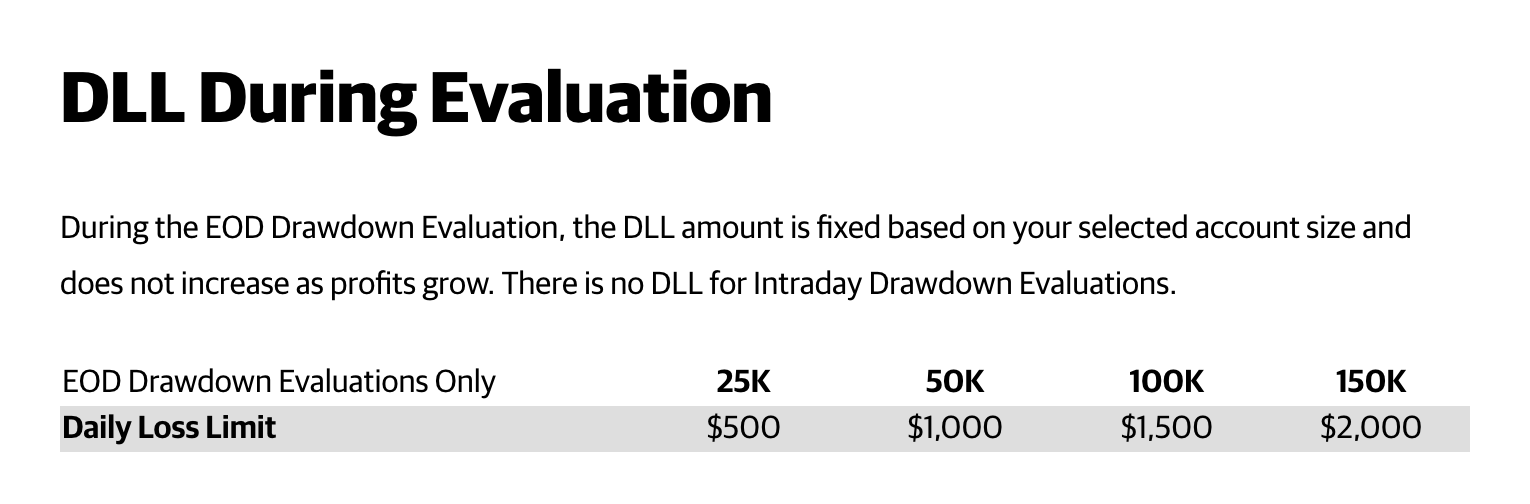
So it really is choose your poison. The intraday account has no daily loss limit but a floor that trails your unrealized peak. The EOD account softens the floor but shackles you to a daily loss cap. Neither is a static floor you can simply trade under.
How to survive Apex’s trailing drawdown
If you do trade an Apex intraday account, a few habits keep the floor off your back:
1. Bank profit, do not let it run. Every dollar of unrealized peak tightens the floor. Take profit into strength rather than riding it back.
2. Watch the peak, not the balance. Your real risk is the distance from your highest point, not from where you sit now.
3. Trade small early. A big swing before your threshold locks (Start + $100 on a PA) is what ends most accounts. Get past the lock, then size up.
4. Know your account type. A Tradovate evaluation trails indefinitely; a Rithmic or Wealthcharts one stops at the profit target. Pick deliberately.
Useful habits, but notice what they are: a set of workarounds for a floor that fights you. The other option is to trade a firm where the floor does not move at all.
The simpler alternative: a static floor
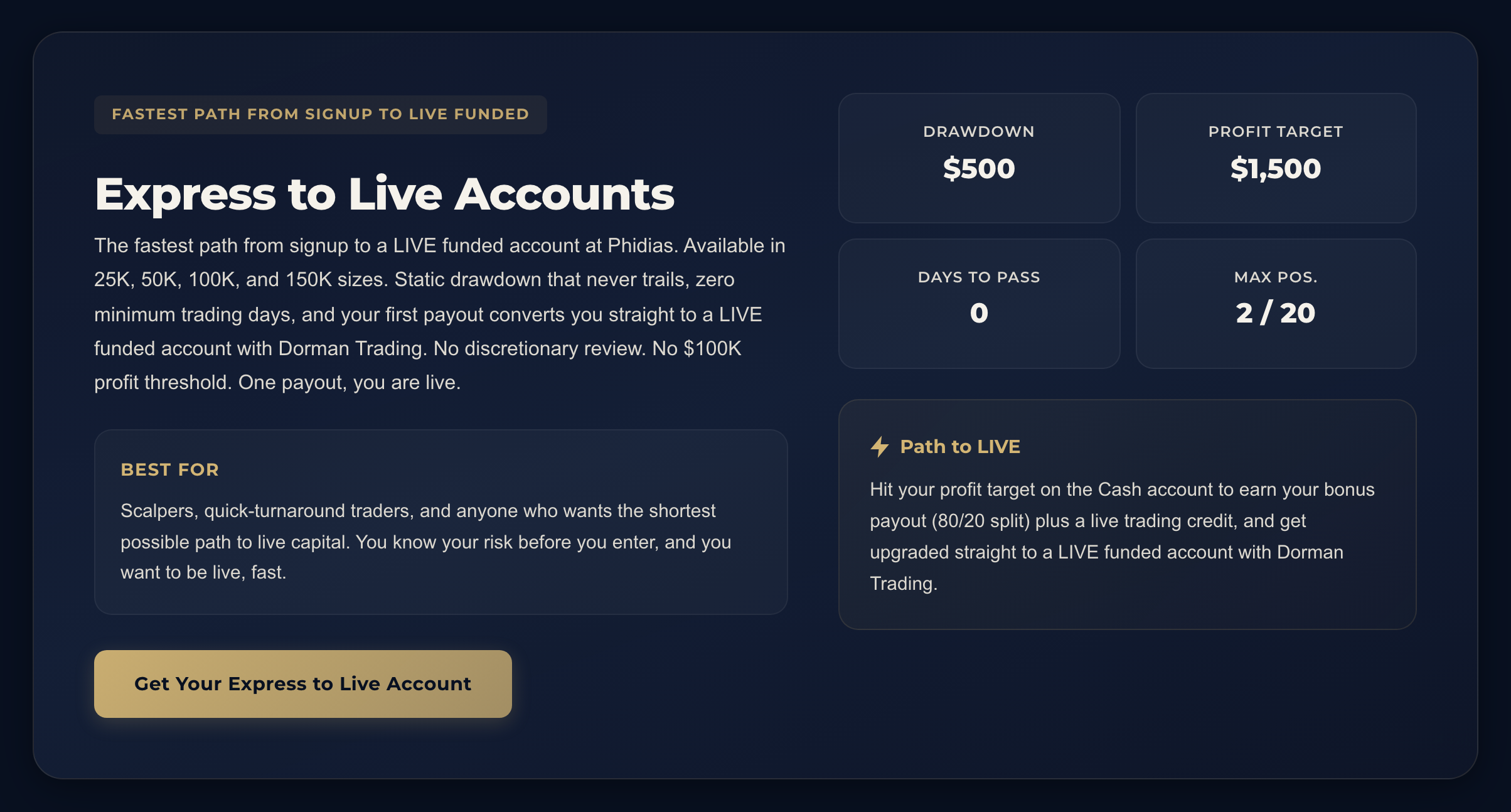
There is a way to remove the whole problem: a static drawdown that never trails and never resets. That is how Phidias Express to Live is built.
Your floor is a fixed dollar amount, from $500 to $1,000 depending on account size, and it does not move. It does not trail your peak, it does not chase unrealized profit, and there is no daily loss limit sitting on top of it. On top of that, your first payout converts the account to a real LIVE account with Dorman Trading, instead of keeping you in a simulation.
Apex intraday
Trails your unrealized peak
Real-time, never moves down
No daily loss limit
Apex EOD
Gentler EOD trail
But a daily loss limit
Still enforced on unrealized
Phidias
Static floor, never trails
No daily loss limit
Real capital on payout one
Be fair to Apex: the trailing drawdown does lock in progress as you grow, and its accounts are cheap. Express to Live pays 80/20, below some funded splits. What you get for that is a floor that never trails, never caps your day, and sits in front of real capital from payout one.
Apex trailing drawdown: frequently asked questions
Does unrealized profit move the Apex trailing threshold?
Yes. On intraday accounts, the threshold follows your Peak Balance, which includes unrealized gains. An open trade that spikes in your favor pushes the floor up in real time, even if you never close for that profit.
Does the Apex trailing drawdown reset each day?
No. The intraday trailing threshold does not reset daily; it only moves up on a new peak and never moves down. The Daily Loss Limit on EOD accounts is the thing that resets each session (at 6 PM ET).
When does the Apex trailing drawdown stop trailing?
On a Performance Account, once the threshold reaches Starting Balance + $100, it locks there. On Rithmic and Wealthcharts evaluations it stops at the profit target. On Tradovate evaluations it trails indefinitely.
Does Apex have a daily loss limit?
Only on EOD accounts. Intraday accounts have no daily loss limit. On EOD evaluations the limit is $500 (25K), $1,000 (50K), $1,500 (100K), $2,000 (150K), and it scales by tier on funded accounts.
Which prop firm has a static drawdown that does not trail?
Phidias Express to Live uses a static floor of $500 to $1,000 by size that never trails and has no daily loss limit, and it converts to a real LIVE account on your first payout. For traders burned by trailing floors, it removes the mechanic entirely.
The bottom line
Apex’s intraday trailing drawdown is the mechanic that ends the most accounts, because it chases profit you never banked and liquidates you on the give-back. The EOD option is fairer on the trail but adds a daily loss limit, so both paths leave you managing a moving or capped floor.
If you would rather trade a floor that never trails and never caps your day, on real capital from payout one, Phidias Express to Live is built that way.
Sources and official references
• Apex: Intraday Trailing Drawdown Explained (official help center): the peak-balance mechanic, amounts, and stop rules.
• Apex: Daily Loss Limit Explained: the DLL amounts and how it applies to EOD accounts.
• Apex: EOD Drawdown Explained: the end-of-day trailing threshold.
• Dorman Trading: the NFA-registered broker behind Phidias LIVE accounts.
• Phidias accounts: Express to Live static drawdown and payout terms.
About the author
William G. is a futures prop-trading analyst at Phidias. He tests prop firms hands-on, reads the fine print in every help center and rulebook, and translates payout, drawdown and funding mechanics into plain English for traders deciding where to put their capital.
Last reviewed 2026.
Related Apex guides
Apex Trader Funding 4.0 Explained: the full breakdown of every account and rule.
Apex vs Topstep: intraday trailing versus end-of-day drawdown, head to head.
Apex Payout Rules: the caps, the 50% consistency rule, and the 6-payout ceiling.
Apex Consistency Rule: the 50% rule that gates your payouts.
How to Pass Apex: the targets and the drawdown you must survive.
Apex vs Tradeify: how the drawdowns and payouts compare.
Risk disclosure: Futures trading involves substantial risk of loss and is not suitable for all investors. Past performance is not indicative of future results. Apex account rules, drawdown amounts, daily loss limits, and stop-trailing thresholds reflect publicly available information from Apex Trader Funding as of July 2026 and are subject to change. Verify current terms on apextraderfunding.com before committing capital.