Topstep Consistency Rule, 2026
The best-day consistency target in the Topstep Combine: no single day should be more than half your total profit. There is a second consistency number too, and it decides your payouts.
Here is exactly how Topstep’s consistency rule works at each stage, why it exists, and the firm that puts no consistency rule on its funded or live accounts.
Prefer no consistency rule on your funded account? Here is Phidias Express to Live. First, how Topstep’s rule works.
Our verdict (William G.)
Topstep’s consistency rule is fair in spirit: a 50% best-day target in the Combine and a 40% payout path both reward spreading profit across days rather than one lucky session. If you trade a steady edge it barely touches you. If you are streaky, or you would rather not be governed by a consistency gate once funded, Phidias Express to Live removes it from the eval and the LIVE account entirely.
What is Topstep’s consistency rule?
Topstep’s consistency rule limits how much of your profit can come from a single day. In the Trading Combine, the target is 50%: your best day should be no more than half of your total profit. At the payout stage, choosing the Consistency path tightens that to 40% in exchange for higher payout caps. The goal is to prove steady trading, not one lucky session.
30-second quiz
Does Topstep's consistency rule fit your trading?
The 50% target in the Combine
To pass the Combine cleanly, your best single day should stay under 50% of your total profit. If you hit your target on one huge day and small change the rest, the account looks like a gamble, not a system, and the consistency target flags it.
Practically, it means you cannot rely on one outsized session. You spread the profit across at least two trading days so no day dominates. It rewards a repeatable edge, which is fair in spirit.
The 40% payout path on the Express account
Once you are on an Express Funded Account, Topstep gives you two payout paths, and consistency is the lever between them.
Standard path: 5 winning days of $150 or more, no consistency target, with the lower per-cycle payout caps.
Consistency path: only 3 trading days, but you accept a 40% consistency target in exchange for higher caps.
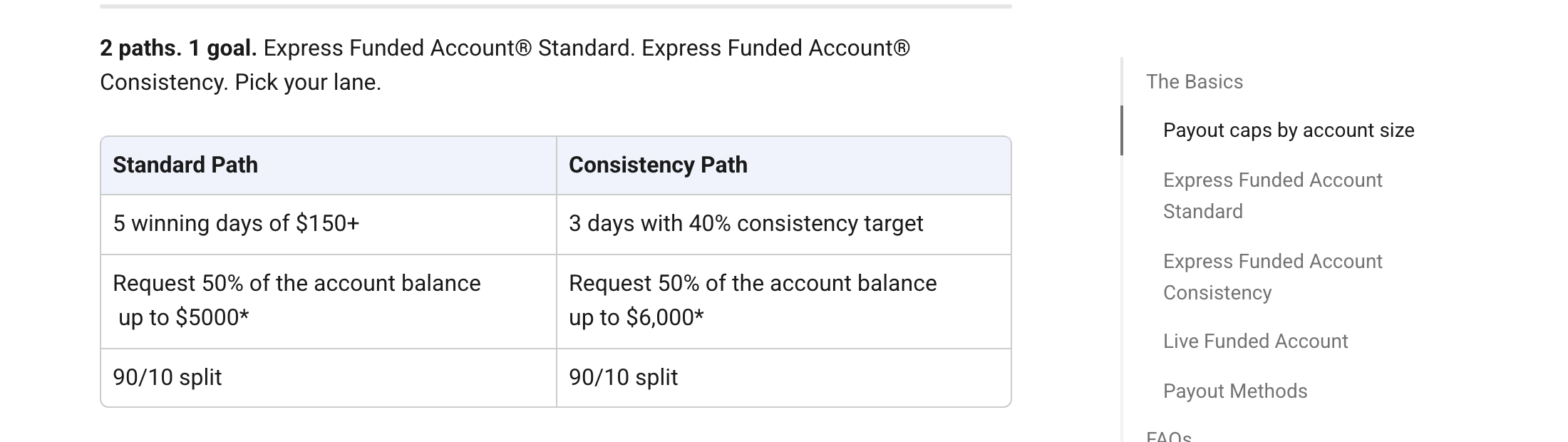
So the rule is not just a hoop to pass the eval. At the payout stage it directly shapes how much and how fast you can withdraw. The full mechanics are in the Topstep payout rules.
Why the consistency rule exists
Prop firms use consistency rules to filter out one-hit gamblers. A trader who makes their whole target on a single all-in trade is a risk, not an edge. Requiring the profit to be spread out is a reasonable way to reward a repeatable process.
The downside for you is flexibility. Some genuinely good traders are streaky, or catch one big move a week, and a consistency target penalizes that style even when the overall equity curve is healthy.
The alternative: no consistency rule on funded or live
Phidias Express to Live takes a different stance. There is no consistency rule on the evaluation and no consistency rule on the LIVE account. On Express to Live you are simply never governed by a consistency target.
That means on a Phidias LIVE account you can have a streaky week, catch one big move, and still withdraw freely. Your first payout also converts the account to a real LIVE account with Dorman Trading, with daily payouts and no per-cycle cap.
A real receipt, not a promise
One Phidias trader, Varun M., ran five 150K Express to Live accounts and took $22,500 in payouts to his Phidias Wallet plus $10,000 in live funded capital with Dorman Trading, his fastest account going from purchase to payout in 6 hours and 18 minutes. A specific, verified result, not a typical or guaranteed outcome.
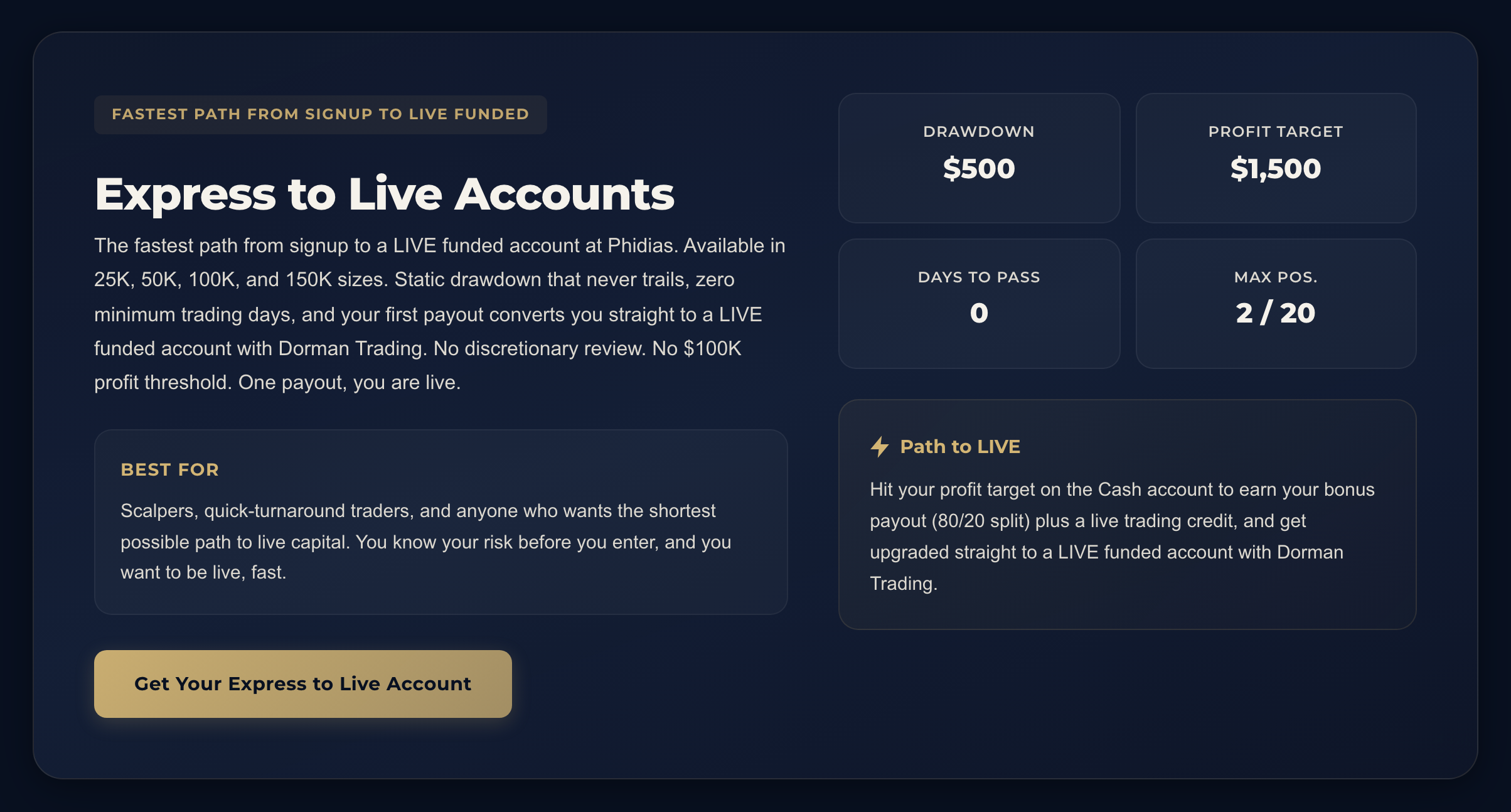
Be fair to Topstep: a consistency rule is a defensible way to reward steady trading, and Topstep’s 90/10 split is competitive. Phidias trades an 80/20 split for freedom: no consistency gate on the eval or the LIVE account, and real capital on payout one.
Topstep consistency rule: frequently asked questions
Does Topstep have a consistency rule?
Yes. The Trading Combine uses a 50% best-day consistency target, and the Express Funded Account offers a Consistency payout path with a 40% target in exchange for higher payout caps. The Standard payout path has no consistency target.
What is the Topstep 50% rule?
The 50% rule is the Combine’s consistency target: your best single day should be no more than 50% of your total profit, so no one day dominates. It is designed to reward steady trading over a single lucky session.
Does the consistency rule affect payouts?
Yes, at the Express stage. Choosing the Consistency path (40% target) unlocks higher per-cycle payout caps than the Standard path, so consistency directly shapes how much you can withdraw at once.
Which prop firm has no consistency rule?
Phidias Express to Live has no consistency rule on the evaluation or the LIVE account. It converts to a real LIVE account on your first payout with daily, uncapped withdrawals.
Sources and official references
• Topstep Payout Policy (official help center): the Standard and Consistency payout paths, including the 40% consistency target.
• Topstep Trading Combine Parameters: the Combine targets and the consistency rule.
• Topstep Trading Combine pricing: the 50% consistency target shown per account.
• Dorman Trading: the NFA-registered broker behind Phidias LIVE accounts.
• Phidias accounts: Express to Live and its consistency terms.
The bottom line
Topstep’s consistency rule is fair in spirit: a 50% target in the Combine and a 40% payout path that both reward spreading your profit across days rather than betting it all on one. If you trade a steady, repeatable edge, it barely touches you.
If you are streaky, or you would simply rather not be governed by a consistency gate once funded, Phidias Express to Live removes it from the eval and the LIVE account entirely, and puts you on real capital from payout one.
Related Topstep guides
Topstep Review: the full firm breakdown, every stage and rule.
How to Pass the Topstep Combine: the winning-day math and the 50% target.
Topstep Payout Rules: how the Standard and Consistency paths pay.
About the author
William G. is a futures prop-trading analyst at Phidias. He tests prop firms hands-on, reads the fine print in every help center and rulebook, and translates payout, drawdown and funding mechanics into plain English for traders deciding where to put their capital.
Last reviewed 2026.
Risk disclosure: Futures trading involves substantial risk of loss and is not suitable for all investors. Past performance is not indicative of future results. Individual results such as the trader payout cited are specific, verified outcomes and are not typical or guaranteed. Topstep consistency targets and payout paths reflect publicly available information as of July 2026 and are subject to change. Verify current terms on topstep.com before committing capital.