MyFundedFutures consistency rule, 2026
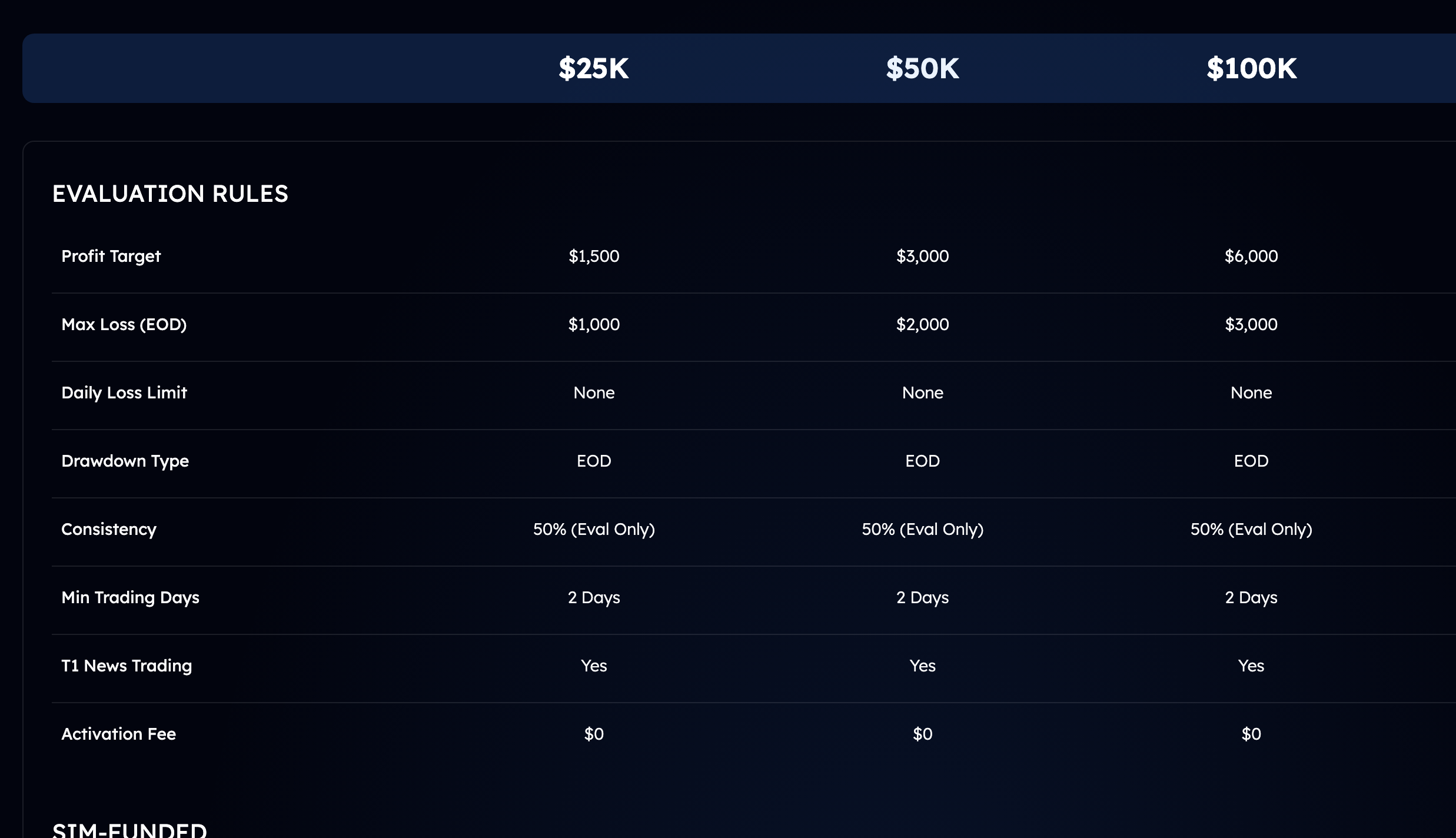
Rapid asks 50%. Rapid EOD asks 30%. Builder asks nothing to pass, then 50% at every single payout.
MyFundedFutures’ own help center sends you to a third-party calculator that knows none of this. Ours is below, and it asks which plan you are on first.
Weighing the alternatives? Phidias Express to Live is the account we build. First, how the rule actually works.
What the consistency rule is
One sentence: your single largest profit day cannot represent more than a set share of your total profit. If it does, you are not allowed to move forward yet.
The point of it is to filter out a trader who hits one lucky session and calls it an edge. Whether you find that reasonable or irritating depends mostly on how your own winning days are distributed, which is a thing very few traders have actually measured.
The important detail first, because almost every review gets it wrong: exceeding the rule does not breach your account. MyFundedFutures states this plainly. Nothing is lost. You simply keep trading until your other days have grown enough to bring the ratio back into range.
The rate depends on your plan and your stage
This is where the summaries fall apart. There is no single MyFundedFutures consistency rule. There are four different answers across five plans, and the stage matters as much as the plan.

Two things stand out.
Rapid EOD has the strictest evaluation of the five. At 30%, your best day must be under a third of your total, which in practice means at least three well-matched sessions and usually four. That is the price of its calmer end-of-day drawdown.
Builder is the only plan where the rule outlives the evaluation. On the other four, passing the evaluation ends the constraint permanently. On Builder it works the other way round: nothing to pass, then 50% checked at every payout request, with the calculation resetting after each approved one. You clear it five separate times, once per payout, for as long as you hold the account.
Work out your own number
MyFundedFutures links to an external calculator hosted on a third-party site. It does one rate. Since their own rules use two, and apply them at different stages depending on the plan, that tool will give you the wrong answer on three plans out of five.
This one asks which plan and which stage before it calculates anything.
Interactive
MyFundedFutures consistency calculator
The rate depends on your plan and your stage. Pick both, and the calculator applies the right one.
Minimum total profit needed
—
Enter your highest day to see the target.
Exceeding the rule does not breach the account. You simply trade more days until the ratio comes back into range.
The arithmetic behind it
The formula is simple once you see it. Divide your best day by the rule.
At 50%, a $1,500 day needs $3,000 of total profit, because $1,500 is exactly half of $3,000. At 30%, the same $1,500 day needs $5,000, because $1,500 is 30% of $5,000.
What the right-hand column shows is the real cost of the rule: it is not money, it is sessions. A 50% rule means roughly two balanced days. A 30% rule means three or four. If you are in a hurry, the rule is a delay, not a tax.
How to stay inside it without thinking about it
Three habits do most of the work.
Know your own distribution before you buy. Take your last twenty winning sessions, divide the largest by the total. Under 0.3 and every MyFundedFutures rule is irrelevant to you. Under 0.5 and four of the five are. Above that, the plan you pick matters a great deal.
Check before you request, not after. On Builder especially, the calculation runs at the moment of the request. Running the numbers first costs nothing; having a request held up costs you a cycle.
Do not chase a big day with a bigger one. The ratio improves by adding ordinary days, not by adding another outlier. A second large session raises the total but often raises your largest day too, which moves you no closer.
The detail that catches Builder traders. The calculation resets after each approved payout. So a huge day early in a new cycle restarts the problem from scratch, even though you cleared the rule comfortably last time. Each of your five payouts is judged on its own cycle alone.
Will the rule get in your way? Four questions on how evenly your winning days are spread, which plan you are on, where you are in the process, and what you would do if one day carried half your profit. No email.
40-second check
Will the consistency rule get in your way?
Where we differ
A consistency rule is a defensible thing for a prop firm to have. It filters out the trader who hits one session and calls it a system, and every firm in this sector needs some answer to that problem.
Our disagreement is about when you find out.
At Phidias there is no consistency rule during evaluation and none on LIVE accounts. There is a 30% rule on funded CASH accounts, and none at all on Express to Live. Three sentences, no table, no per-plan variation.
The contrast worth drawing is not 50 against 30. It is that a MyFundedFutures trader has to know their plan, their stage and whether the rule survives the evaluation before they can answer a simple question about their own account. On Builder, they have to answer it again before every payout.
See Phidias accounts and pricing
MyFundedFutures consistency rule: frequently asked questions
What is the MyFundedFutures consistency rule?
Your single largest profit day cannot represent more than a set share of your total profit. The share depends on the plan and the stage: 50% during evaluation on Rapid, Pro and Flex, 30% on Rapid EOD, and none on Builder to pass. Builder instead applies 50% at every payout request once funded.
Does exceeding the consistency rule breach your account?
No, and this is the single most misreported thing about it. MyFundedFutures states that exceeding the target does not breach the account. Nothing is lost. You keep trading until your other days have grown enough to bring the ratio back into range, then proceed.
Which MyFundedFutures plan has the strictest consistency rule?
Rapid EOD, at 30% during evaluation. Your best day must stay under a third of your total, which in practice means at least three well-matched sessions and usually four. It is the price of its calmer end-of-day drawdown, since standard Rapid asks only 50% over two days.
Is there a consistency rule on funded MyFundedFutures accounts?
Only on Builder. Rapid, Rapid EOD, Pro and Flex apply their rule during the evaluation only, so passing ends the constraint permanently. Builder is the reverse: nothing to pass, then 50% checked at every single payout request, with the calculation resetting after each approved payout.
How do you calculate the MyFundedFutures consistency rule?
Divide your best day by the rule. At 50%, a $1,500 day needs $3,000 of total profit. At 30%, the same $1,500 day needs $5,000. The calculator on this page does it for you and applies the correct rate for your plan and stage, which a single-rate calculator cannot.
How many days do you need to pass the consistency rule?
At 50%, roughly two balanced sessions. At 30%, three or four. That is the real cost of the rule: it is measured in trading days rather than money, so it functions as a delay rather than a charge.
Why does my payout keep getting held up on Builder?
Almost certainly the 50% rule at the request stage. Because the calculation resets after each approved payout, a large day early in a new cycle restarts the problem even if you cleared the rule comfortably last time. Each of your five payouts is judged on its own cycle alone.
Does MyFundedFutures have a consistency calculator?
They link to a third-party calculator hosted elsewhere, which applies a single rate. Since their own rules use two rates at different stages depending on the plan, that tool returns the wrong answer on three plans out of five. The calculator on this page asks for your plan and stage first.
Does the consistency rule apply to losses?
No. The rule looks only at your winning days and compares your largest one against the total profit. Losing days affect the total, and therefore the ratio, but they are not measured against the rule themselves.
Does Phidias have a consistency rule?
None during evaluation and none on LIVE accounts. There is a 30% rule on funded CASH accounts, and none at all on Express to Live. We state it rather than bury it, because a consistency rule you discover at the payout stage is worse than one you knew about at checkout.
More on MyFundedFutures
· MyFundedFutures review 2026: the full breakdown, all five plans.
· MyFundedFutures payout rules 2026: every buffer, minimum, ceiling and split.
· MyFundedFutures discount code: the CLUB code and the price grid.
· Tradeify vs MyFundedFutures: what each firm does when you win too much.
Useful resources
About the author
William G. is CMO at Phidias Propfirm. He writes the firm’s competitor analyses from primary sources: help centers, terms of service and published policies, never aggregators. The rates on this page were read from the five individual plan guides and the consistency rule article in MyFundedFutures’ help center on 10 September 2026, which is why they differ from the single figure most reviews quote. The calculator above was built for this page and applies the rate for your plan and stage.