Lucid Trading LucidDirect, 2026
On a LucidDirect 25K you need $1,500 of profit, five days minimum and a 20% consistency score before you can withdraw a maximum of $1,000.
Read from the LucidDirect cards on lucidtrading.com and the six LucidDirect articles in their help center, 28 September 2026.
We are a competing prop firm, so read our comparison at the end with that in mind. Everything before it is Lucid Trading’s own documentation, linked at the bottom.
In short
- LucidDirect is Lucid Trading’s straight to funded plan: no evaluation, a simulated funded account from day one, $230.30 to $585.20 with their VAULT code.
- First payout on a 25K: $1,500 profit goal, at least 5 days, largest day no more than 20% of the cycle, then $1,000 maximum ($900 after the 90/10 split).
- The target did not disappear. Profit Goal 1 equals the LucidPro evaluation target on the 50K, 100K and 150K, and is $250 higher on the 25K.
- No reset is listed for LucidDirect. A breached account is a new purchase.
- Live accounts are discretionary: the fifth payout, a large payout total or exceptional performance only opens a review.
What is LucidDirect?
LucidDirect is the Lucid Trading plan that sells you a simulated funded account straight away, with no evaluation phase. Lucid’s own words: “you start building simulated capital to earn payouts immediately and work towards being moved live.” It sits beside LucidPro, LucidFlex and LucidDaily, which all start with an evaluation.
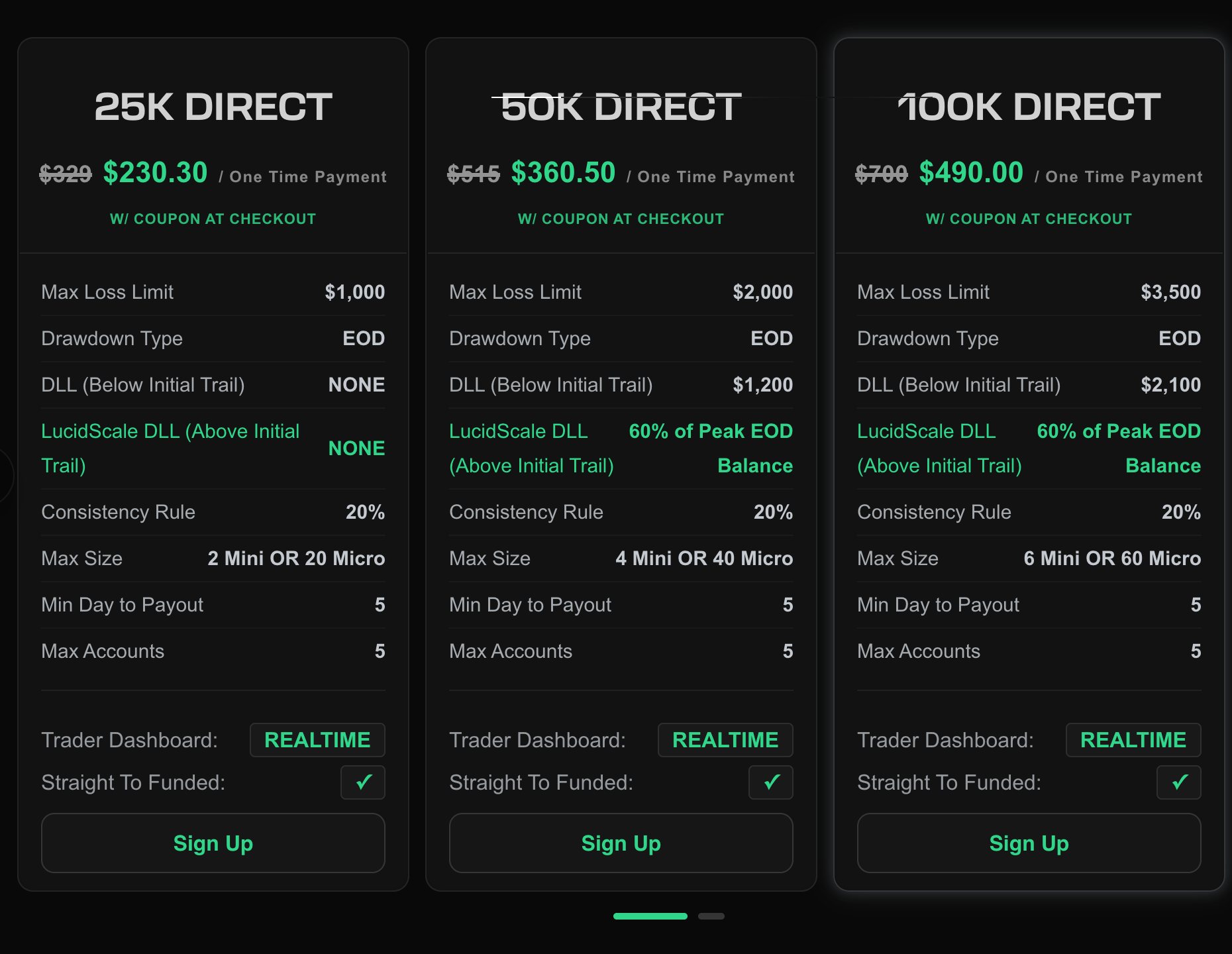
It is also the most expensive way into Lucid, by a wide margin. The four sizes, with their VAULT code applied:
Every size shares the same payout frame: a 20% consistency rule, five minimum days to payout, a one time payment with no subscription, and a limit of five LucidDirect accounts. The full contract size is available from day one, with no scaling plan on the funded account.
If you are comparing all four Lucid plans rather than this one, our complete Lucid Trading guide covers the range.
What do you have to make before your first LucidDirect payout?
On a 25K: $1,500 of profit, spread over at least five days, with no single day above 20% of the total. Meet all three and you can request between $500 and $1,000. Here are the published numbers for every size.
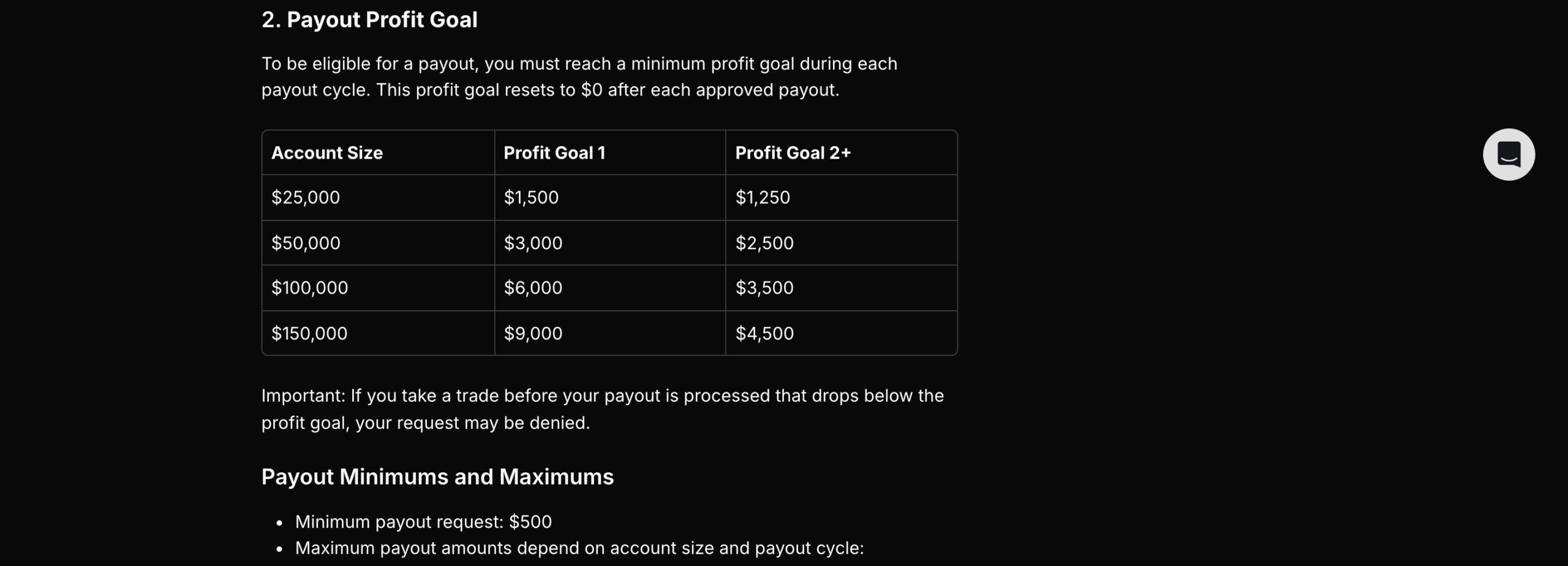
The rest of the rules, in Lucid’s order:
- Split: 90% to you, 10% to Lucid, on every funded payout.
- Minimum request: $500.
- No payout window: request on any day once the conditions are met.
- Timing: deducted from the account within minutes of approval, paid out within two business days.
- Final: a request cannot be edited or cancelled once submitted.
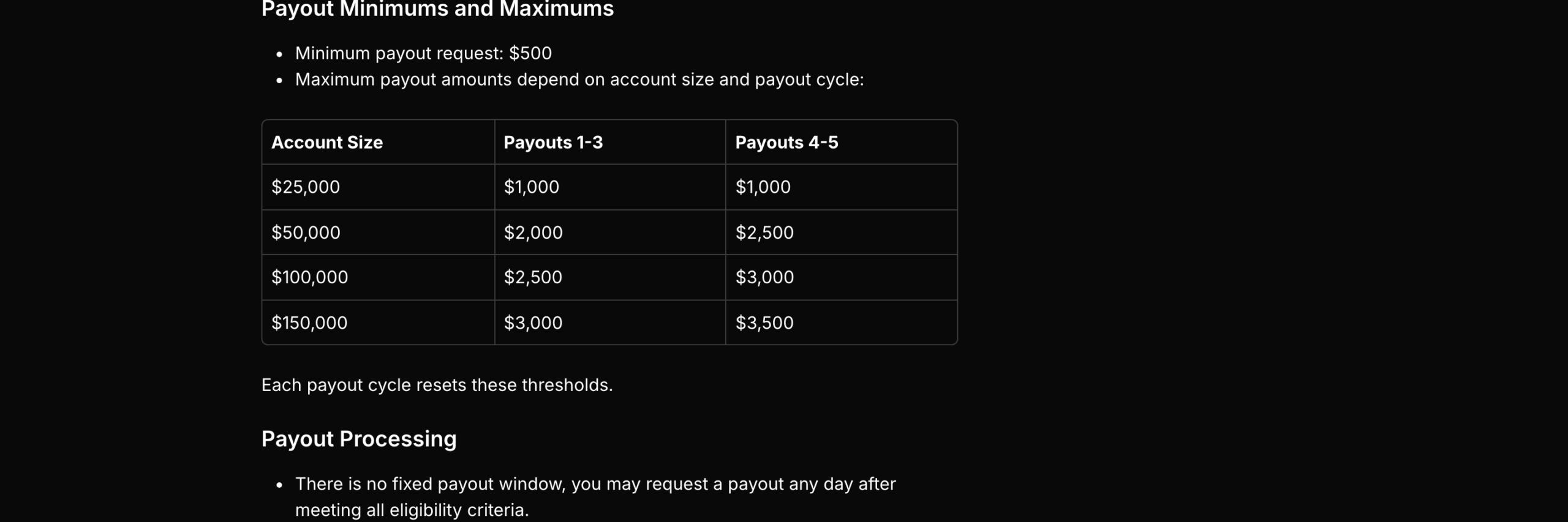
Read the 25K line twice. The first cycle asks for $1,500 of profit and lets you take out $1,000 of it. That is $900 in your pocket after the split, on a $230.30 account. The later cycles ask for $1,250 and still cap you at $1,000. You will always leave money in the account, and on the 25K it is the reason the account survives the payout.
One more line from their payout page deserves attention: “If you take a trade before your payout is processed that drops below the profit goal, your request may be denied.” Stop trading between the request and the approval.
A contradiction in their own help center. The LucidDirect account overview lists “No simulated payout caps” among its benefits. The LucidDirect payout page, the very next article in the same collection, publishes the caps in the table above. We have used the payout page, because it is the one that gives numbers.
Why does the 20% consistency rule mean at least five winning days?
Because if no day may exceed 20% of the total, you need at least five days to reach 100%. Five equal days of $300 make $1,500 on a 25K, with each day at exactly 20%. Any losing day in the cycle lowers the total and pushes the requirement further out.
Lucid’s own example, on a 50K: a largest day of $500 against a cycle profit of $3,000 gives 16.7%, under the limit, so the trader can request a payout.
The rule bites hardest after a good day. Make $600 in one session on a 25K and the cycle must now reach $3,000 before you can request anything, because $600 has to be no more than 20% of the total. You still cannot withdraw more than $1,000. The big day did not bring the payout closer, it pushed it further away.
The practical rule: on a 25K, treat $300 as a daily ceiling for the first cycle. On a 50K it is $600, on a 100K $1,200, on a 150K $1,800. Above that, you are not breaking a rule, but you are adding days to your cycle. The consistency rule resets after each payout, and it no longer applies once you are moved to a live account.
Did you really skip the evaluation?
No: the evaluation target moved into the funded account. LucidDirect’s first profit goal matches the LucidPro evaluation target on three sizes out of four, and is higher on the fourth. What you skip is the separate phase, not the number.
Now the honest part, because the comparison does not end there. After passing a LucidPro evaluation you still have to build a buffer on the funded account before you can withdraw anything: on a 25K, a balance of $26,600 for a $500 payout and $27,100 for the $1,000 maximum. LucidDirect has no such buffer step. Counted to a first $1,000 payout on a 25K:
So LucidDirect does get you to a first payout on less total profit. On the 25K, $1,500 against $3,350. That is a real advantage, and it is what the extra $160 buys.
What it costs you is the second chance. On LucidPro a failed evaluation is a $70 reset. On LucidDirect, Lucid lists no reset at all, because there is no evaluation to reset: a breach means buying a new account. Breach a LucidDirect 25K once and start again: $460.60. Fail a LucidPro 25K evaluation once and reset it: $140.60. The plan rewards traders who rarely breach, and charges full price to everyone else.
For a closer look at the evaluation route, read our LucidPro review and the LucidPro vs LucidFlex comparison.
How do the LucidDirect daily loss limit and LucidScale work?
The 25K has no daily loss limit at all. The three larger sizes start with a fixed limit, then switch to a limit that grows with your profit. Lucid calls the second one LucidScale.
Once the account closes above its initial trail balance, the fixed limit is replaced by 60% of your highest end of day profit. Their example: a peak end of day profit of $4,000 gives a daily limit of $2,400. It only moves up, never down, even if the account gives profit back.
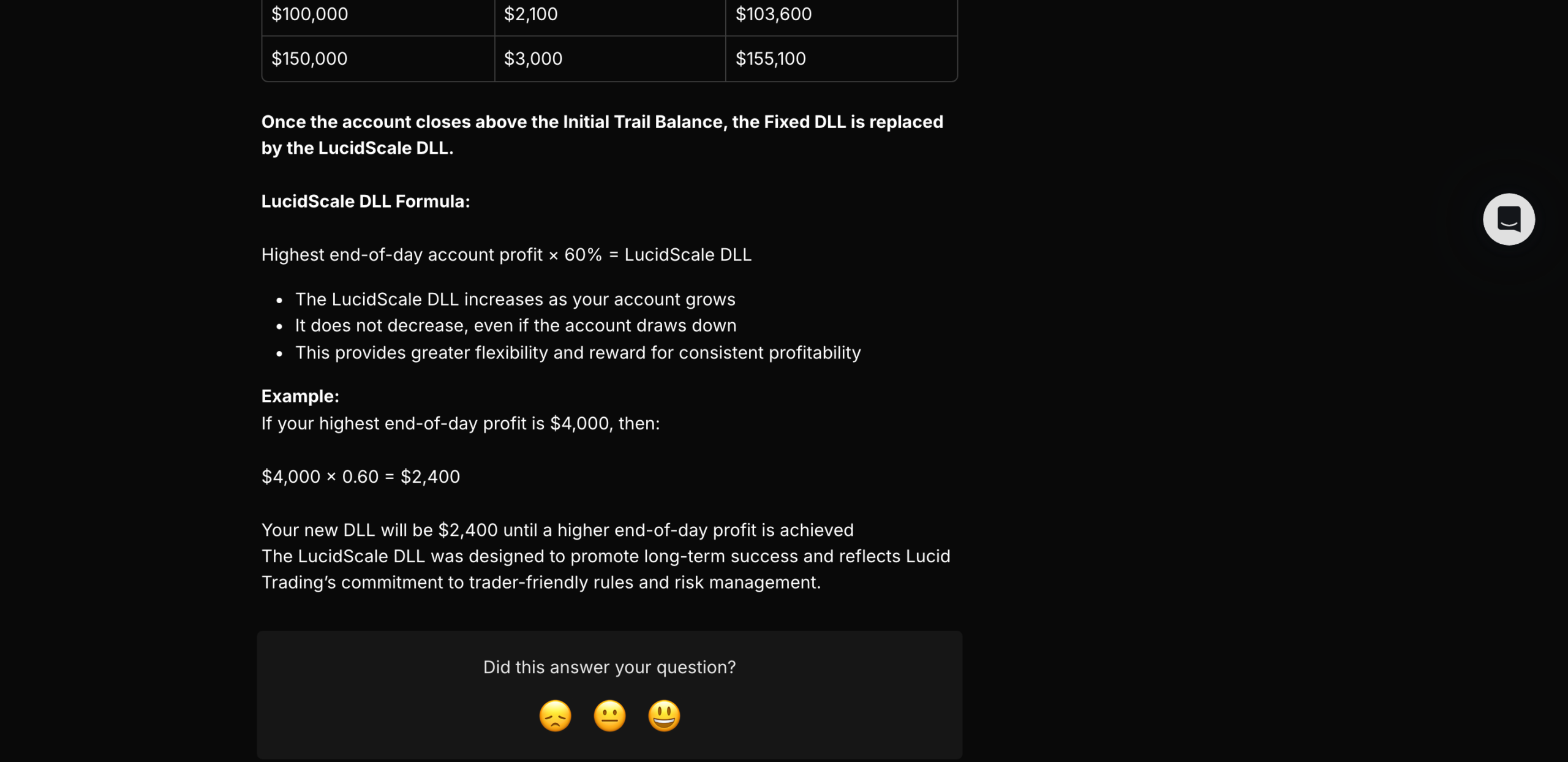
Lucid’s own pages disagree. The pricing card and the LucidDirect account overview read “60% of Peak EOD Balance”. The daily loss limit article reads “Highest end-of-day account profit × 60%”. On a 50K with $4,000 of profit, 60% of the balance would be a $32,400 daily limit, which is not a limit. The daily loss limit article is right and the balance label is wrong: read LucidScale as 60% of your best profit.
Hitting the limit is a soft breach: trading stops until the next session and the account survives, as long as the maximum loss has not been reached. That is the most generous way to run a daily limit, and we will say so.
We will also say what it is not. A daily limit does not prevent a loss, it books it. The day ends at the limit, the loss is on the account, and the one thing it takes away is your ability to trade back. That is also why the 25K, with no limit at all, is the most interesting size of the four.
How does the LucidDirect drawdown lock?
The maximum loss trails your highest end of day balance until the account closes above its initial trail balance, then locks $100 above the starting balance for good.

This interacts with the payout in a way worth working out before your first request. On a 25K that has reached Profit Goal 1 at $26,500, the floor is locked at $25,100. Withdraw the full $1,000 and the balance falls to $25,500: $400 above the floor. On a 50K, the same move leaves $900. On a 100K and a 150K, the larger goals leave $3,400 and $5,900.
After a maximum first payout, a LucidDirect 25K has $400 of room left. That is less than half the $1,000 it started with. If you plan to keep trading the account, it is a reason to take less than the maximum on the first cycle.
When does LucidDirect move you to a live account?
When Lucid’s risk team decides, and not before. Their live structure page lists four triggers for the live review pool: the final payout (Payout 5), a significant lifetime payout total, exceptional performance on the funded account, or having been live before. Then, in their words: “Payout 5 represents the maximum payout level, not a guaranteed minimum for live eligibility.”
When it happens, every funded account with at least one payout moves live together, each with a $0 starting balance, daily payouts, an end of day drawdown ($1,000 for a 25K) and no daily limit. No consistency rule applies at live, whatever plan you came from. Every other simulated account is closed, including evaluations kept in reserve; only a funded account that never received a payout has its cost refunded, and only if at least 50% of its drawdown is left.
Do not buy LucidDirect for the Live Bonus. The live structure page offers a one time bonus to first time live traders. The LucidDirect legacy page states that LucidDirect accounts bought from 18 January are not eligible, the bonus being “now exclusive to LucidBlack”. Lucid has not reconciled the two pages, so ask their support before counting on it.
LucidDirect vs Phidias Express to Live
LucidDirect gets you paid on simulated capital with less total profit than Lucid’s evaluation route. Express to Live gets you to a real brokerage account. Those are different goals, so here are both, side by side on the 25K.
Two points where Lucid is ahead, and we will not bury them. Their drawdown is twice ours on the 25K, and their split is 90/10 against our 80/20, which is why their first payout nets $900 and ours $800.
Where we differ is the destination. On Express to Live you reach the target on the CASH account, you click Switch to Live, and the fixed bonus payout converts the account to a LIVE account, opened with Dorman Trading via Sweet Futures, with $500 of LIVE credit that stays in the account as its minimum balance. No review pool, no fifth payout to wait for: the conversion is written into the product.
That conversion on the first payout is an Express to Live rule. On our Fundamental and Premium accounts the move to live is discretionary, as it is at Lucid: five payouts or $100,000 of profit make you eligible for review, and reaching them guarantees nothing.
See Phidias accounts and pricing
Test: is LucidDirect the right Lucid plan for you?
Four questions on how often you breach, what your best days look like, and what you actually want at the end. No email.
30 second check
Is LucidDirect the right Lucid plan for you?
LucidDirect payout rules: frequently asked questions
What are the LucidDirect payout rules?
Three conditions, all reset after every approved payout. You must reach the cycle’s profit goal ($1,500 on a 25K for the first payout), your largest single day must be no more than 20% of the cycle’s profit, and at least five days must pass before a payout. The minimum request is $500, the split is 90/10, and funds reach you within two business days of approval.
How much do you need to make before your first LucidDirect payout?
Profit Goal 1 is $1,500 on the 25K, $3,000 on the 50K, $6,000 on the 100K and $9,000 on the 150K. Those are the same numbers as the LucidPro evaluation targets on the three larger sizes, and $250 more than it on the 25K. From the second payout onwards the goal drops to $1,250, $2,500, $3,500 and $4,500.
What is the maximum LucidDirect payout?
It depends on the size and the cycle. For payouts one to three: $1,000 on the 25K, $2,000 on the 50K, $2,500 on the 100K and $3,000 on the 150K. For payouts four and five: $1,000, $2,500, $3,000 and $3,500. On the 25K you must make $1,500 to withdraw at most $1,000, which is $900 after the split.
Does LucidDirect have a consistency rule?
Yes, 20%: your largest profitable day cannot exceed 20% of the cycle’s total profit. Mathematically that means at least five profitable days in every cycle, and a single big day raises the bar. A $600 day on a 25K means the cycle has to reach $3,000 before you can request anything. The rule disappears once you are moved to a live account.
Does the LucidDirect 25K have a daily loss limit?
No. The 25K is the only LucidDirect size with no daily loss limit at all. The 50K, 100K and 150K start with a fixed limit of $1,200, $2,100 and $3,000, which becomes the LucidScale limit once the account closes above its initial trail balance.
Can you reset a LucidDirect account?
The LucidDirect cards list no reset fee, while every Lucid evaluation card does, and Lucid’s own fee page describes resets as something you buy for a failed evaluation. On LucidDirect there is no evaluation to reset. Plan on a breached account costing a new purchase at $230.30 or more.
How long do LucidDirect payouts take?
There is no fixed payout window: you can request on any day once the conditions are met. Once approved, the amount leaves your account within a few minutes and reaches your payment method within two business days. A request is final once submitted and cannot be edited or cancelled.
Does LucidDirect lead to a live account?
Possibly, at Lucid’s discretion. Traders enter a live review pool after their fifth and final payout, after a large lifetime payout total, or on exceptional performance, and Lucid states that Payout 5 is a maximum payout level, not a guarantee of live eligibility. Consistency rules no longer apply once you are live.
Is LucidDirect worth it?
For a trader who is confident of reaching the target without a reset, it is a fair product: on the 25K you need $1,500 of profit for a first payout, where the LucidPro route asks for $1,250 in the evaluation and then another $2,100 on the funded account before its maximum first payout. It costs $230.30 against $70.60, and there is no reset if it goes wrong.
How does Phidias compare?
Our 25K Express to Live costs $69 with code PHIDIAS for the evaluation and the CASH account together. It has no daily loss limit, no consistency rule and no minimum number of days, and when you reach the target you click Switch to Live: the fixed bonus payout is paid and the account converts to a LIVE account. Lucid gives you more drawdown room and a better split; on our side, the conversion to LIVE is a product rule rather than a review.
Related guides
Read it yourself
- LucidDirect payout objectives (profit goals, caps, timing)
- LucidDirect consistency percentage (the 20% rule and its example)
- LucidDirect daily loss limit (fixed limit and LucidScale)
- LucidDirect drawdown (trail and lock)
- Lucid live structure (review pool, Live Bonus)
- Phidias accounts and pricing
The verdict
“LucidDirect is an honest product for a trader who rarely breaches: the first payout needs less profit than their evaluation route, and the 25K has no daily limit at all. What it does not have is a second chance, and at $230.30 an account, that is the line I would read before buying.”
William G., CMO at Phidias Propfirm