Lucid Trading drawdown, 2026
How the Lucid Max Loss Limit trails, when it locks, what a payout does to it and which plans add a daily loss limit: every public Lucid plan, side by side.
Every Lucid figure read in its help center and on lucidtrading.com on November 9, 2026.
Lucid’s intraday drawdown is the default on LucidDaily funded accounts, with end of day sold as a paid add-on, and the evaluation is intraday or end of day at checkout. LucidPro, LucidFlex, LucidDirect and Lucid’s standard live account use an end of day trailing Max Loss Limit of $1,000 to $5,000 that locks at your starting balance plus $100.
Updated on 10 November 2026
In short
- Intraday: LucidDaily funded accounts by default (end of day costs extra). The LucidDaily evaluation is intraday (cheaper) or end of day (pricier), your choice at checkout.
- End of day: LucidPro and LucidFlex (evaluation and funded), LucidDirect, and the standard live account.
- Max Loss Limit: $1,000 / $2,000 / $3,000 / $4,500 by size; LucidDirect $3,500 on the 100K and $5,000 on the 150K.
- Lock: above the Initial Trail Balance ($26,100 on a 25K), the limit freezes at the starting balance plus $100.
- Daily loss limit: optional on Pro, Flex and Daily, forced on LucidDirect 50K and up, none on live. Always a soft breach.
- Static: no public Lucid plan. Phidias Express to Live is static from the evaluation, with no daily loss limit.
Lucid Trading drawdown rules 2026: every plan at a glance
Lucid calls its drawdown the Max Loss Limit, or MLL. The amount is almost the same on every plan. What changes is how it is measured, and whether a daily loss limit sits on top:
Every trailing limit stops at the same place: the starting balance plus $100. On a 25K, that is $25,100. The full plan lineup is in our Lucid Trading guide.
Does Lucid have an intraday drawdown?
Yes, on LucidDaily. Lucid’s customization page says that whatever you pick at checkout, “all LucidDaily Funded accounts use an Intraday Drawdown.” But the LucidDaily cards on lucidtrading.com now carry a “Drawdown In Funded” switch: intraday by default, end of day for an extra $55.30 on the 25K with the current coupon (checked November 10, 2026). The two Lucid sources disagree, so trust what your checkout shows.
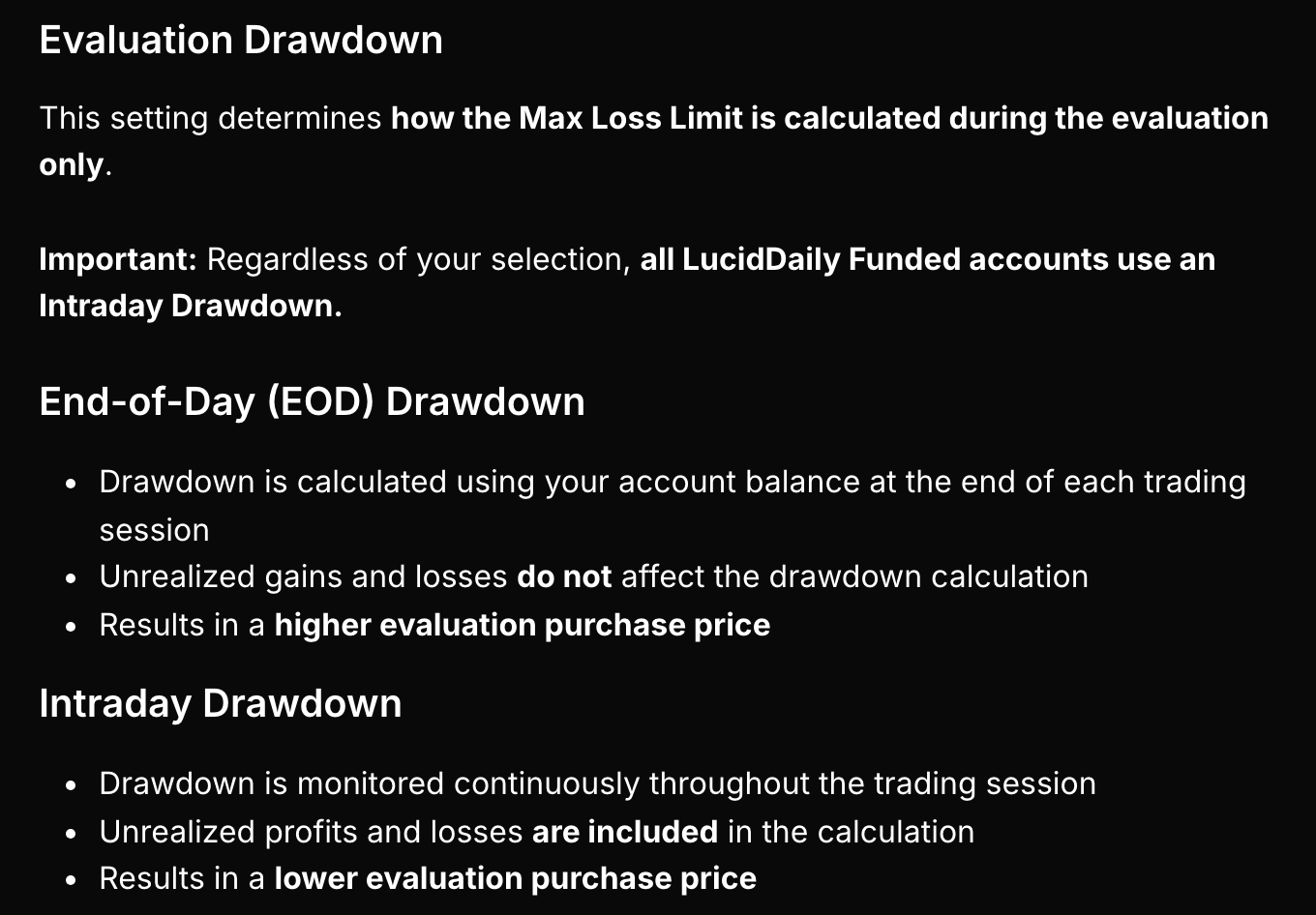
Lucid lists the trade-off itself. End of day uses your balance at the close, unrealized gains and losses do not count, and the evaluation costs more. Intraday is monitored continuously, unrealized profits and losses count, and the evaluation costs less. Once bought, the setting cannot be changed on that account.
How does the Lucid intraday drawdown work?
Lucid’s wording: an intraday drawdown “brings your MLL up with your real-time P&L.” Open profit you never bank still lifts the floor. Our illustration on a 25K LucidDaily funded account:
- You start at $25,000, with the limit at $24,000.
- A trade runs to +$600 open. The limit follows it up to $24,600.
- The trade comes back and you close at breakeven. Balance $25,000, limit still $24,600: $400 of room left, not $1,000.
- On an end of day account, the same day closes at $25,000 and the limit stays at $24,000.
That is the whole cost of intraday trailing: it charges you for the profit you gave back. If your trades breathe before you close them, it eats your room faster than an end of day drawdown would. Our trailing drawdown guide walks through the same mechanics across firms.
How does the Lucid EOD drawdown work?
LucidPro and LucidFlex (evaluation and funded) and LucidDirect use an end of day drawdown. At the end of each session, Lucid takes your highest closing balance and moves the limit up behind it. Intraday swings do not move it.
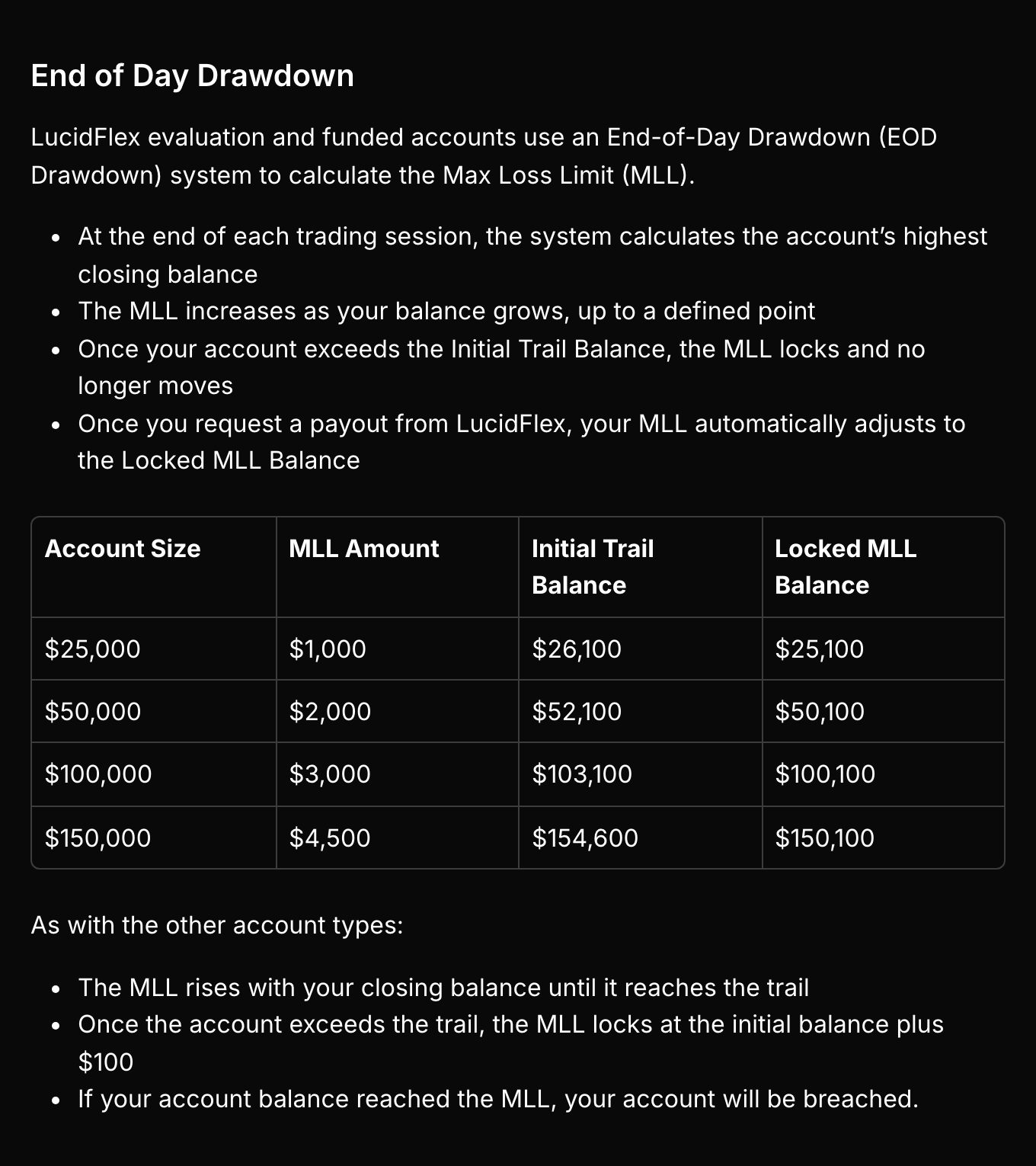
On a 25K: you close day one at $25,400, so the limit moves to $24,400. Once a close takes the account above $26,100, the limit locks at $25,100 and never moves again. The starting limit column is our arithmetic.
One caution. The level moves only at the close, but Lucid’s pages say the account is breached when the balance reaches the MLL. They do not say the check waits for the close, so treat the floor as live during the session.
When is end of day at Lucid Trading?
Lucid does not publish a single “EOD snapshot” time. What it does publish, for Pro, Flex and Direct:
- 4:45 PM ET: all positions must be closed, and Lucid closes anything still open. Holding past it does not fail the account.
- 6:00 PM ET: trading resumes, Sunday to Thursday. On its LucidDaily live page, Lucid also writes that the final session report comes in at 6 PM ET.
- Holidays: close before the market closes, whatever the usual 4:45 PM cutoff.
Read together, your closing balance is the balance you are flat at by 4:45 PM ET. Lucid writes EST on these pages; we use ET because the times follow the New York session.
Is the Lucid drawdown trailing or static?
Trailing, until it locks. On every public Lucid plan, the limit climbs behind your best closing balance (or your best real time balance on LucidDaily funded), then freezes at the starting balance plus $100.
So the answer to “does Lucid have a trailing drawdown” is yes on Pro, Flex, Daily, Direct and the standard live account. The only static drawdown Lucid describes is on the LucidMaxx live account, and LucidMaxx is invite-only. Firms with a static floor from day one are in our static drawdown prop firms list.
What happens to your Lucid drawdown after a payout?
It depends on the plan, and LucidFlex is the one that surprises people.
Our LucidFlex illustration on a 25K: your best close is $26,000, so the limit sits at $25,000 and you have $1,000 of room. You request $500, the most Flex allows at that profit (50% of profit). The limit moves to $25,100 and the balance drops to $25,500: $400 of room left. Our LucidFlex payout rules cover the caps and the 5 profitable days.
Lucid daily loss limit: which plans have one?
On top of the MLL, Lucid can add a daily loss limit. Lucid treats every one as a soft breach: hit it, and you are locked out until the next session, but you keep the account as long as the MLL holds.
Lucid prices it as a trade: with the limit on, the evaluation is cheaper and the funded account can request payouts during the session. With it off, you pay more and payouts follow the end of day schedule. One discrepancy: Lucid’s LucidPro daily loss limit and evaluation pages list no limit on the 25K, while lucidtrading.com and the LucidPro funded page show $600.
One LucidDaily detail matters for intraday accounts. The daily limit stays fixed during the session, while the MLL can trail above it. When that happens, the MLL becomes the tighter level, and touching it is a hard breach.
A daily loss limit is sold as protection against a tilt day, and that argument is fair. Mechanically, though, it stops you at a fixed loss for the day: no more trades until the next session, so you cannot work back the room that day cost you.
Lucid live account drawdown
Lucid’s standard live account starts at $0, with an end of day drawdown of $1,000 to $4,500 and no daily loss limit. Once your live profits equal that starting drawdown, the MLL locks at $100 and stops moving.
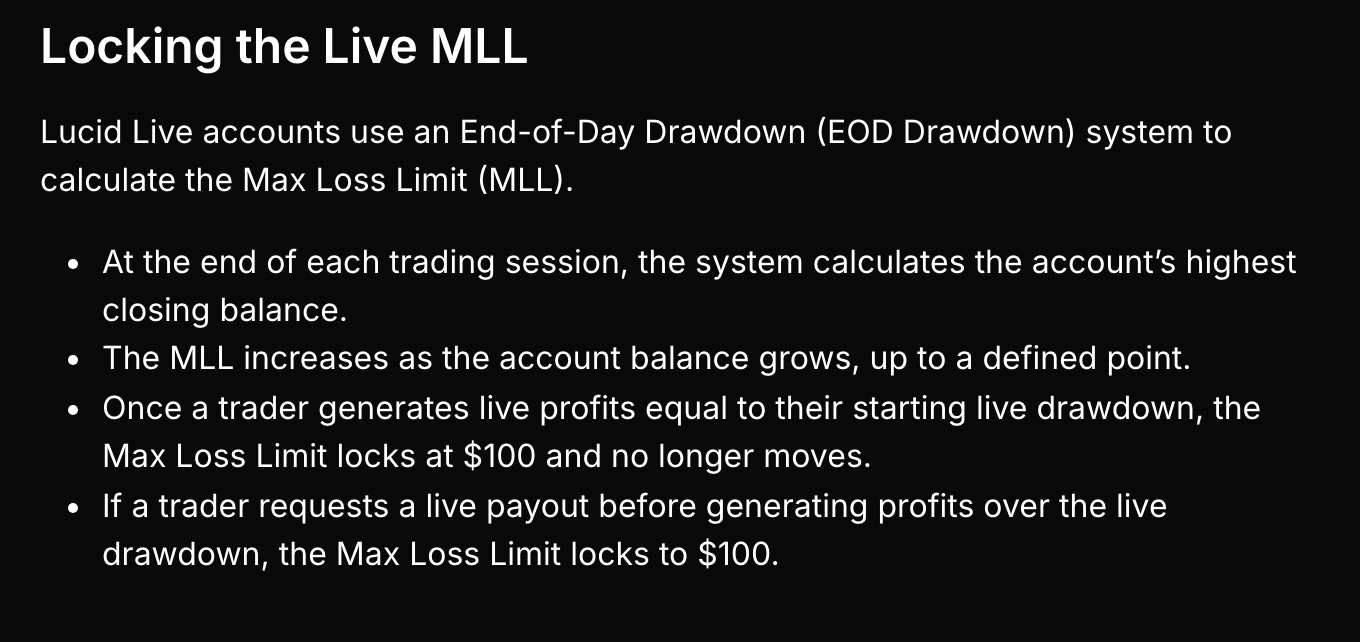
Getting there is not a rule you can trigger: Lucid writes that all live transitions occur at the discretion of its risk team. Our Lucid live account rules detail the review pool, the cashout and the scaling plan.
A drawdown that never trails: see Express to Live
Lucid drawdown vs Phidias Express to Live
Phidias first: Express to Live has a static drawdown that never trails, from the evaluation onward, and no daily loss limit. No consistency rule, no minimum trading days, and the bonus payout converts the account to LIVE by rule.
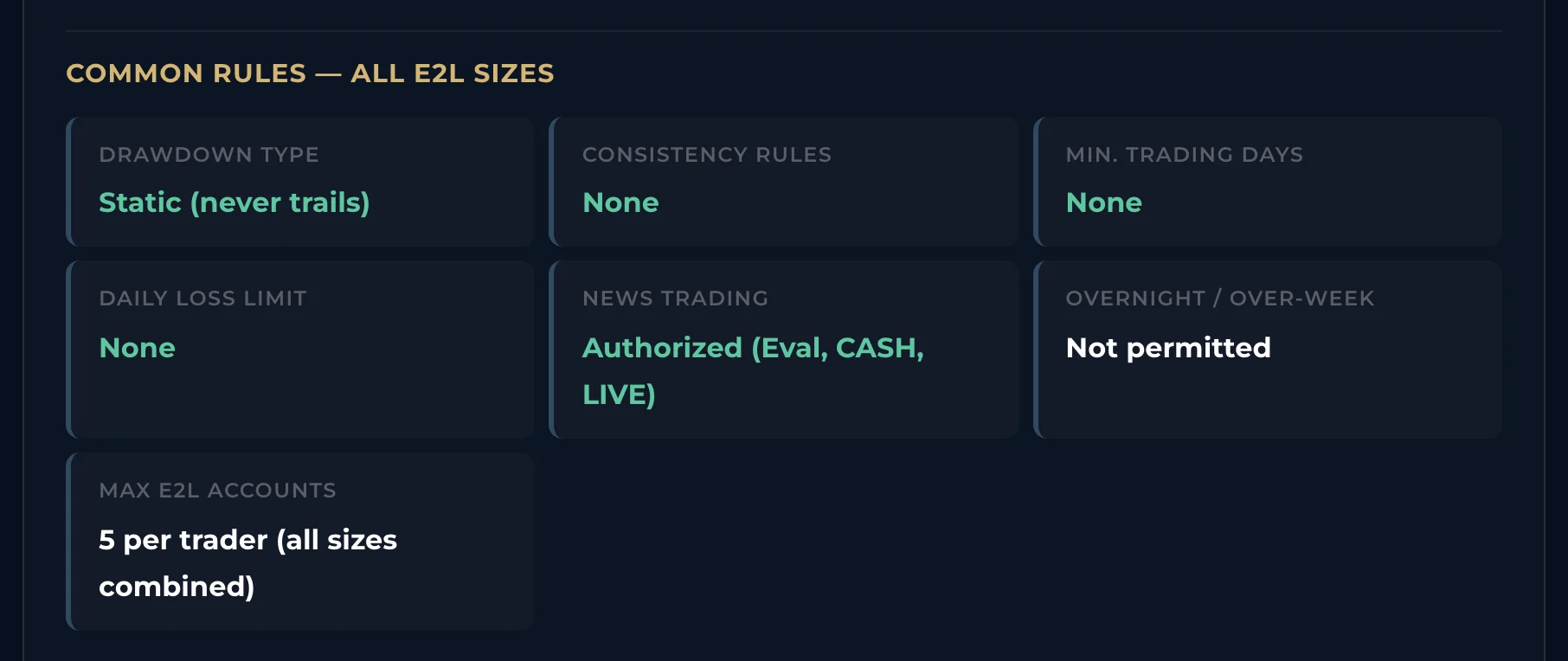
The honest reading: in dollars, Lucid gives you more room at the start, $1,000 against $500 on our 25K Express to Live. But Lucid’s floor climbs with every good close, while ours stays at $24,500. Past $500 of profit, you have more room on Express to Live than on Lucid, and the gap widens with every good close until Lucid locks.
A payout on Day 1 is possible, 90% of Phidias payouts are processed in under 30 minutes and every payout within 24 hours. The 25K Express to Live costs $69 instead of $277 as a one-time payment with code PHIDIAS. Express to Live positions must be closed before the end of the trading day, like Lucid’s. Every rule is on our rules page.
Test: which drawdown fits the way you trade?
Four questions on your trades, the daily limit and where you want to end up. No email.
30 second check
Which drawdown fits the way you trade?
Lucid Trading drawdown 2026: frequently asked questions
Does Lucid Trading have an intraday drawdown?
Yes, on LucidDaily. LucidDaily funded accounts trail intraday by default; lucidtrading.com now also sells an end of day funded drawdown as a paid add-on, which the help center does not mention yet. The LucidDaily evaluation is intraday or end of day depending on the option you pick at checkout. LucidPro, LucidFlex, LucidDirect and Lucid’s standard live account all use an end of day drawdown.
Is the Lucid drawdown trailing?
Yes, until it locks. Lucid’s Max Loss Limit rises with your highest closing balance (or with your real time balance on intraday accounts). Once the account exceeds the Initial Trail Balance, it locks at your starting balance plus $100 and no longer moves. Only the LucidMaxx live account, which is invite-only, is described as static.
When is end of day at Lucid Trading?
Lucid does not print a single snapshot time. Its rules say all positions on Pro, Flex and Direct must be closed by 4:45 PM ET, when Lucid flattens anything still open, and trading resumes at 6:00 PM ET. Our reading: your closing balance is the balance you are flat at by 4:45 PM ET.
What is the Lucid max loss limit?
$1,000 on a 25K, $2,000 on a 50K, $3,000 on a 100K and $4,500 on a 150K for LucidPro, LucidFlex and LucidDaily. LucidDirect uses $3,500 on the 100K and $5,000 on the 150K. Live accounts start with a drawdown of $1,000 to $4,500.
When does the Lucid drawdown lock?
When the account exceeds its Initial Trail Balance: $26,100 on a 25K, $52,100 on a 50K, $103,100 on a 100K, $154,600 on a 150K ($103,600 and $155,100 on LucidDirect). The Max Loss Limit then locks at the starting balance plus $100, for example $25,100 on a 25K.
What happens to the Lucid drawdown after a payout?
On LucidFlex, requesting a payout moves your Max Loss Limit straight to the Locked MLL Balance, for example $25,100 on a 25K. On LucidPro and LucidDaily, you can only withdraw profit above a buffer equal to the initial Max Loss Limit plus $100. On a live account, a payout requested before the lock locks the limit at $100.
Does LucidFlex have a daily loss limit?
Only if you choose it. LucidFlex and LucidPro let you turn the daily loss limit on or off at checkout: on makes the evaluation cheaper and gives the funded account on demand payouts, off removes it from both the evaluation and the funded account. When on, lucidtrading.com lists $600 to $2,700 by size. Lucid treats it as a soft breach.
Does Lucid have a static drawdown?
Not on its public plans. LucidPro, LucidFlex, LucidDirect and the standard live account trail end of day, and LucidDaily funded accounts trail intraday unless you buy the end of day add-on. The only static drawdown Lucid describes is on the LucidMaxx live account, which you can only reach by invitation.
Related guides
Read it yourself
The verdict
“Lucid’s drawdown is fair by industry standards: end of day on most plans, a lock at the starting balance plus $100, and the daily limit is optional on Pro, Flex and Daily. The trap is LucidDaily, where the funded account trails intraday unless you pay extra for end of day, and open profit you give back costs you room. If you want a floor that never moves and no daily limit at all, Express to Live is built that way from the first trade.”
William G., CMO at Phidias Propfirm
William G., CMO at Phidias Propfirm, a futures prop firm. He reads competitors’ rules at the source so you do not have to. Last reviewed 2026; Lucid figures read on November 9, 2026.