7 stocks.
That is how most beginners day trade the stock market now. Nvidia, Tesla, Apple, Meta, Amazon, Microsoft, Alphabet. Different tickers, same obsession. The problem is that many traders spend months trying to master seven separate charts when they are really chasing one underlying engine the whole time.
This guide shows you how to day trade stocks properly, what beginners usually get wrong, and the deeper structural reason many serious traders eventually stop trading individual stocks the way they started.
See all Phidias account types and pricing →
How to Day Trade Stocks: Quick Answer
To day trade stocks, you need a broker, a small watchlist of liquid names, a repeatable setup, strict position sizing, and enough discipline to stop forcing trades. Most beginners focus too much on stock picks and not enough on execution, structure, and risk.
The hidden issue is that many stock traders are not really trading isolated companies. They are trading momentum, volatility, and large-cap tech concentration through multiple separate tickers. Once you understand that, the entire game starts to look different.
| What Most Beginners Think | What Actually Matters |
|---|---|
| Finding the hottest stock | Trading liquid names with clean movement |
| Watching 10 to 20 charts at once | Reducing noise and focusing on a few repeatable instruments |
| Entry signals solve everything | Risk management and market structure matter more |
| More tickers means more opportunity | More tickers often means more confusion |
| Stocks are the only way to trade big tech movement | Sometimes one cleaner instrument expresses the same idea better |
What Is Day Trading in Stocks?
Day trading stocks means opening and closing positions during the same trading session. You are trying to capture short-term price movement instead of holding for weeks or months. That can mean trading morning breakouts, opening range setups, trend continuation, news reactions, failed breakouts, or mean reversion.
The attraction is obvious. No overnight exposure. Immediate feedback. Plenty of movement. And if you are good, real income potential.
But stock trading for beginners usually gets framed in a way that makes it sound much easier than it is. Most articles tell you to find momentum, manage risk, and stay disciplined. That is true, but shallow. The bigger issue is that new traders are often trying to trade the right market behavior through the wrong structure.
How to Start Stock Trading the Right Way
If you are serious about learning how to day trade stocks, start here.
1. Build a very small watchlist
Do not start with 20 names. That is how you get chopped up. Pick a handful of highly liquid stocks that trade every day with real volume. Most beginners end up circling the same names anyway: Nvidia, Tesla, Apple, Meta, Microsoft, Amazon, and AMD. That is not an accident. Those names dominate attention and intraday movement.
2. Trade one setup before you trade five
You do not need ten strategies. You need one setup you can recognize fast, explain clearly, and size consistently. That could be an opening range breakout, first pullback after trend confirmation, or failed breakout around a key level. Until you can execute one setup well, adding more only hides weakness.
3. Define risk before entry
The stop is not something you figure out after you click buy. If you do not know where the trade is wrong before you enter, you are not trading. You are improvising.
4. Avoid forcing trades in dead conditions
Not every session is worth trading. Thin volume, no catalyst, no clean range expansion, sloppy open, random chop. A lot of beginners think more screen time equals faster progress. Usually it just means more low-quality trades.
1
Primary Setup Needed
5–7
Stocks Max on Watchlist
0
Reason to Force a Trade
What Makes a Good Day Trading Stock?
The best stocks for day trading usually share the same traits: liquidity, clean range expansion, real volume, and strong participation around key levels. Most traders know that part.
What they miss is that this naturally pulls them toward the same cluster of stocks over and over again. Big U.S. tech dominates because that is where the liquidity, narrative, and momentum often live.
This creates a hidden trap. The trader thinks he is choosing among many opportunities. In reality, he is often chasing one market engine through several different names.
The Hidden Problem With Day Trading Stocks
Here is what most articles on stock trading for beginners leave out.
Individual stocks add friction. A lot of it.
Capital friction
Active stock traders run into capital constraints fast. The account size needed to trade properly is often larger than people expect. That changes behavior immediately. It makes every bullet feel heavier. It encourages forcing setups and cutting good trades too fast.
Headline risk
One rumor, one analyst note, one earnings leak, one CEO comment, and your clean technical trade turns into nonsense. That is part of stock trading. It is also why many traders eventually want a cleaner expression of the move.
Ticker overload
Watching too many names fragments your attention. One stock trends cleanly. Another fakes out. Another gaps. Another reacts to sympathy. Another barely moves. You think you are broadening opportunity. You are usually broadening noise.
Short-side friction
Shorting stocks is not always as clean as traders imagine. Availability, restrictions, extra friction, and inconsistent behavior all matter more than most people realize when they first start.
The Real Issue
Most struggling stock traders do not only have a strategy problem. They often have a vehicle problem. They are trying to express the right market idea through a messier structure than necessary.
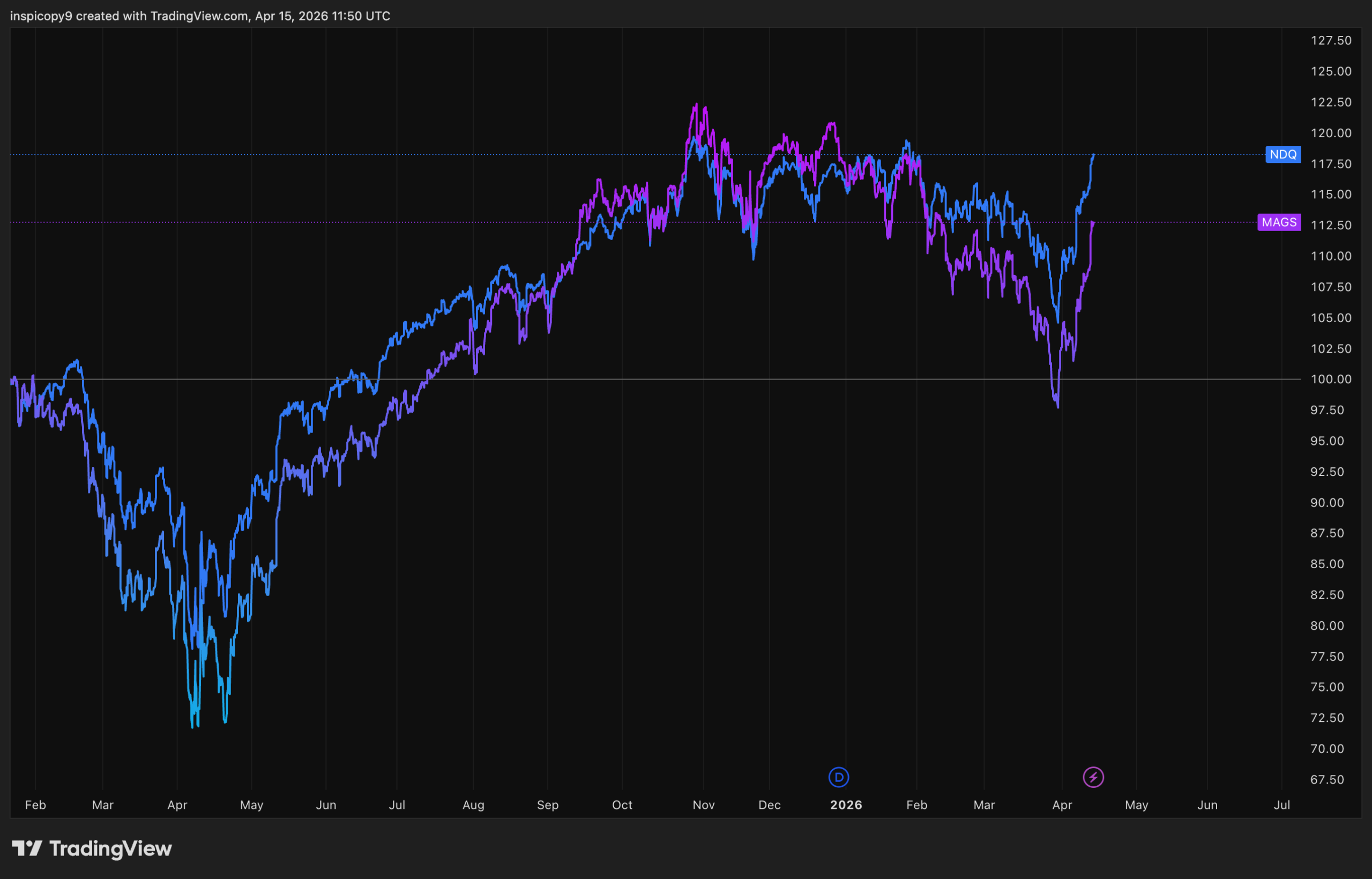
If You Trade the Mag 7, You May Already Be Trading the Nasdaq
This is where the article changes.
If your watchlist revolves around Nvidia, Apple, Meta, Amazon, Microsoft, Alphabet, and Tesla, then you are already orbiting the same concentration machine. Different personalities, yes. Different chart behavior, yes. But often the same deeper force.
You are not just trading seven unrelated companies.
You are often trading large-cap tech leadership, index concentration, macro response, and Nasdaq momentum through multiple separate windows.
This is exactly where your manual chart insert should go.
Once a trader sees how tightly that basket and NQ futures can move around the same core engine, the obvious question hits:
Why am I trying to manage seven separate charts if one cleaner instrument often expresses the same thesis?
Why Many Serious Traders Eventually Move to Futures
This is the part most stock day trading guides never say out loud.
A lot of active traders eventually move to futures not because stocks are useless, but because futures often provide a cleaner way to trade the exact thing they were trying to trade all along.
CME Group describes E-mini Nasdaq-100 futures as a cost-efficient way to gain Nasdaq-100 exposure, with nearly 24-hour access, simpler short exposure, and more capital-efficient control over a large contract value. CME also explicitly positions NQ as a practical way to trade broad Nasdaq performance instead of trying to manage large baskets of individual names.
That matters because many stock traders are not really trying to become company analysts. They are trying to trade movement, momentum, and large-cap tech expansion with cleaner execution.
Stock Route
Multiple tickers, more noise, more company-specific randomness, more attention fragmentation.
Cleaner Route
One instrument, clearer macro expression, easier shorting, more direct exposure to the engine behind big-tech movement.
The Next Wall: Most Traders Still Use Their Own Capital
Even after traders realize futures can be cleaner than stocks for active trading, they hit the next constraint.
Capital.
They still have to grow a personal account, absorb losses personally, size smaller than they want, and deal with the emotional pressure that comes from every drawdown hitting their own money.
This is where the conversation stops being just educational.
Because once a trader understands that stocks are not always the cleanest vehicle, the next logical question becomes:
What is the cleanest path to trade that vehicle with real buying power and a real path to payouts?

Data Feed : dxFeed  Or Rithmic
Data Feed : dxFeed Or Rithmic
Data Feed : dxFeed Or Rithmic
Data Feed : dxFeed Or Rithmic
Data Feed : dxFeed Or Rithmic
Data Feed : dxFeed Or Rithmic
Data Feed : dxFeed Or Rithmic
Data Feed : dxFeed Or Rithmic
Data Feed : dxFeed Or Rithmic
Data Feed : dxFeed Or Rithmic
Data Feed : dxFeed Or Rithmic
Data Feed : dxFeed Or Rithmic
Data Feed : dxFeed Or Rithmic
Data Feed : dxFeed Or Rithmic

Data Feed : dxFeed Or Rithmic

Where Phidias Fits In
This is where Phidias becomes relevant, not as a random promo, but as the logical solution to the exact problem the reader has now uncovered.
If you came here searching for how to day trade stocks, what you probably wanted was not “stocks” in the purest sense. What you wanted was cleaner movement, liquidity, fast execution, a workable capital structure, and a path to getting paid.
That is why Phidias fits so well here.
1. Faster path to funded capital
Phidias is known for one of the fastest paths from signup to payout in the space. The 25K Static account exists for traders who want clarity and speed, not a bloated evaluation treadmill.
2. Cleaner rule structure
For traders moving from stocks into futures, simplicity matters. Phidias offers static and end-of-day drawdown structures that are easier to understand and easier to trade around than the traps many firms build into their funded logic.
3. One-time payment options
A lot of traders bleed out before they ever get traction because recurring fees keep draining them while they are still trying to find consistency. One-time payment paths change that math materially.
4. Payout speed that actually feels fast
This is where the difference stops being theoretical. Phidias now processes 90% of payouts within 30 minutes. That is not marketing fluff. That is an operational difference traders actually feel.
5. A real path to LIVE
The evaluation is not the goal. LIVE is the goal. At Phidias, traders can qualify for LIVE after 3 payouts or $75K cumulative payouts. That means the model is designed around progression, not endless simulation loops.
Trade the move, not the mess
If your watchlist is already built around big-tech momentum, there may be a cleaner way to express the same idea.
Who Should Keep Trading Stocks
You may want to keep focusing on stocks if your edge comes from company-specific catalysts, earnings reactions, or single-name behavior. If you genuinely trade stories, not just movement, stocks still make sense.
The point of this article is not that stock trading is fake. It is that a lot of people who think they are stock traders are really trading large-cap tech concentration through a more fragmented route than necessary.
Who Should Seriously Look at Futures and Phidias Instead
You should look hard at futures and Phidias if:
- your watchlist is basically the same 5 to 10 names every day
- you mostly chase big-tech momentum and intraday expansion
- you are tired of capital constraints
- you want cleaner execution
- you want a more direct path to payouts
- you want a path to LIVE, not just another evaluation cycle
Final Thought
The beginner question is usually this:
How do I get better at day trading stocks?
The better question is this:
What am I actually trying to trade, and what is the cleanest way to trade it?
For a surprising number of traders, the answer is not a bigger watchlist, a better stock screener, or another Discord alert room.
It is a cleaner instrument, a cleaner capital model, and a cleaner path to payouts.
That is the moment where many stock traders stop thinking like stock traders and start making much better decisions.
FAQ
Is stock trading good for beginners?
Stock trading can work for beginners, but most underestimate how much execution skill, discipline, and risk control it requires. The biggest mistake is focusing on stock picks instead of trade structure and consistency.
How much money do you need to day trade stocks?
That depends on your broker, account type, and location, but active stock day traders usually run into capital constraints much faster than they expect. That is one reason many serious active traders eventually look for more efficient instruments and prop firm models.
What are the best stocks for day trading?
The best day trading stocks are usually liquid names with real volume, clean range expansion, and strong participation. In practice, many traders end up circling the same big-tech names because that is where the movement is.
Is it better to trade stocks or futures?
That depends on what you are trying to express. If your edge comes from broad momentum, large-cap tech leadership, and intraday market movement, futures often provide a cleaner instrument than managing several separate stock charts.
Why do traders move from stocks to futures?
Many move because futures offer cleaner execution, easier short exposure, broader trading hours, and more capital-efficient access to the same market forces they were trying to trade through individual stocks.
Can beginners use a prop firm for futures trading?
Yes, but the firm matters. The best firms reduce friction with clear rules, faster payouts, and a realistic path to growth instead of trapping traders in endless evaluation cycles.
What makes Phidias different from other prop firms?
Phidias focuses on a faster path to payout, cleaner drawdown structures, one-time payment options, fast payout processing, and a real path to LIVE accounts. It is built for traders who want progress, not more unnecessary friction.
Risk Disclaimer
Trading futures and leveraged products involves significant risk and is not suitable for every investor. Past performance does not guarantee future results. You can lose money. Always understand the rules, risk, and structure of any trading product or prop firm before participating.