How to pass the Lucid evaluation, 2026
Every Lucid evaluation asks for the same profit target and the same drawdown. What changes is how many days the plan forces you to take.
Every Lucid figure read on Lucid Trading’s own help center and pricing page on October 27, 2026.
To pass a Lucid evaluation, you hit the profit target ($1,250 on a 25K up to $9,000 on a 150K) without touching the max loss limit ($1,000 to $4,500), calculated at the end of the day on Flex and Pro. On LucidFlex your best day must stay at 40% or less of your profit, so at least 3 days. LucidPro has no consistency rule in the evaluation, so one day can be enough.
In short
- Targets: $1,250, $3,000, $6,000 or $9,000. Max loss: $1,000, $2,000, $3,000 or $4,500. Same numbers on Flex, Pro and Daily.
- LucidFlex: 40% consistency (at least 3 days), or 50% as a paid add-on (at least 2 days).
- LucidPro: no consistency rule in the evaluation. Lucid says you can pass in one trading day.
- LucidDaily: 50% on the evaluation page, but the customization page and the pricing card now offer 40% or 50%, so 3 days or 2.
- Drawdown: each record close lifts your floor until the balance passes the trail; then the max loss limit locks at your starting balance plus $100.
- Cost: from $45.50 (Flex 25K with Lucid’s checkout coupon). Resets are paid, not automatic.
- No consistency at all: Phidias Express to Live has no consistency rule, no minimum days and no daily loss limit.
Lucid eval rules 2026: the table for every plan
Lucid sells three public evaluations, and they share their targets and drawdowns. LucidMaxx is invitation-only. LucidDirect has no evaluation at all: it is a straight-to-funded account. The table below is built from Lucid’s evaluation pages and its pricing cards.
What separates the three plans is everything around those numbers:
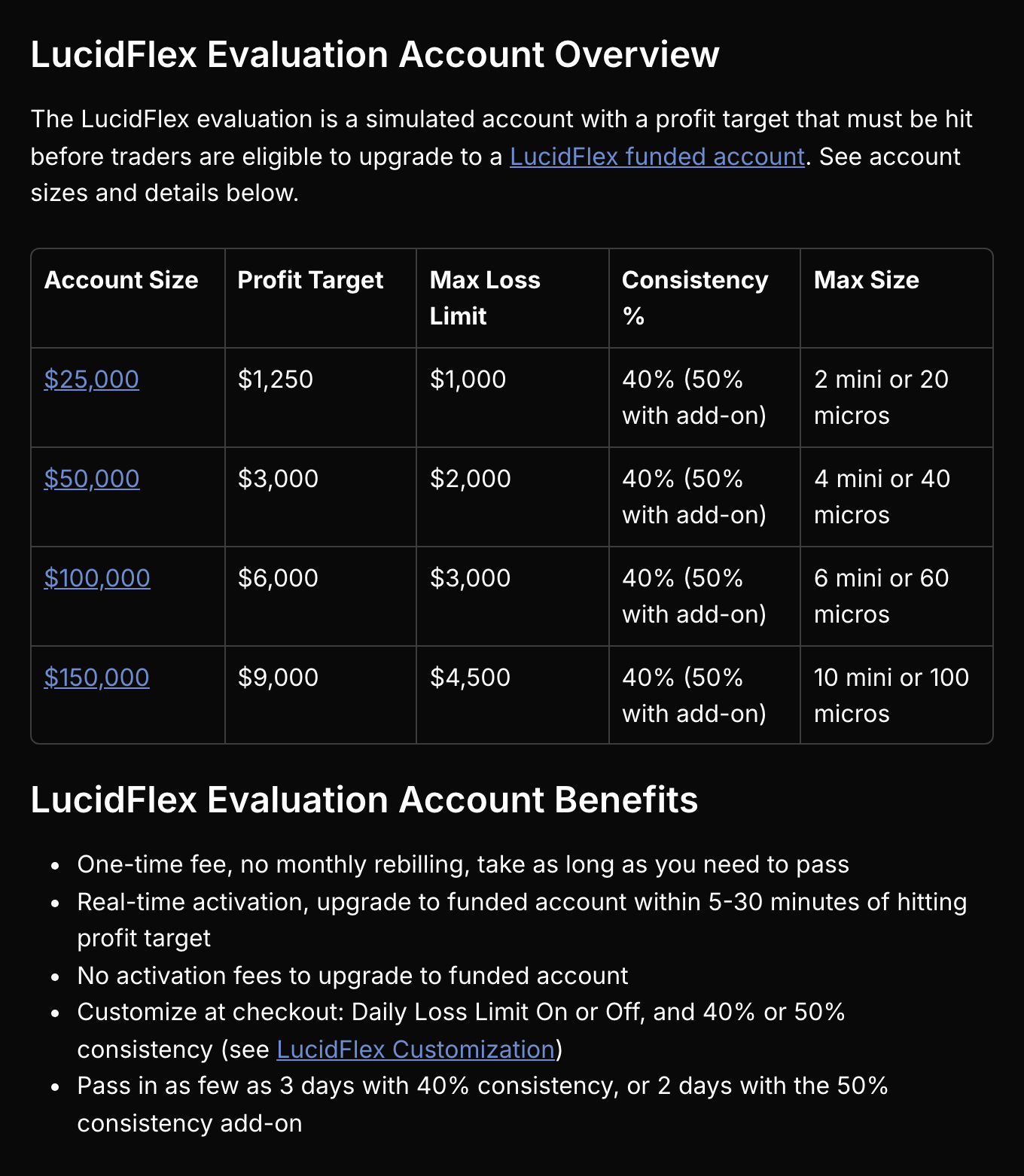
All three are bought with a one-time fee, with no monthly rebilling and no deadline. Lucid upgrades you to the funded account within 5 to 30 minutes of hitting the target and charges nothing for that upgrade.
How to pass the LucidFlex evaluation: the 40% rule
The LucidFlex evaluation turns on one ratio: your largest single day divided by your total evaluation profit. It must be 40% or less to upgrade, or 50% or less if you bought the add-on. The detailed formula and its edge cases are in our Lucid Trading consistency rule guide; here is what it means for passing.
Read it as a daily ceiling. On a 50K at 40%, any day above $1,200 does not fail you, but it pushes the finish line back: you keep trading until that big day is back under 40% of your total. A $2,000 day means you need $5,000 of profit, not $3,000.
The 50% add-on has a small cushion. Lucid’s own example table shows a 50K largest day of $1,560 instead of $1,500, but it insists the cushion is not a fixed dollar amount and that taking your time is the best approach.
The add-on costs money and cannot be switched later: DLL and consistency settings are fixed once the account is active. If you usually make your week in two sessions, buy the 50% version from the start.
Can you pass a Lucid evaluation in one day?
Only on LucidPro. Lucid writes “Pass the evaluation in one trading day” on its Pro evaluation page, and the Pro evaluation table has no consistency column. Hit $3,000 on a 50K in one session and you qualify.
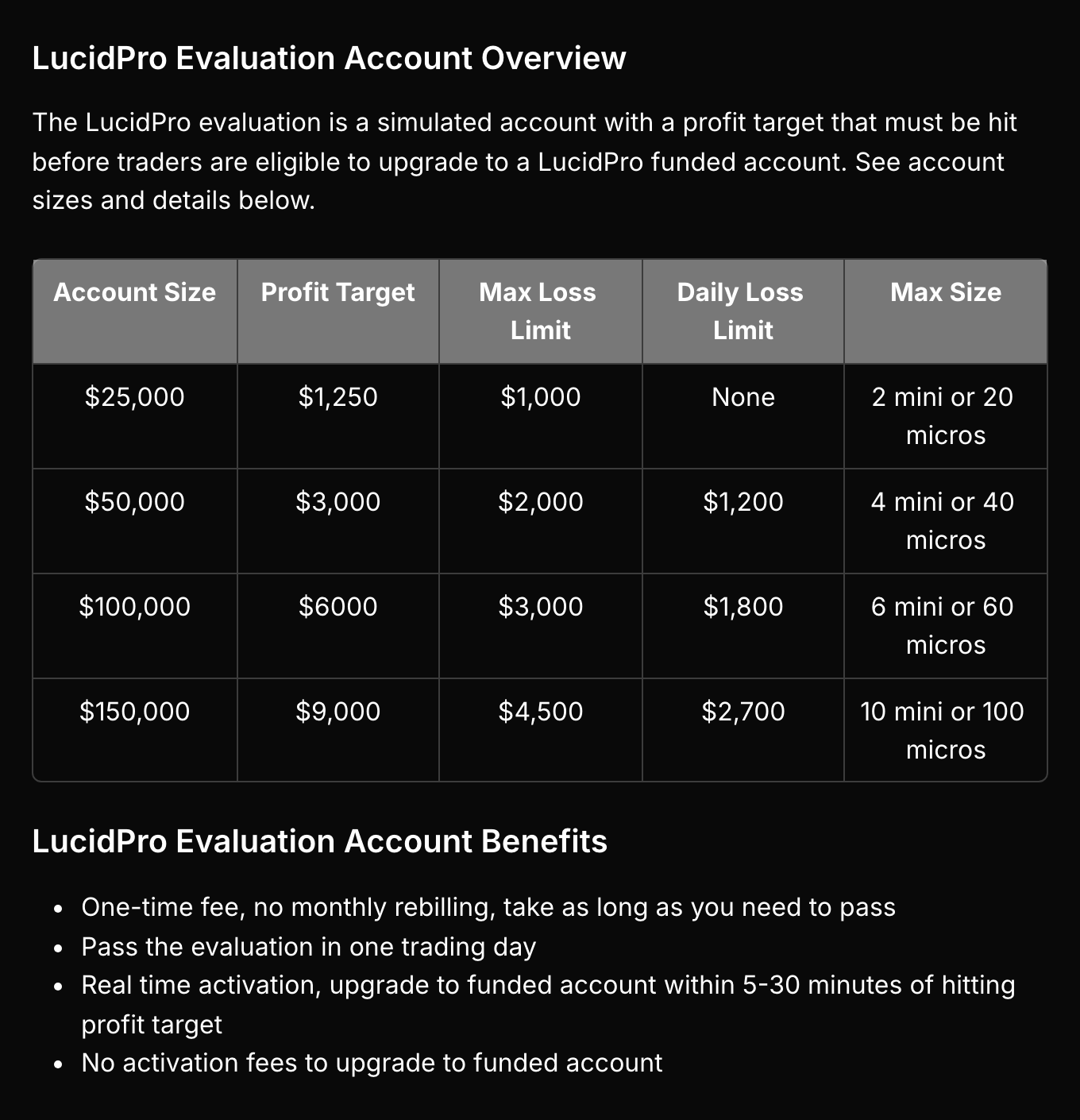
Two things to know before you try. First, the consistency rule moves to the funded side: every LucidPro payout cycle has a 40% rule, detailed in our LucidPro payout rules. Second, Lucid’s own pages disagree on the 25K: the evaluation page above lists no daily loss limit on the 25K, while the pricing card shows $600 with the DLL switched on. Check the card at checkout.
LucidFlex cannot be passed in a day by design (3 days at 40%, 2 with the add-on), and neither can LucidDaily: two days with its 50% option, three with 40%.
How the Lucid evaluation drawdown works
Lucid uses an end-of-day drawdown on the Flex and Pro evaluations. At the close of each session the system takes your highest closing balance, and the max loss limit rises with it. Intraday swings do not move it.
When the max loss stops moving
Once a closing balance passes the initial trail balance, the max loss limit locks at your starting balance plus $100. Every target sits above that trail: on a 50K the trail is $52,100 and the target $53,000.
The tight stretch comes before the lock: each record close lifts your floor, from $48,000 up to $50,100 on a 50K. Picture a 50K that closes at $52,500: your floor is now $50,100, $2,400 below, and it will not move again. A trader who sizes up to finish the last $500 can still give back that cushion in one session. On LucidDaily you can choose an intraday evaluation drawdown instead, which is cheaper but follows your open profit in real time.
Daily loss limit on or off?
Lucid lets you switch the daily loss limit on or off at checkout, on all three evaluations. The pricing cards show $600, $1,200, $1,800 or $2,700 when it is on. It is a soft breach: hit it and you are locked out until the next session, without losing the account.
On is cheaper. On a 50K Flex at 40%, the card showed $80.50 with the DLL on and $115.50 with it off. On also gives the funded account intraday On Demand Payouts.
The cost is less obvious. A daily loss limit does not avoid a loss, it books it: you are cut at $1,200 down, even if the trade was about to come back, and that loss is booked: the account has to earn it back. It does stop a tilt day from becoming a blown account. If you trust your own stop, the cheaper version is not automatically the better one.
What fails a Lucid evaluation, and what does not
- Fails it: your balance reaching the max loss limit. That is a breach.
- Hedging: long and short on the same contract, in one account or across accounts, or correlated contracts across accounts (long ES here, short NQ there), is prohibited. A first flag resets the accounts to the prior day’s balance without restoring the drawdown; repeat offenses breach them.
- Microscalping: you are flagged if more than 50% of your profits come from trades held 5 seconds or less. A review comes first, possibly a written warning, then the profits from microscalping are forfeited.
- News on LucidDaily: Lucid’s general rules say news trading is not allowed on Daily, and its funded page makes high-impact USD news a hard breach. News is allowed on Flex, Pro and Direct.
- Does not fail it: on Pro, Flex and Direct, holding past 4:45 PM EST. Lucid closes the position for you, and the account survives.
- Inactivity: no trade with at least $1 of net profit or loss in 30 calendar days, and the account is deleted.
Lucid allows scaling in, automated strategies, trade copiers and flipping. It strongly discourages martingale: adding to a loser to get back to even is the fastest way to the max loss.
Lucid evaluation price and reset fee 2026
Lucid’s cards show a struck-through price and a price “with coupon at checkout”. Here are those coupon prices on October 27, 2026, with the daily loss limit on and the standard consistency, followed by the reset fee shown on the same card.
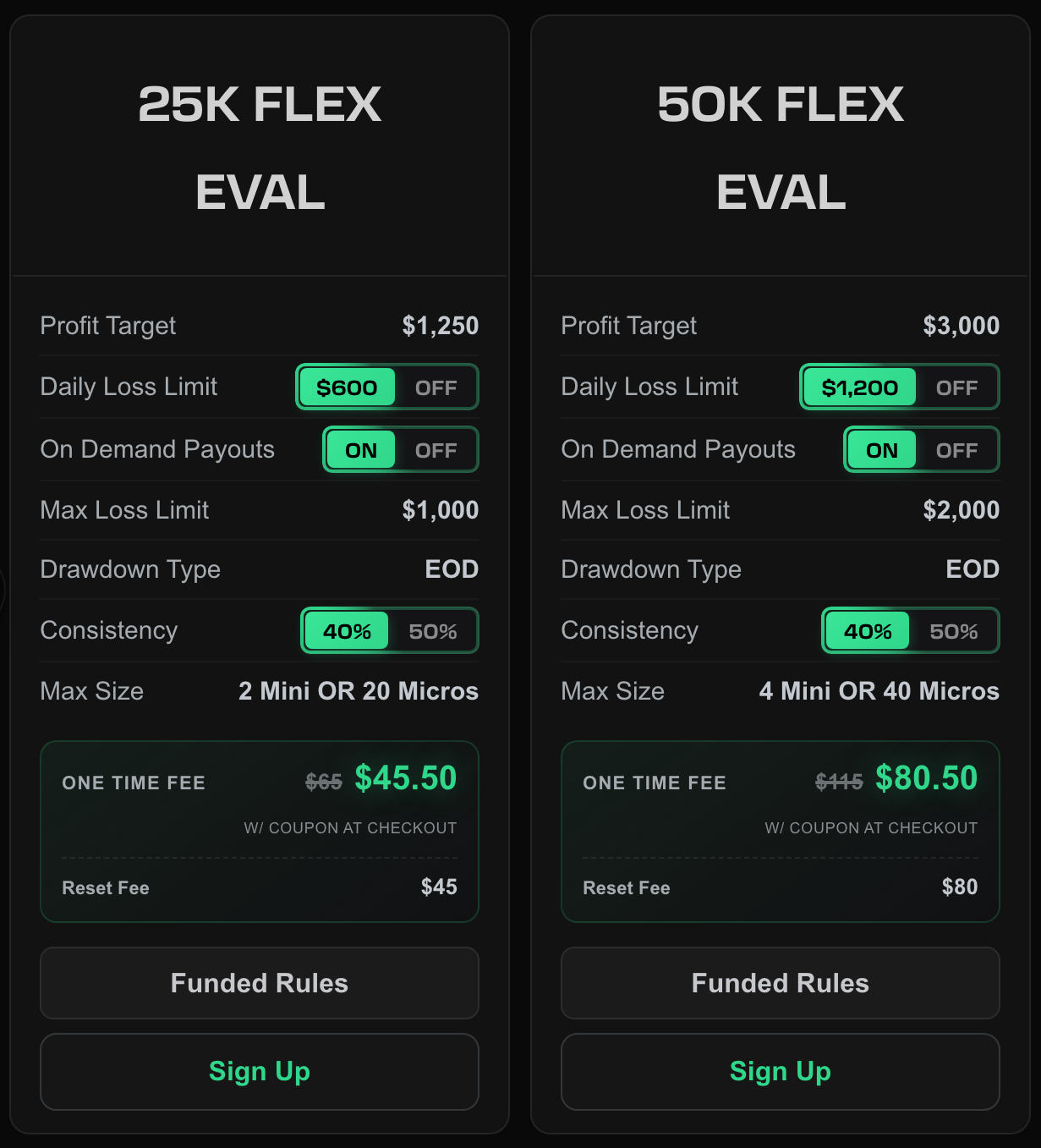
Every option moves both numbers. The 50% add-on takes a 50K Flex from $80.50 to $90.30, and switching the DLL off takes it to $115.50; both together, $130.20. On LucidPro, DLL off means $150.50 on a 50K. Resets follow the same options.
Resets are paid and never automatic. A reset puts the account back to its starting balance and risk parameters, and a breached evaluation is deleted after 30 days if you have not reset it. You can run up to 10 evaluations per household, within a total of 10 accounts across evaluations and funded accounts.
Express to Live: no consistency rule, no minimum days
A 5-step plan to pass the Lucid evaluation
- Pick the plan for your profit curve. Big-day trader: LucidPro, or the 50% add-on on Flex. Steady trader: Flex at 40%, the cheapest version.
- Write down your daily ceiling before the first trade. Target × 40% (or 50%). On a 50K Flex: $1,200. Above it, you are buying extra days.
- Size against the max loss, not the target. With $2,000 of room on a 50K, a plan that risks $400 a day survives four bad sessions in a row; the fifth would reach the max loss.
- Know where your floor is. Every record close lifts it until a close passes the trail balance; then it is fixed at the starting balance plus $100. Slow down near the finish rather than speeding up.
- Stay inside the rules. Flat by 4:45 PM EST on Pro and Flex, no strategy that makes most of its profit from trades of 5 seconds or less, no hedge, and on LucidDaily no news trading.
Passing is the first half. What the funded account pays, and when it can go live, is in our LucidFlex payout rules and Lucid live account rules guides.
Lucid evaluation vs Phidias Express to Live
At Phidias, the Express to Live evaluation has no consistency rule, no minimum trading days and no daily loss limit, on every size. The drawdown is static: it never trails, so there is no lock to plan around. News trading is allowed at every stage.
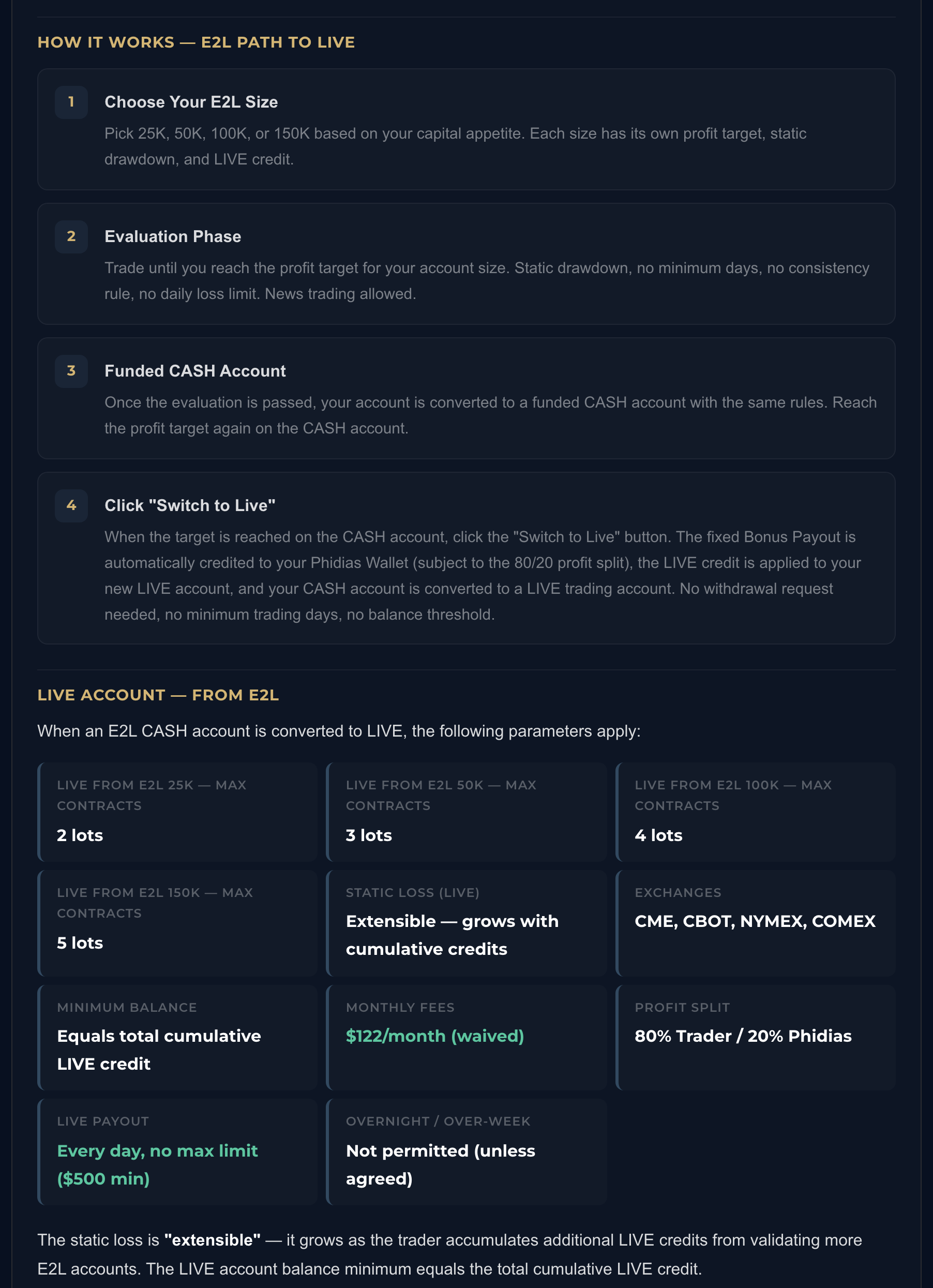
The honest part: Lucid gives you more room. Its 50K drawdown is $2,000 against our $650, and its entry price is lower (a 50K Flex at $80.50 with its coupon, against $144.60 with code PHIDIAS for our 50K Express to Live bought as a one-time payment, catalog $723). Targets cut both ways: $1,500 against $1,250 on a 25K, but $2,500 against $3,000 on a 50K. And on our side the target counts twice: once on the evaluation, once more on the CASH account before the payout.
What you get in exchange is a race with no ratio. No ratio to watch, no days to fill, no daily cut, and a first payout that converts the account to LIVE. The full Express to Live cycle can run in a single day: our record from purchase to payout is 6 hours 18 minutes, and 90% of our payouts are processed in under 30 minutes, all within 24 hours. The 25K Express to Live goes from $277 to $69 with code PHIDIAS as a one-time payment. Positions are closed before the end of the session, and every rule is on our rules page.
Test: which evaluation fits the way you trade?
Three questions on how you make your money. No email.
30 second check
Which evaluation fits the way you trade?
Lucid eval rules 2026: frequently asked questions
What are the Lucid eval rules?
Every Lucid evaluation has the same targets and drawdowns: $1,250 profit target and $1,000 max loss on a 25K, $3,000 and $2,000 on a 50K, $6,000 and $3,000 on a 100K, $9,000 and $4,500 on a 150K. The drawdown is end of day on Flex and Pro, and LucidDaily lets you pick end of day or intraday for the evaluation. LucidFlex adds a 40% consistency rule (50% as a paid add-on), LucidDaily a 40% or 50% rule depending on the Lucid page, and LucidPro has no consistency rule in the evaluation.
Can you pass a Lucid evaluation in one day?
On LucidPro, yes: Lucid says you can pass the evaluation in one trading day, because the Pro evaluation has no consistency rule. On LucidFlex, no: the 40% rule means at least 3 profitable days, or 2 with the 50% add-on. LucidDaily needs at least 2 days with its 50% option, 3 with 40%.
How many days does it take to pass LucidFlex?
At least 3 trading days with the standard 40% consistency, or 2 days with the 50% add-on. There is no deadline: the evaluation is a one-time fee with no monthly rebilling, and Lucid says you can take as long as you need. An account with no trade of at least $1 net profit or loss in 30 calendar days is deleted, though.
Is there a consistency rule on the Lucid evaluation?
On LucidFlex, yes: your largest single day must be 40% or less of your evaluation profit, or 50% with the add-on. On LucidDaily, Lucid’s evaluation page says 50%, while its customization page and the pricing card offer 40% or 50%. The LucidPro evaluation has no consistency rule; Pro’s 40% rule applies to funded payouts.
How much is a Lucid reset?
It depends on the plan, size and options. With the daily loss limit on and the standard 40% consistency (end-of-day drawdown on LucidDaily), the reset fee shown on Lucid’s pricing cards on October 27, 2026 was $45 to $225 on LucidFlex, $75 to $255 on LucidPro and $60 to $200 on LucidDaily. Other options move it: up to $250 on Flex with the 50% add-on and the daily loss limit on ($295 with it off), from $50 on LucidDaily with an intraday drawdown. A reset returns the account to its starting balance and risk parameters, and a breached evaluation is deleted after 30 days if you do not reset it.
How many Lucid evals can you have?
Up to 10 active evaluation accounts per household, and 10 accounts in total across evaluations and funded accounts. Funded accounts are capped at 5 per household, so with 5 funded accounts you can keep 5 evaluations in reserve.
What happens after you pass the Lucid evaluation?
Lucid upgrades you to the funded account within 5 to 30 minutes of hitting the profit target, and it charges nothing for the upgrade. The funded rules then change by plan: no consistency rule on Flex and Daily funded accounts, a 40% rule per payout cycle on Pro.
Which prop firm has no consistency rule on the evaluation or the funded account?
Phidias Express to Live: no consistency rule at any stage, no minimum trading days and no daily loss limit, with a static drawdown that never trails. Your first payout converts the account to a LIVE account.
Related guides
Read it yourself
The verdict
“Lucid’s evaluation is fair on paper: a roomy drawdown, a cheap entry and no deadline. The catch is the ratio. On Flex you are not trading to a target, you are trading to a target spread over at least three days. If your edge shows up in one or two big sessions, take the evaluation that has no ratio at all.”
William G., CMO at Phidias Propfirm
William G., CMO at Phidias Propfirm, works on futures prop trading rules and payouts every day. Last reviewed 2026.
Lucid Trading rules and prices as published on its help center and pricing page on October 27, 2026. Prop firms change their rules and prices often: check the official pages before you buy. Trading futures involves substantial risk of loss.