LucidPro payout rules, 2026
The LucidPro payout rules size by size: $1,000 to $3,000 on payout 1, then $1,500 to $3,500, the buffer you can never withdraw, the 40% consistency rule that resets after every payout, On Demand payouts, and what really happens after payout five.
Every rule read in Lucid Trading’s help center, and every price on lucidtrading.com with the Daily Loss Limit switched both ways, on October 21, 2026.
LucidPro pays 90/10 when three conditions are met in the same cycle: a minimum profit goal ($250 to $1,000 by size), a largest day of no more than 40% of the cycle’s profit, and a balance above the buffer. The first payout is capped at $1,000 on a 25K up to $3,000 on a 150K, every later one at $1,500 to $3,500. The minimum is $500, and Payout 5 is the last one before a discretionary live review.
In short
- Max payout: payout 1 up to $1,000 (25K), $2,000 (50K), $2,500 (100K) or $3,000 (150K). From payout 2: $1,500, $2,500, $3,000 or $3,500. Minimum $500.
- To qualify for a payout: the minimum profit goal of the cycle, a best day of 40% or less of the cycle’s profit, and a balance above the buffer. All three reset after each payout.
- The buffer: starting balance plus the max loss limit plus $100. On a 25K, $26,100. You can never withdraw it.
- The upside of the buffer: after a payout, your full max loss limit is still there, because the floor is locked at the starting balance plus $100.
- On Demand payouts: only if you bought the account with the Daily Loss Limit on.
- Live: Payout 5 is the maximum payout level, not a guarantee. The move to live is at Lucid’s discretion, and live accounts start at a $0 balance.
- Faster to LIVE: Phidias Express to Live, 25K $69 instead of $277 as a one-time payment with code PHIDIAS, and the first payout converts the account to LIVE.
What are the LucidPro payout rules?
Three conditions open a LucidPro payout, and a cap that depends on the size and the payout number limits it. Here is the whole rule set of a funded LucidPro account, as Lucid’s help center states it in October 2026:
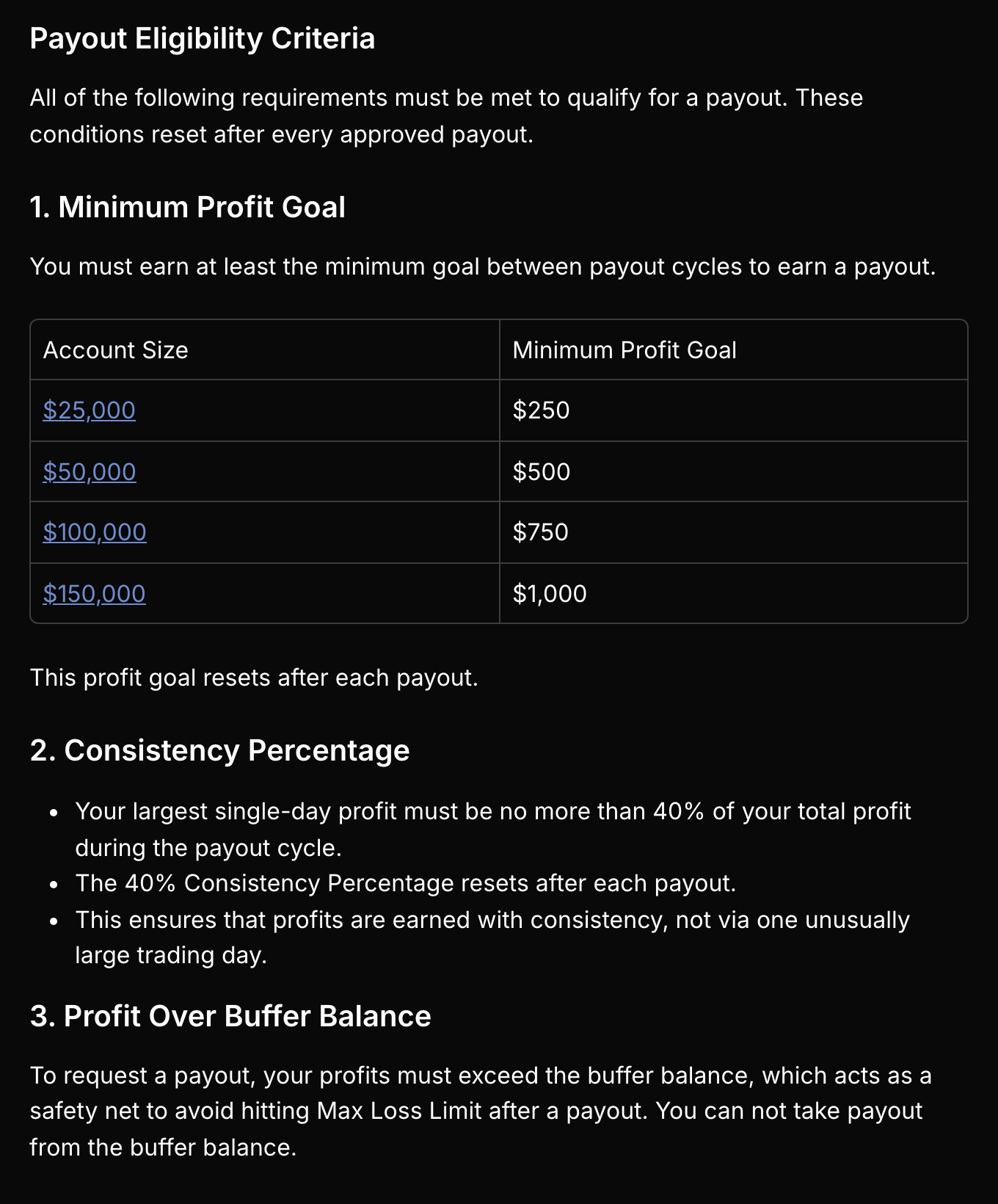
Two more lines from the same page matter. A payout request is final: it cannot be edited or cancelled once submitted. And if you trade after submitting and your balance drops into the buffer before approval, the request may be denied. Lucid’s advice: trade as if the payout had already left the account.
What is the LucidPro max payout per account size?
The cap depends on the size and on whether it is your first payout. Unlike LucidFlex, the LucidPro cap rises from the second payout on, and each cap comes with the balance you need to take it in full.
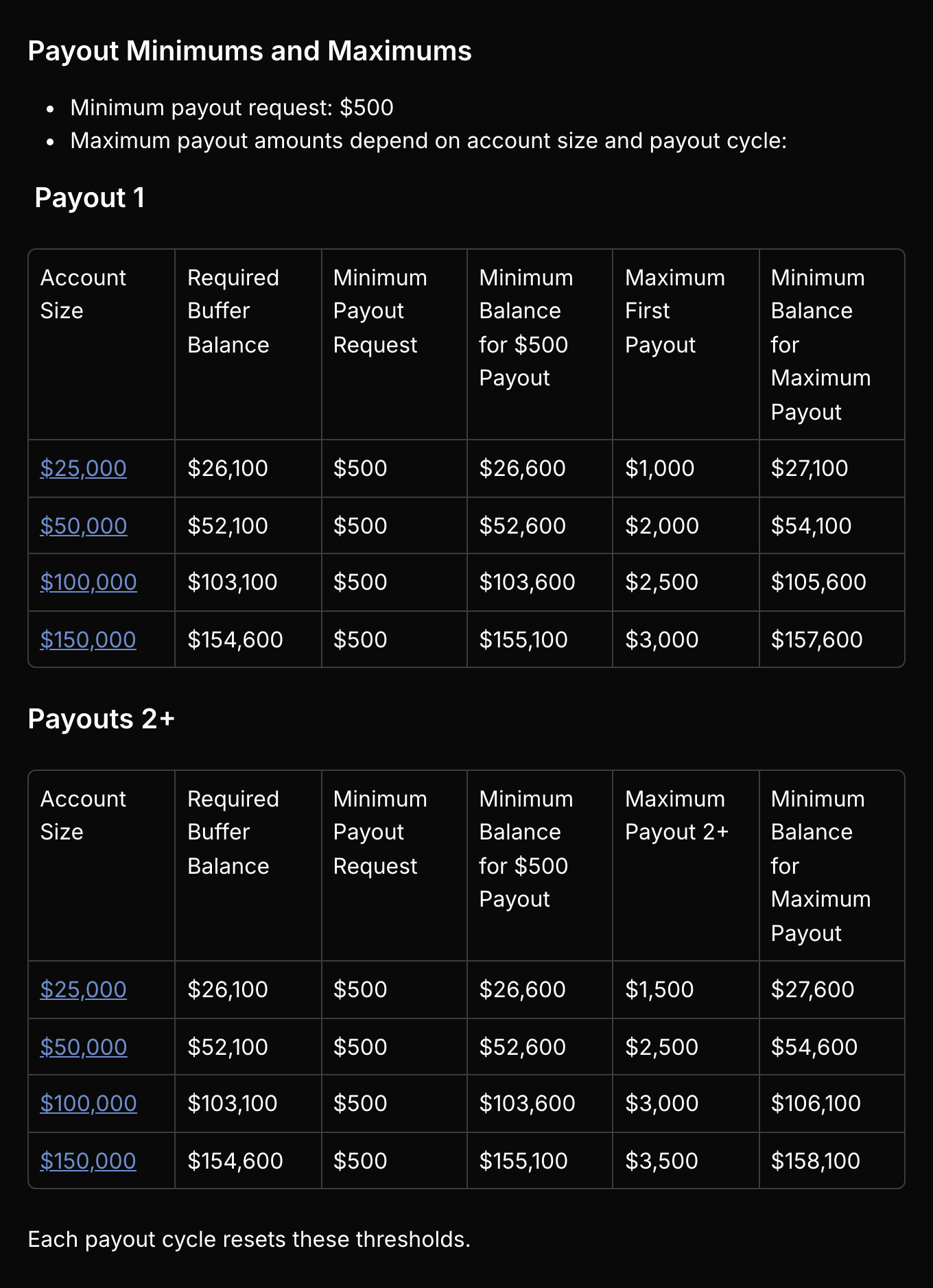
How much can one account pay in total? For accounts bought or reset after February 27, 2026, Lucid’s live page says Payout 5 is the maximum payout level on Pro. Five payouts at the cap add up to, by our sum and before any move to live:
One wording detail: Lucid’s funded account page lists “No simulated payout caps” among its benefits, while the payout page sets a maximum for every request. Plan on the payout table: it is the one that decides what you can request.
What is the LucidPro buffer?
The buffer is the part of the balance you can never withdraw: the starting balance plus the initial max loss limit plus $100. Your profit has to sit above it before any request.
Read the buffer with the drawdown page next to it. The buffer equals Lucid’s Initial Trail Balance, the level where the end of day max loss limit stops trailing and locks at the starting balance plus $100. So once your balance has closed above the buffer, the floor no longer moves.
Worked example on a 50K: you close at $54,100, so $4,100 of profit. You take the full $2,000 and the balance drops to $52,100. The floor is locked at $50,100, so you still have $2,000 of room, your whole original max loss limit. That is the real benefit of the buffer: a payout never eats your drawdown.
How does the LucidPro 40% consistency rule work?
On a funded LucidPro account, your largest single day must be no more than 40% of your total profit in the payout cycle. The count resets after every payout, so each cycle has to pass it again.
Lucid’s formula is largest single day profit ÷ account profit. Its example on a 50K: a $1,000 best day on $4,000 of profit is 25%, so you can request. If your best day is above 40%, you keep trading until it falls back under the line.
Apply it to the worked example above. To take the full $2,000 on a 50K, you need at least $4,100 of profit; close the cycle at exactly $4,100 and no single day can be above $1,640. In the next cycle, the $2,500 cap needs at least $2,500 of fresh profit; at exactly $2,500, no day can be above $1,000. In practice every cycle needs at least three profitable days, since two days could never both stay under 40%.
Two exceptions. Accounts bought or reset before November 28, 2025 at 3:00 PM EST keep a 35% rule. And the rule disappears once you are promoted to a live account. Our guide to the consistency rule shows how these percentages compare across firms.
What are LucidPro On Demand Payouts?
On Demand Payouts let a funded LucidPro account withdraw profit made during the session, from 6:00 PM to 3:45 PM ET. You only get them if you bought the account with the Daily Loss Limit on, and after an intraday payout request, trading on the account is paused until the end of the trading day.
LucidPro has a single setting at purchase, so two configurations, and it cannot be changed once the account is active:
Prices are those shown on Lucid’s pricing card on October 21, 2026, with the coupon applied at checkout, against a catalog price of $108, $172, $272 and $365. The catalog price is the same in both setups: turning the daily loss limit off adds a surcharge (+$14.70 on the 25K card), so the version with the limit is the cheaper one at every size. The evaluation is a one-time fee, the funded account is activated within 5 to 30 minutes of hitting the target, there is no activation fee to move to it, and it has no scaling plan: the max contract size is available from day one. With the limit on, on the funded account, once the balance closes above the buffer, the fixed daily limit becomes a LucidScale DLL of 60% of your highest end of day profit.
Lucid calls its daily loss limit a soft breach: hit it and you are locked out until the next session. The account survives as long as the max loss limit is not hit, but the loss is booked. On Demand payouts are the reward for accepting that limit.
How long does a LucidPro payout take?
Approved payouts are deducted from the account within a few minutes. Lucid’s help center commits to sending them to your payment method within 2 business days, and its homepage advertises “15ish min from request to bank”. Lucid offers three payout methods:
- Plaid: instant bank transfers for U.S. traders.
- WorkMarket by ADP: U.S. and international, by bank transfer or PayPal, often as early as the next business day.
- Crypto for international traders: BTC, ETH, LTC, USDT or USDC.
Positions on LucidPro must be closed by 4:45 PM EST, Monday to Friday. Lucid closes them automatically at that time, and holding past it does not fail the account.
Express to Live: no consistency rule, payout on Day 1
Does LucidPro move you to a live account after 5 payouts?
Not automatically. Payout 5 puts you in Lucid’s live review pool, and Lucid’s live structure page is explicit: it “represents the maximum payout level, not a guaranteed minimum for live eligibility”, and all live transitions are at the risk team’s discretion. Lucid also reviews traders who have been paid a large amount over time or who perform exceptionally in sim funded, but no route guarantees a live account.
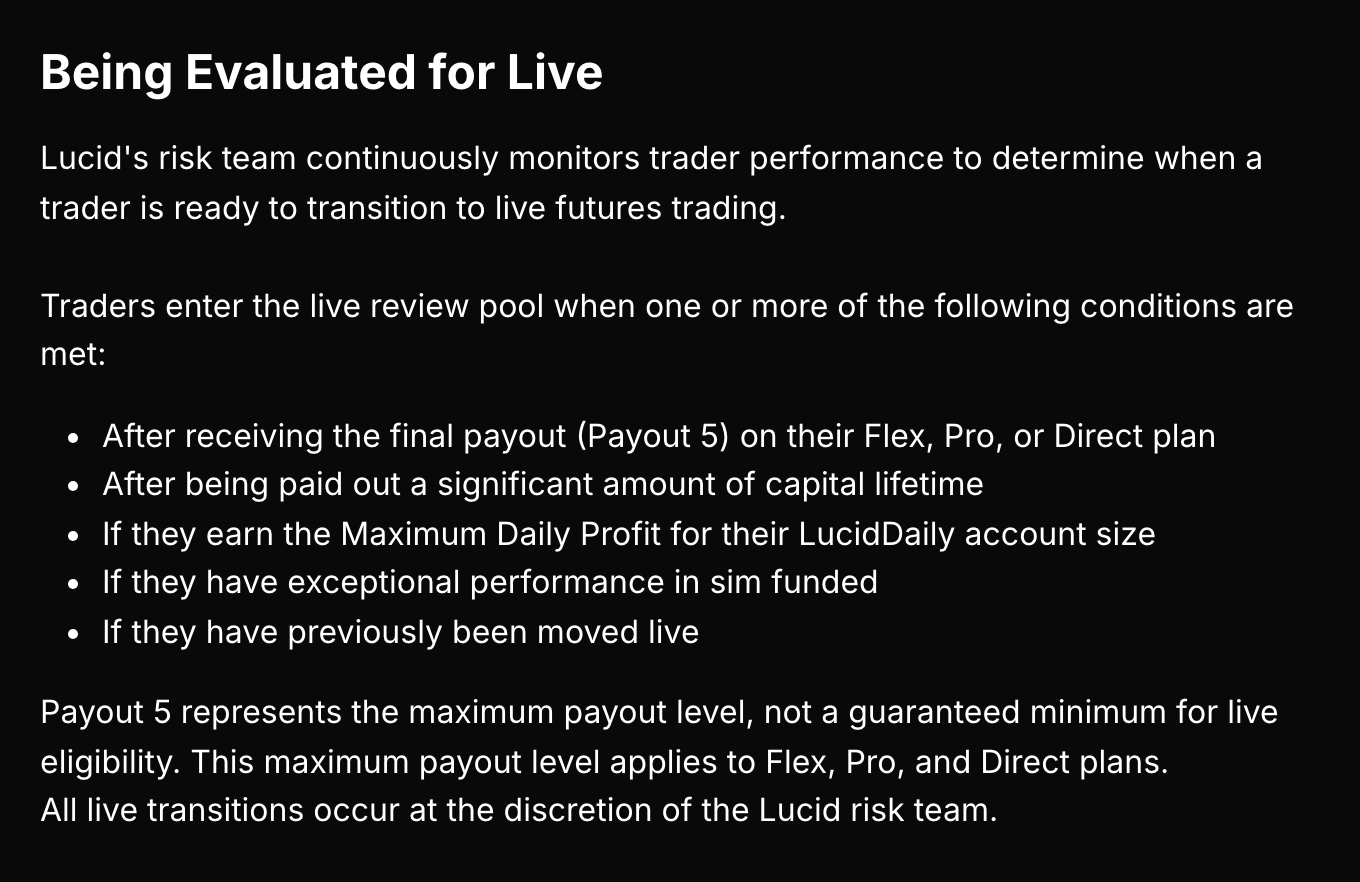
If you are moved live, the terms are clear. Every live account starts with a $0 balance, with an end of day drawdown of $1,000 (25K), $2,000 (50K), $3,000 (100K) or $4,500 (150K), daily payouts, no daily loss limit and no consistency rule. Each funded account needs at least one payout to qualify, and all your simulated accounts are closed when you move. Our Lucid live account rules guide covers the scaling plan and the repeatable Live Bonus. If a funded account is not moved live because it is ineligible, Lucid refunds its evaluation cost, as long as at least 50% of its total drawdown remains.
Lucid also offers a cashout instead of going live, equal to 50% of what it calls ‘a traders live starting balance’, at 90/10; without a choice within 24 hours of the email, the accounts move live automatically. A repeatable live bonus pays, for example, $2,000 on a 50K after $4,000 of live profit and 20 trading days, also at 90/10. Pro accounts bought or reset on or before February 27, 2026 follow an older structure, with a sixth payout, a move to live cap and escrow.
LucidPro vs Phidias Express to Live
Phidias first: Express to Live bought as a one-time payment bundles the evaluation and the funded account in one price, and your first payout converts the account to LIVE. No buffer, no consistency rule, no daily loss limit.
The honest reading: LucidPro gives you a bigger drawdown in dollars, a better split, a cap that rises, up to five payouts from the funded account, and a buffer that protects your room after each payout. Ours pays one fixed bonus before LIVE, and our drawdown is smaller, but it is static: it never trails your highest point, nothing about your best day can block a payout, and the step to LIVE is set by a rule, not a review: the first payout converts the account, with a $1,000 LIVE credit as a static loss allowance on the 50K. Lucid’s live 50K starts at a $0 balance with a $2,000 end of day drawdown.
Our record from purchase to payout is 6 hours 18 minutes, and 90% of Phidias payouts are processed in under 30 minutes, every payout within 24 hours. Once LIVE, payouts are available every day at 80/20, with no payout cap ($500 minimum), no consistency rule and no minimum days. One-time payment prices with code PHIDIAS: $69 (25K, standard $277), $144.60 (50K, $723), $180 (100K, $900), $225 (150K, $1,125).
Two honest notes. Express to Live positions must be closed before the end of the trading day, and a position left open at the close disqualifies the account; Lucid closes open positions itself at 4:45 PM EST without failing the account. And our monthly subscription accounts do have an activation fee, from $83 to $169: only the one-time payment includes the funded account. Both are on our rules page. Our static drawdown prop firms guide explains why a fixed floor matters.
LucidPro vs LucidFlex payouts
LucidPro trades more rules for a bigger cap. Both plans cap the first payout at the same amount. From payout 2, the Pro cap rises ($1,500 on a 25K) and the Flex cap does not. In exchange, Pro adds a 40% consistency rule and a buffer on the funded account, where Flex has neither but asks for five days at a minimum profit per cycle and caps each request at half your profit. The details are in our LucidFlex payout rules, and LucidPro vs LucidFlex goes deeper on the choice. Our Lucid payout rules guide compares every Lucid plan.
Test: do the LucidPro payout rules fit you?
Four questions on how you make money, what you want from each payout, the daily loss limit and what comes after. No email.
30 second check
Do the LucidPro payout rules fit the way you trade?
LucidPro payout rules 2026: frequently asked questions
What are the LucidPro payout rules?
To request a LucidPro payout you need three things in the same cycle: the minimum profit goal ($250 on a 25K, $500 on a 50K, $750 on a 100K, $1,000 on a 150K), a largest day of no more than 40% of the cycle’s profit, and a balance above the buffer, which is the starting balance plus the max loss limit plus $100. The minimum request is $500 and the split is 90/10.
What is the LucidPro max payout?
The first payout is capped at $1,000 on a 25K, $2,000 on a 50K, $2,500 on a 100K and $3,000 on a 150K. From payout 2 the cap rises to $1,500, $2,500, $3,000 and $3,500. Lucid’s live page says Payout 5 is the maximum payout level, so a funded account bought or reset after February 27, 2026 can pay at most $7,000 to $17,000 in requests before the 90/10 split (our sum), before any live account.
What is the LucidPro buffer?
The buffer is the initial max loss limit plus $100 above the starting balance: $26,100 on a 25K, $52,100 on a 50K, $103,100 on a 100K and $154,600 on a 150K. You cannot withdraw from it, so the $500 minimum needs a balance of $26,600 on a 25K, and the maximum first payout needs $27,100.
Does LucidPro have a consistency rule on the funded account?
Yes. On a funded LucidPro account your largest single day must be no more than 40% of your total profit in the payout cycle, and the count starts again after every payout. Accounts bought or reset before November 28, 2025 at 3:00 PM EST keep a 35% rule. The rule disappears once you are moved to a live account.
How many days do you need for a LucidPro payout?
There is no minimum number of days, but the 40% consistency rule sets one in practice: no single day can be more than 40% of the cycle’s profit, so you need at least three profitable days in each cycle. Once eligible, you can request any day: Lucid has no fixed payout window.
How long does a LucidPro payout take?
Lucid says approved payouts are deducted from the account within a few minutes and sent to your payment method within 2 business days, and its homepage advertises “15ish min from request to bank”. Methods are Plaid, WorkMarket by ADP or crypto. With the Daily Loss Limit on, the funded account can also request On Demand payouts during the session.
Can you pass LucidPro in one day?
Lucid says the LucidPro evaluation can be passed in one trading day, with a profit target of $1,250 on a 25K up to $9,000 on a 150K. The 40% consistency rule only starts on the funded account, before each payout.
Does LucidPro move you to a live account after 5 payouts?
Not automatically. Lucid’s live structure page says Payout 5 represents the maximum payout level, not a guaranteed minimum for live eligibility, and that every live transition is at the risk team’s discretion. Lucid also reviews traders who have been paid a large amount over time or who perform exceptionally in sim funded, but no route guarantees a live account. Live accounts start with a $0 balance and an end of day drawdown.
Related guides
Read it yourself
- Phidias accounts and prices
- Phidias rules (Express to Live)
- Lucid: LucidPro payouts
- Lucid: LucidPro consistency percentage
- Lucid: LucidPro drawdown
- Lucid: LucidPro customization and On Demand Payouts
- Lucid: LucidPro funded account
- Lucid: live structure
- Lucid: payout methods
- Lucid: LucidPro evaluation account
- Lucid: LucidPro daily loss limit
- Lucid: allowed trading times
- Lucid: LucidPro live legacy
- Lucid Trading: pricing
The verdict
“LucidPro is the Lucid plan for steady traders: a cap that rises after the first payout, and a buffer that leaves your whole drawdown in place when you withdraw. But the 40% rule comes back in every cycle, and five payouts lead to a review you do not control. If the goal is a LIVE account, pick one where the first payout gets you there.”
William G., CMO at Phidias Propfirm