MyFundedFutures scaling plan, 2026
Rapid, Rapid EOD and Builder have no scaling plan at all. Pro has one, and almost nobody mentions it: 3 minis become 5 the day you pass.
Then Pro scales back down at the live stage, and so does Rapid. The three plans that had a real balance-linked ladder have all been retired. Every figure read from their plan guides and plan page configurations on 15 September 2026.
Weighing the alternatives? Phidias Express to Live is the account we build. First, the contract limits as published.
Does MyFundedFutures have a scaling plan?
On one of the four plans it sells today. Pro raises your allowance when you pass, and its own parameter table labels the row “Scaling / Max Contacts”. On the 50K that is 3 minis in the evaluation and 5 once sim funded.
Rapid, Rapid EOD and Builder have nothing of the kind. The number is set by the account size you buy and is identical before and after you pass. There is nothing to climb.
If what you had in mind was an allowance that grows with your balance, that belonged to Core, Scale and Flex. All three are retired. The rest of this page is the current grid, stage by stage, and it is the one part of MyFundedFutures nobody publishes in one place.
What each plan actually allows, by stage
Read the first two columns across. On the top eight rows nothing changes: the number you buy is the number you trade, from your first order in the evaluation to your last one as a sim funded trader. On the Pro rows it rises by two thirds.
Pro: the only current plan that scales, and it scales both ways
Pro is genuinely different and it is badly under-reported, including by us until we checked the configuration behind their own plan page.
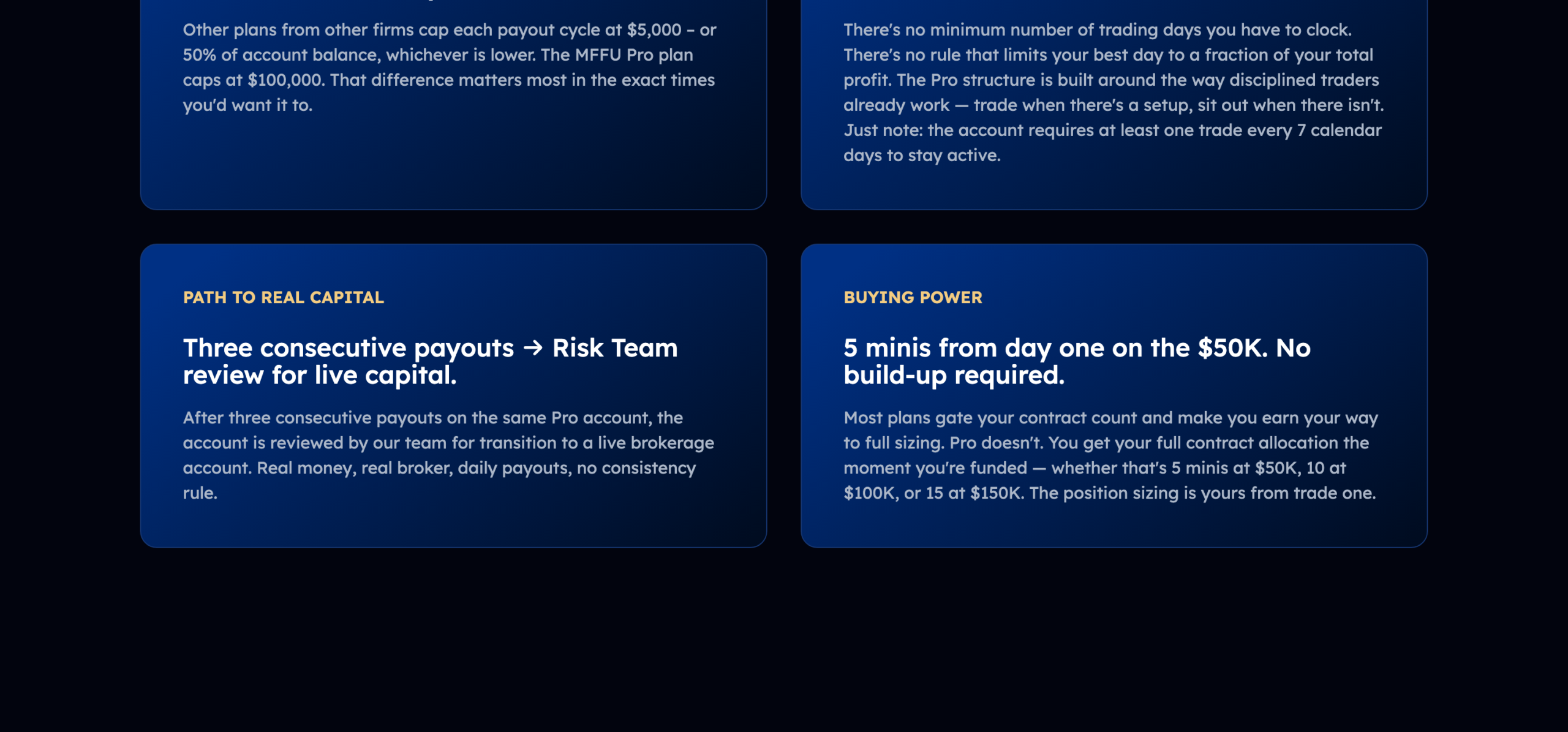
Evaluation: 3 minis on the 50K, 6 on the 100K, 9 on the 150K. Sim funded: 5, 10 and 15. That is a 67% increase at the moment you pass, and MyFundedFutures confirms the mechanism in its own Pro FAQ: asked whether the scaling rule is present in the evaluation, it answers that scaling rules are not present there. The implication is that they are present afterwards.
Live: a range rather than a number. 2 to 4 on the 50K, 3 to 5 on the 100K, 4 to 6 on the 150K. So the plan that scales up is also the plan that scales back down.
The range is not arbitrary. It sits directly beneath a live allocation that is itself a range, $2,000 to $5,000 on the 50K, $3,000 to $7,500 on the 100K and $4,500 to $10,000 on the 150K, with a daily loss limit range that widens in step. Your contract band tracks the size of the live account you are actually granted. What decides that allocation is not published.
One line in the Pro table that deserves a second look. Its sim funded row reads “5 mini / 5 micro”, then “10 mini / 10 micro” and “15 mini / 15 micro”. That is a one to one micro ratio, where every other current plan counts ten micros to a mini. Taken literally it would make micros almost unusable on Pro, since 5 micros is a twentieth of the risk of 5 minis. We are reporting it exactly as published rather than assuming a typo, but it is worth a support ticket before you size a micro strategy on this plan.
Rapid: flat all the way, then smaller at the live stage
Everything about a prop firm evaluation is framed as progress: pass, get funded, take payouts, reach live. On Rapid the contract allowance does not reward any of that, and at the last step it reverses.
Between a fifth and two fifths of your size, removed at the moment you arrive. The 50K is the sharpest: you finish the hardest part of the process and trade 40% smaller than you did the day before.
There is a defensible reason for it. A live account is real money at a clearing firm rather than a simulated balance, and sizing down at that transition is prudent risk management on the firm’s side. But it is not what the word scaling implies, and it is on no pricing page.
The three ladders MyFundedFutures retired
Every genuine balance-linked ladder this firm published belongs to a plan it no longer sells. Worth recording, because these are the tables the search results are still full of.
Scale went furthest. On the 150K it ran five rungs, from 2 minis below $1,000 to 9 minis above $6,000. On the 50K it was 1 mini, then 2, then 3.
All five of those ladders applied to the sim funded stage only. Each plan’s evaluation was flat, which is a distinction most summaries lose.
Core and Scale went around the turn of 2026. Flex was discontinued on 5 August at 10pm ET, a date its own help center guide still carries at the top, and the MyFundedFutures homepage now states “Four plans”: Builder, Rapid, Rapid EOD and Pro.
Note also that Core and Scale counted five micros to a mini, while Flex counted ten. The ratio has never been consistent at this firm, which is the practical reason to read your own plan’s table rather than a generic one.
Will contract limits get in your way? Four questions on what brought you here, how much size you need, whether you mix minis and micros, and where you are trying to get to. No email.
30-second check
Will contract limits get in your way?
The document that contradicts all of this
If you have read that Rapid starts you at 2 contracts, this is the source. MyFundedFutures’ cross-instrument policy says, in its own worked example:
If you are trading a Rapid 50k sim funded plan, you start off with 2 contracts (2 minis OR 20 micros) due to the scaling plan.
MyFundedFutures cross-instrument policy
Three current sources say otherwise, and they agree with each other: the Rapid 50K plan guide gives 5 minis / 50 micros in the sim funded stage, the rendered Rapid plan page shows the same, and the configuration behind that page carries an identical value for the evaluation and funded stages.
We follow the three, not the one, and we are telling you which rather than picking quietly. That is a weight of evidence judgement, not a claim that the cross-instrument page is abandoned: it carries a recent update stamp. It may simply be an example written for an older plan and never revisited. If your own dashboard shows 2 contracts on a Rapid 50K, that is worth a support ticket rather than an assumption either way.
What actually limits your size, if not a ladder
The cross-instrument rule. Your allowance is a total, not a per-instrument figure, and MyFundedFutures is explicit that the platform will let you break it:
Orders that combine different instruments (e.g., 2 minis and 20 micros) may technically execute even if they exceed the overall limit (e.g., more than 2 contracts in total), but this is not permitted!
MyFundedFutures cross-instrument policy
A single instrument order over the cap is rejected automatically. A mixed order is not. The fill is not permission, and MyFundedFutures states that deliberate attempts to circumvent the limit are treated as a breach. Note separately that an E-mini and its Micro count as the same underlying asset for the hedging rule, so opposing positions across the two are not two trades.
The 2% price limit rule. Independently of contract counts, you cannot trade a product sitting within 2% of its exchange price limit, and MyFundedFutures applies this in the sim funded and live stages. On equity products the overnight limit is 7%, which puts the trader ceiling at 5%. It restricts what you can trade rather than how much, but it bites on exactly the volatile days when size matters.
Where we differ
A firm capping contract size is normal and correct. Someone has to carry the risk, and an uncapped simulated account would be a worse product, not a better one.
Our disagreement is about which direction the account travels. Take Rapid: you buy your size, you keep that size through the evaluation, you keep it while you take payouts, and then you lose a third of it at the moment you arrive. Take Pro: it rises by two thirds when you pass, then falls back into a band decided by an allocation nobody publishes.
At Phidias you can hold five accounts per family across Express to Live, Fundamental and Premium, fifteen at once, and the simulated stage exists to get you to a LIVE account, which is where real capital enters the picture. That is the only stage at which the money stops being simulated, and it is the destination rather than a step down.
If a growing allowance is genuinely what you are after, the honest summary is this: MyFundedFutures retired all three plans that offered one, and the single plan that still scales does it in one jump and then takes part of it back.
See Phidias accounts and pricing
MyFundedFutures scaling plan: frequently asked questions
Does MyFundedFutures have a scaling plan?
On one of the four plans it sells today. Pro raises your contract allowance when you pass, from 3 minis to 5 on the 50K, and its own parameter table labels that row “Scaling / Max Contacts”. Rapid, Rapid EOD and Builder have no scaling at all: the number is fixed by account size and identical in evaluation and sim funded. The gradual balance-linked ladders people usually mean belonged to Core, Scale and Flex, all three now retired.
What is the MyFundedFutures scaling rule on the Rapid plan?
There is not one. The Rapid plan guide gives a single figure per size that applies in evaluation and again once sim funded: 3 minis on the 25K, 5 on the 50K, 8 on the 100K and 10 on the 150K, or ten times those numbers in micros. The configuration behind their own Rapid plan page lists the same value for both stages.
Why do some sources say Rapid starts with 2 contracts?
Because MyFundedFutures’ cross-instrument policy says so. It reads that on a Rapid 50K sim funded plan you start with 2 contracts due to the scaling plan. Three current sources disagree with it: the Rapid 50K guide, the rendered plan page and the configuration behind that page all give 5. We follow the three rather than the one, and we flag the conflict rather than hide it.
How many contracts does the Pro plan allow?
Three different answers by stage. Evaluation: 3 minis on the 50K, 6 on the 100K, 9 on the 150K. Sim funded: 5, 10 and 15. Live: a range of 2 to 4, 3 to 5 and 4 to 6, sitting directly beneath a live allocation that is itself a range. Pro is the only current plan where the number goes up at funding, and it goes back down at live.
Is the micro ratio the same on every MyFundedFutures plan?
No, and this catches people out. Rapid, Rapid EOD, Builder and Flex all count ten micros to a mini. Pro’s parameter table reads “5 mini / 5 micro”, a one to one ratio, which would make micros almost unusable on that plan as published. The retired Core and Scale plans used five micros to a mini. Check the figure for your own plan rather than assuming the ten to one you saw elsewhere.
What was the MyFundedFutures Core scaling plan?
Contracts grew with your sim funded balance in three steps: 1 mini or 5 micros below $1,000, 2 minis or 10 micros from $1,000 to $2,000, and 3 minis or 15 micros above that. MyFundedFutures stated that scaling applied to the sim funded stage only and never to the evaluation. Core was retired around the turn of 2026.
Does the Flex plan have a scaling plan?
It did, on the sim funded stage only. Flex 25K gave 1 mini from $0 to $749 then 2 minis above $750; Flex 50K gave 1 mini to $1,499, 2 to $1,999 and 3 from $2,000. Its evaluation was flat at 2 and 3 minis. The Flex guide carries its own notice that the plan was discontinued on 5 August at 10pm ET, and the MyFundedFutures homepage now states four plans without it.
Do MyFundedFutures contracts increase when you get funded?
Only on Pro, where 3 minis becomes 5 on the 50K. On Rapid, Rapid EOD and Builder nothing changes at that step. The stage where the number moves for everyone is the live account, and there it falls: on Rapid, 3 minis becomes 2, 5 becomes 3, 8 becomes 6 and 10 becomes 8.
Can you trade minis and micros at the same time on MyFundedFutures?
Only within your total allowance. MyFundedFutures states that an order combining 2 minis and 20 micros may technically execute even though it exceeds the overall limit, and that this is not permitted. A single instrument order over the cap is rejected automatically; a mixed one is not, so the fill is not permission. Deliberate attempts to circumvent the limit are treated as a breach.
How does Phidias handle contract scaling?
Phidias runs futures accounts in three families, Express to Live, Fundamental and Premium, with up to five accounts per family and fifteen in total. The difference worth drawing here is the direction of travel: at Phidias the simulated stage leads to a LIVE account, which is where real capital enters the picture, rather than to a smaller contract allowance.
More on MyFundedFutures
· The Rapid plan explained: the drawdown that does change when you get funded.
· The retired Core plan: where the scaling ladder came from, and what replaced it.
· MyFundedFutures review 2026: the full breakdown of the current plans.
· The trading rules: the 2% price limit rule and what else can breach you.
· How many accounts you can hold: ten, then five, then one.
Useful resources
· The Rapid 50K guide, the document we follow on contract counts
· The cross-instrument policy, including the line that contradicts it
· Understanding Rapid Live, where the contract reduction is published
About the author
William G. is CMO at Phidias Propfirm. He writes the firm’s competitor analyses from primary sources: help centers, terms of service and published policies, never aggregators. Every contract figure on this page was read on 15 September 2026 from the individual MyFundedFutures plan guides, the Rapid Live and Pro articles, and the configurations behind their own plan pages, with the retired Core, Scale and Flex ladders recovered from archived copies of pages the firm has deleted. Where two of their documents disagree, as they do on Rapid sim funded contracts, this page says so and states which it follows and why, rather than quietly picking the more convenient number.