Tradeify discount code, 2026
Tradeify’s current code is not one discount. It is two, and the second one is worse.
It is written on their own banner, in six words that every coupon page reprints without reading: 2 time use, then 30% off. It also has a real end date, which is rarer in this industry than the discount itself.
Weighing this against the alternatives? Phidias Express to Live is the account we build. First, the Tradeify code, read properly.
What is the Tradeify discount code?
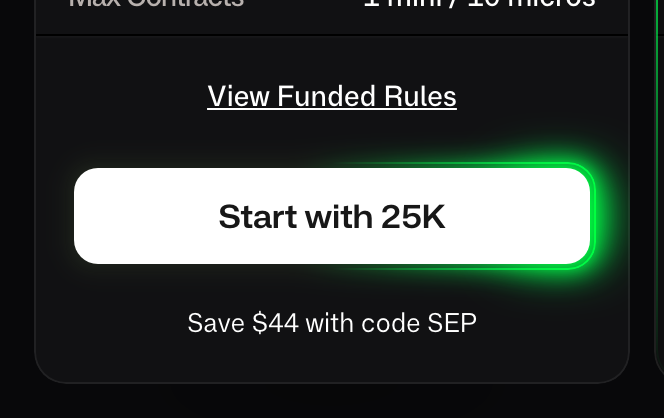
At the time of writing, the code on Tradeify’s own banner is SEP. It is not hidden behind an affiliate page or a newsletter signup: it sits on every account card, and each card prints the exact dollar saving it produces.

The code, as published by Tradeify
SEP
40% off, five uses. Then 30% off. Their banner reads: “40% OFF, MAX OF 5 USES, THEN 30% OFF”, then “ENDS 30 SEPTEMBER, 11:59PM EST”. The code itself sits on every account card, as “Save $44 with code SEP” on the cheapest size, rising to $148 on the largest.
Read from tradeify.co on 21 September 2026. The code is named after the month and carries a dated expiry, so expect it to be replaced. Tradeify publishes no promotion calendar, so if the letters above have changed, check the banner and read the small print next to the percentage. The structure of this page still applies: the tiering and the end date are the parts worth reading, not the letters.
Our verdict (William G.)
We compete with Tradeify, so weigh this accordingly, and we are not going to pretend the offer is bad. Tradeify charges no activation fee, which means a discount on the purchase price is a discount on the whole path to funded. That is not true of several firms we write about, and it makes this code worth more than a bigger-looking percentage elsewhere. Our two reservations are narrow. The headline rate is capped at five uses, after which it falls to 30%, which almost nobody reprinting this code mentions. And we could not find coupon terms anywhere Tradeify publishes them, so what happens if you want to apply the code to a reset is genuinely undocumented.
The part every coupon page leaves out
Search this term and you will find a dozen pages printing SEP next to the number 50. None of the pages ranking on page one when we checked printed the words that follow it on Tradeify’s own banner.
“40% OFF, MAX OF 5 USES, THEN 30% OFF”
The discount degrades, and it degrades fast. Read the obvious way, your first two purchases take 50% off and everything after that takes 30%. Whether those two uses are counted per account, per buyer or per code is not defined anywhere Tradeify publishes. For a trader buying one account, this changes nothing. For anyone running several accounts at once, which is the normal way funded traders operate, it is the difference between two prices.
Put a number on it. A Select 50K lists at $165, and Tradeify displays the discounted price as $83. At the lower rate the same account works out to about $116, and we say about because Tradeify never displays the lower-rate price anywhere: it rounds every saving it shows to the whole dollar, so the exact figure only appears at your own checkout. Call it thirty-three dollars more for an identical account, decided purely by where it falls in your sequence.
The bundle asks for five. The code now rewards five.
Directly under the account cards, Tradeify advertises a second offer:
“Buy 5 accounts, save 5%” / “Activate the bundle at checkout”
Through August these two offers did not match. The bundle asked you to buy five accounts while the code paid its top rate on only two, so the last three cost more and the gap landed on the buyer. That gap has closed. The September code carries a cap of five uses, which is exactly the number the bundle asks for.
Price it honestly. A Select 50K lists at $165 and shows $99 with the code, a saving of $66. Five of them at that same rate is $495, or about $470 if the bundle’s own 5% stacks on top.
That is less than the identical basket cost in August, when the headline rate was ten points higher. Two accounts at the old top rate plus three at the fallback came to roughly $513. A smaller percentage spread across five uses beats a bigger percentage capped at two, which is the whole reason the cap matters more than the number on the banner.
What the code actually covers
This is where a Tradeify discount behaves differently from most of the codes we analyse, and the reason is structural rather than generous.
Tradeify charges no activation fee. Every account card on their site, across all three plans, reads “Activation Fee: None”. There is no second payment waiting at the end of a passed evaluation. So the purchase price is the price of getting funded, and a discount on it is a discount on the entire path.
That is worth stating plainly, because several of the firms we write about do charge. At firms that charge to activate a funded account, a headline discount on the evaluation can leave the larger payment untouched, and the percentage on the banner describes only the smaller half of what you will spend.
The gap in the evidence
We checked three places Tradeify publishes policy: the Payouts and Billing collection in their help center, which holds eight articles and none on coupon codes; their Terms of Use; and their Funded Trader Agreement. None of the three sets out coupon scope. The Funded Trader Agreement does address the adjacent money, stating that fees paid are non-refundable and naming reset fees explicitly, but it says nothing about what a discount code reaches.
One thing their pricing page does show, and it cuts against the simple reading: the Growth 25K card displays its reset fee as $70 struck through, with $60 beside it. So resets can carry a discount. That reduction is neither 50% nor 30%, so it is not the code doing it, and Tradeify explains it nowhere. If you need a code to apply to a reset, ask their support in writing before you buy.
What you actually pay with the code
Every figure below was read from Tradeify’s own account selector on 7 September 2026, with each of the three plan tabs opened in turn. The table covers the four sizes common to all three plans. The discounted column is what their cards display. It works out to 50% in every case, rounded to the whole dollar, which is why a few cells land a fraction either side.
One thing to watch on their site: the tab selected by default is Select, not Growth, despite Growth being listed first. If you compare prices from memory afterwards, it is easy to attribute one plan’s numbers to another.
The discount is worth most in absolute terms on Lightning, which is the instant-funding plan with no evaluation to pass. A 150K Lightning account drops by $398. The same headline rate on a Growth 25K saves $49. If the code is what is deciding your purchase, that gap is worth a minute of thought before you pick a plan for other reasons.
What is the code actually worth to you?
Four questions on how many accounts you plan to buy, which plan you are leaning towards, what is driving the timing and how you intend to scale. One of the four outcomes tells you not to buy yet. No email.
40-second check
What is the Tradeify code actually worth to you?
How this code compares to the other permanent discounts
Almost every futures prop firm runs a standing discount, so the percentage on the banner is a poor way to tell them apart. What actually differs is the shape of the offer: whether it expires, whether it degrades, and how much of your total spending it can reach.
Tradeify’s code expires and degrades, but it reaches everything. The end date is real and the rate drops after two uses. Against that, there is no activation fee for it to miss, so what you save is a share of your whole cost of getting funded.
Apex runs the opposite shape. Their code is close to permanent and the headline number is far larger, but Apex states on its own page that coupon codes cannot be applied to resets or PA activation fees. A discount that big is applied to a smaller share of what you eventually spend. We take that apart in our page on the Apex Trader Funding coupon code.
Which of the two is worth more depends entirely on you, and it comes down to one question: how much of what you will spend happens after the purchase? If you expect to pass on your first or second attempt and there is no fee waiting at the end, a smaller discount on a complete price beats a huge discount on an entry ticket. If you expect a long run of attempts, neither code is documented as reaching a reset, so neither structure is one you can plan around.
Three things to read on the order screen
1. The total, not the code field. A code that is accepted is not the same as a code that was applied. The order total is the only confirmation that counts.
2. Which rate you got. If you have bought before, check whether the amount taken off matches the higher rate or the lower one. That tells you where you are in the sequence.
3. The plan on the card. The selector defaults to Select, and Growth is cheaper at every size except 150K, where both list at $369. Confirm the plan name on the line item, not the one you remember clicking.
Where we differ from Tradeify
Two things Tradeify does well, stated without hedging, because a comparison that pretends otherwise is not useful to you.
No activation fee, and a route to live capital with a published threshold. Tradeify presents Elite as a live program on real capital, and states the requirement on its own site: “Hit 3 approved payouts to qualify for Tradeify Elite – the best live program in prop.” Their help center lists the Elite article under the same three-payout qualification. We cannot audit what sits behind it, but a stated number is more than several firms in this bracket publish.
Our difference is the length of that route. On Phidias Express to Live bought as a one-time payment, the evaluation and the funded account are a single purchase, and your first payout converts the account to a live funded account. Not the third. The first.
Our record
Purchase to payout received, in a single day. One payment on the one-time path, and no tiered code deciding which of your accounts got the better price.
Tradeify discount codes: frequently asked questions
What is the current Tradeify discount code?
Tradeify publishes its code on the account cards on its own site. When this page was last checked it was SEP, at 50% off for two uses and 30% off after that, ending 14 September at 11:59PM EST. The code is named after the month and carries a stated end date, so expect a replacement. Treat their site as the source of truth rather than any coupon site.
Is the Tradeify discount really 50%?
Yes, on your first two uses. Tradeify’s banner states 50% off for two uses, then 30% off. Every account card displays the resulting saving in dollars, and those figures work out to 50% of the list price, rounded to the whole dollar.
What happens after two uses?
The rate drops to 30%. On a Select 50K, that is the difference between the $83 Tradeify displays and roughly $116 computed at the lower rate. Tradeify does not display the lower-rate price, so treat it as an estimate until you see your own order total. If you plan to run several accounts, buying them before you exhaust the two uses is worth more than any code-hunting.
Does the Tradeify code work on resets?
Tradeify does not publish an answer. Neither their help center, their Terms of Use nor their Funded Trader Agreement sets out coupon scope, so there is no documented policy on resets, existing accounts or retroactive application. Their Growth 25K card does display a reduced reset fee, $70 struck through against $60, but the size of that reduction matches neither discount rate and Tradeify does not explain it. Ask their support in writing before you buy.
Can I combine the code with the five-account bundle?
Tradeify advertises both offers on the same page and publishes terms for neither, and since 1 September they no longer line up: the bundle is five accounts, the top rate covers two. Add five to the cart, apply the code, and check whether the order total reflects both before paying. That is the only reliable way to find out.
Does Tradeify charge an activation fee on top?
No. Every account card on Tradeify’s site displays an activation fee of None, across Growth, Select and Lightning. The purchase price is what you pay to reach a funded account, which is why a discount on it is worth more than the same percentage at a firm that charges to activate.
Which plan does the discount help most?
Lightning, in absolute terms, because it is the most expensive. A 150K Lightning account falls by $398 with the code, against $49 on a Growth 25K. The headline rate is identical; the money saved is not.
What does a Tradeify reset cost?
On the Select plan, Tradeify’s cards list reset fees of $75, $109, $169 and $239 for the 25K, 50K, 100K and 150K sizes, with up to 10 resets allowed per month. Growth resets are cheaper except at 100K, where both are $169, and the Growth 25K card currently shows $70 struck through against $60. Whether a discount code applies to any of them is not documented anywhere we could find.
Does Tradeify move traders to real capital?
Tradeify says so. They present Elite as their live program and state on their own site that three approved payouts qualify you for it, with performance rewards advertised up to $18,000 per account. Their help center lists the Elite article under the same three-payout qualification. Those are Tradeify’s figures, reported rather than audited.
When does the Tradeify code expire?
The SEP code is stated to end on 14 September at 11:59PM EST. Unlike firms that run a rolling permanent discount, this one carries a real date. Tradeify publishes no promotion calendar, so we cannot tell you what replaces it or at what rate. The letters and the end date are the parts to re-check.
Useful resources
Tradeify’s own pages
· Tradeify home and account selector
Our analysis of the firm
About the author
William G. is CMO at Phidias Propfirm. He writes the firm’s competitor analyses from primary sources: help centers, terms of service and published policies, never coupon aggregators. Every price and quotation on this page was read from Tradeify’s own site on 7 September 2026, with each plan tab opened in turn, and their Terms of Use and Funded Trader Agreement were read for coupon scope. Where Tradeify publishes nothing, this page says so instead of guessing.