Take Profit Trader instruments, 2026
Take Profit Trader permits 38 instruments, and every single one is a futures contract. No stocks, no spot forex, no spot crypto.
That is less limiting than it sounds. Most of what people come here wanting has a futures equivalent, and this page maps each one.
Trading futures for a funded account? Phidias Express to Live is the alternative we build. First, exactly what Take Profit Trader lets you trade.
Can you trade stocks on Take Profit Trader?
No. Take Profit Trader is a futures prop firm, and its published permitted products list contains 38 futures contracts. It states on its about page that its program and platforms do not support or facilitate trading in stocks, options, forex, cryptocurrencies or CFDs. Everything on the list trades on one of four CME Group exchanges: CME, CBOT, NYMEX or COMEX.
One nuance worth carrying into the rest of this page: alongside the 38-item list, Take Profit Trader also describes its policy more broadly, saying you may trade most futures products on those four exchanges. The list is what is enabled today, not a closed universe, and there is a documented route to ask for additions.
Our verdict (William G.)
We compete with Take Profit Trader, so read this knowing that. On this point there is not much to compete over: this is what a futures prop firm is, and Take Profit Trader documents it clearly. If you searched for stocks here, the useful answer is not no, it is what to trade instead. An index future gives you in one contract the exposure that a basket of shares would. The genuine limitation is narrower than most people expect: you cannot express a view on a single company.
What to trade instead of the thing you searched for
Start here. Whatever brought you to this page, there is probably a contract that does the job.
The last row is the only genuine gap. If your edge is company-specific, this is the wrong product entirely, and no prop firm in the futures space will serve it. Everything above that row is a substitution rather than a compromise.
The full permitted products list
Take Profit Trader publishes the whole list with symbols and exchanges. Here is the top of it, straight from their help centre.
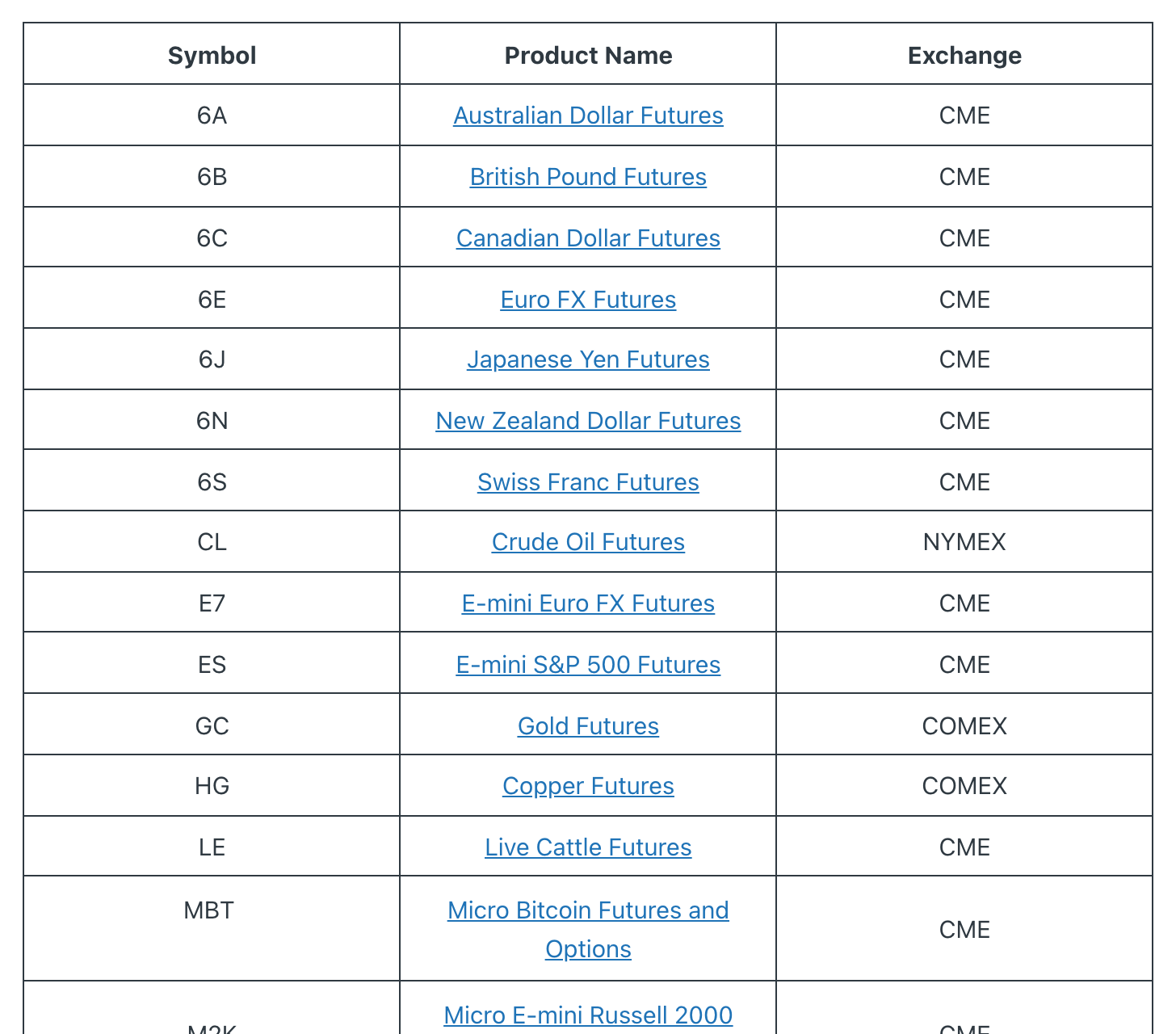
Grouped by what they actually are, the 38 break down like this.
Two things stand out from that breakdown. Currencies are the largest group, which surprises people who assume a futures prop firm is an index-trading shop. And crypto is the smallest, with exactly two contracts, both micro-sized.
Can you trade forex on Take Profit Trader?
Not spot forex. But currency futures are the single best-served asset class here, with ten contracts.
You get the Australian dollar (6A), British pound (6B), Canadian dollar (6C), euro (6E), Japanese yen (6J), New Zealand dollar (6N) and Swiss franc (6S), plus two smaller euro contracts, E7 and M6E, and a micro Australian dollar, M6A.
If you came from a retail forex background, the practical differences are worth knowing up front. These are exchange-traded contracts with fixed sizes and defined expiries, cleared through a central counterparty rather than faced against a dealer. You pay a commission per round trip per contract instead of a spread mark-up, which is more visible but not free.
The hard daily deadline is not a property of the market either: it comes from Take Profit Trader’s own Rule 4, which is the next section.
What you do not get is the long tail: no exotics, no crosses beyond what the list carries, and nothing quoted against anything other than the US dollar.
Can you trade crypto on Take Profit Trader?
Two contracts, both futures, both micro: MBT for Bitcoin and MET for Ether. There is no spot crypto, no altcoins beyond those two, and no way to hold a coin.
One detail in Take Profit Trader’s own list is worth flagging because it is easy to misread. Those two entries are named Micro Bitcoin Futures and Options and Micro Ether Futures and Options. That is the CME’s product name for the family, not an options permission.
Take Profit Trader settles the question elsewhere, on its own about page, stating that its program and platforms do not support or facilitate trading in stocks, options, forex, cryptocurrencies, or CFDs. So the answer on options is no, and the two product names are simply the CME’s.
When you are allowed to trade them
The permitted list is only half of the rule. Take Profit Trader’s fourth core rule covers approved products and approved hours, and the hours half ends accounts.
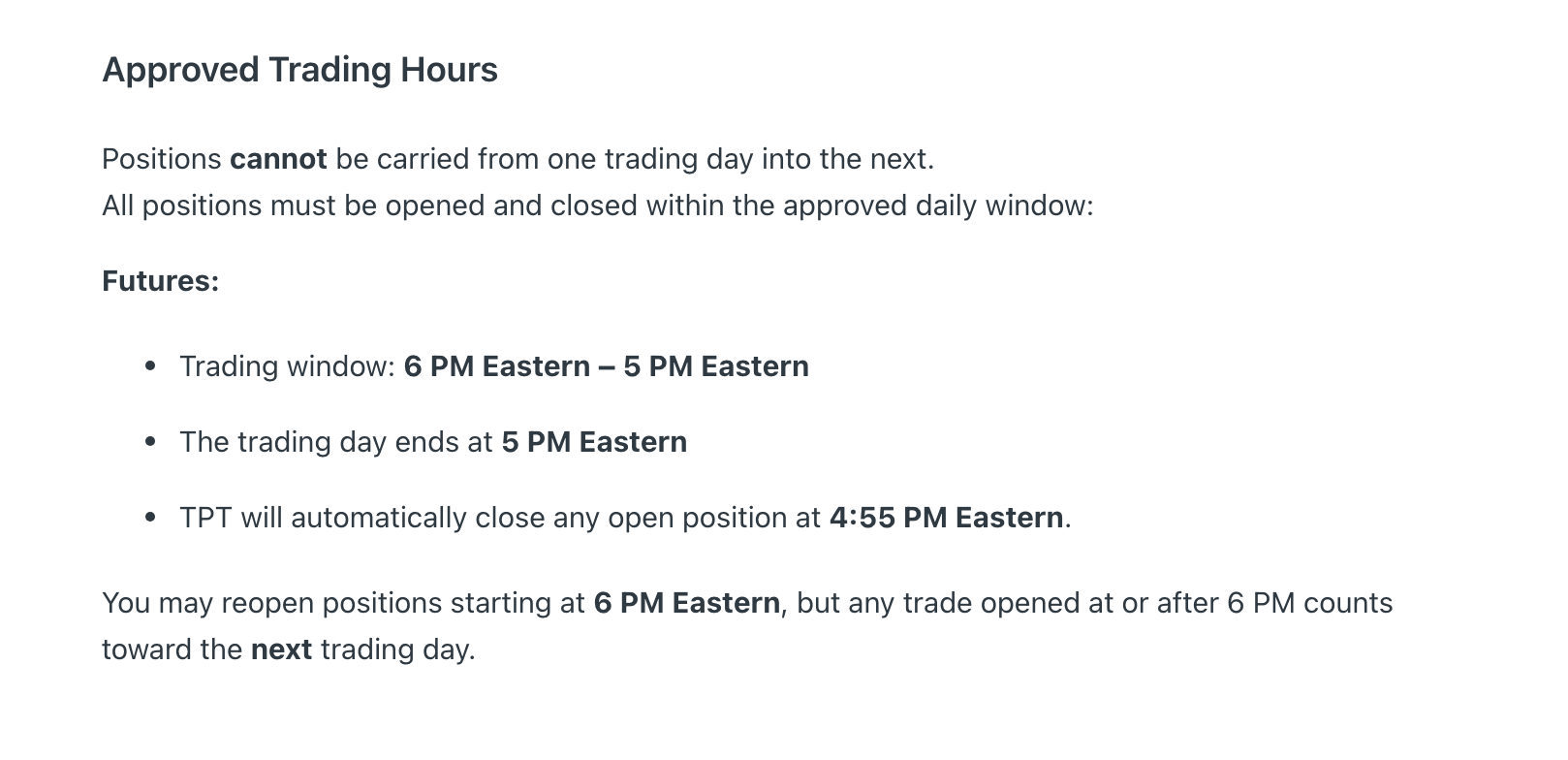
Positions cannot be carried from one trading day into the next. The window runs from 6 PM Eastern to 5 PM Eastern, the trading day ends at 5 PM Eastern, and Take Profit Trader automatically closes any open position at 4:55 PM Eastern.
The line that surprises people is the last one: you may reopen from 6 PM Eastern, but any trade opened at or after 6 PM counts toward the next trading day. An evening session is tomorrow’s session, which matters for anything measured per day.
The instrument-specific trap. Take Profit Trader puts the burden on you: always know the specific hours for the product you are trading. If the market for your product closes before 5 PM Eastern and you cannot exit before the deadline, the account is liquidated. The same applies to holidays, where monitoring the adjusted schedule is explicitly the trader’s responsibility and missing a holiday-adjusted close also results in liquidation.
That is a real reason to check the session of anything outside the index contracts before you trade it. The grains and Live Cattle on this list run shorter sessions than the equity index products, which turns an ordinary end-of-day into a liquidation risk that ES simply does not carry. The rest of the rulebook, and what each breach costs, is in our guide to the Take Profit Trader rules.
How many of them you can hold at once
The permitted list tells you what. Rule 2 tells you how much, and it is a static ceiling rather than a margin calculation: a fixed number of contracts you may have open at any one time, set by your account size.
These are the maximums Take Profit Trader publishes for the Test. The PRO rulebook contains no position-size rule of its own, and the Universal Trading Policies say only that you may not exceed the maximum permitted for your account type as displayed to you.
Notice the ratio. You are allowed 10x position size on micros, which sounds generous until you line it up against the commission. Ten micros equal one mini in exposure, so the sizing cap is identical in economic terms, while the commission is over three times higher. The micro allowance buys you granularity, not extra size.
Your instrument choice decides which news can end your day
This is the part of the product list that almost nobody connects, and it is a genuine reason to prefer one contract over another.
First, the scope, because it is narrower than most articles suggest: this rule appears in the PRO and PRO+ rulebooks only. None of the six Test core rules mentions news at all, so on an evaluation account it does not apply. Once funded, Take Profit Trader prohibits open positions and open orders one minute before, during and one minute after certain news events. Three apply to every product: FOMC statements on Wednesdays at 2:00 PM ET, Non-Farm Payroll monthly on Fridays at 8:30 AM ET, and CPI. Fed speakers and FOMC meeting minutes are explicitly allowed.
Then come the instrument-specific ones, and this is where your product choice bites:
Crude Oil Inventories are prohibited for Crude Oil. Take Profit Trader names the product, not the symbol, so if you trade crude in any form you inherit a weekly event an index trader never thinks about.
Bond Auctions are prohibited for the 10-Year Note and 30-Year Bond, in Take Profit Trader’s own wording. Of the four rate contracts on the permitted list only ZN matches that description cleanly, and note that a 30-Year Bond is not on the list at all: UB is the Ultra U.S. Treasury Bond, a different contract. If you trade rates, ask support which symbols they consider covered.
So a funded ES or NQ trader carries three prohibited events. A funded crude trader carries four, one of them weekly. That is not a reason to avoid crude, but it is a reason to know your calendar before you pick your product. Take Profit Trader points you to the red-folder USD events on forexfactory.com and to the trader calendar in your own dashboard.
Micros, and why they are not the free option
Five of the seven groups have a smaller version available, and small accounts are pushed toward them for a good reason: a tight drawdown rewards finer position sizing. Note the two that do not: interest rates and agriculture have no micro contract on this list at all, so ZN, UB, ZS and the rest come in one size only.
There is a cost to that, and it is larger than most people price in. Take Profit Trader charges $4.50 per round trip per contract on futures and $1.50 on micros. Ten micros equal one mini in size, but the micro rate is a third of the mini rate, not a tenth.
So the same exposure traded in micros costs 3.33 times the commission. Three minis at $4.50 is $13.50 per round trip; the equivalent 30 micros at $1.50 is $45.00. Use micros where you genuinely need the smaller increment, not as a default. We break the full cost picture down in our guide to what Take Profit Trader actually costs.
What if the instrument you want is not on the list?
Two useful facts here, and the second is better than you would expect.
First, if an order is rejected for a product you believed was allowed, Take Profit Trader says to contact support. Do not read that as a guarantee that every off-list order is blocked for you: trading outside approved products is a rule breach in its own right, with the usual consequences attached.
Second, and this is the part almost nobody knows: the list is not closed. Take Profit Trader states that if you want to trade an instrument that is not listed, you can reach out to Live Chat Support and they will review whether it can be added.
That will not get you Apple shares. But for a futures contract on a CME Group exchange that simply is not on the list yet, it is a real route rather than a brush-off.
Which contract fits what you wanted to trade?
Four questions on what brought you here, where your experience comes from, what drives your entries and when you are at the screen. The check routes you to the contract that does the job, or tells you honestly that none does. No email.
40-second check
Which Take Profit Trader contract fits what you wanted to trade?
What we offer at Phidias
On instruments there is little to separate us from Take Profit Trader, and we are not going to invent a difference. What we do differently is upstream of what you trade.
Phidias Express to Live converts to a live account at your first payout, and there is no monthly subscription attached to the evaluation, so the time you spend learning a contract is not being billed to you month after month.
Our record
Our fastest verified cycle, from evaluation purchase to payout received. Separately, the full Express to Live cycle, through to a LIVE account, can be completed in under a day, with no meter running while you learn the product.
Take Profit Trader instruments: frequently asked questions
Can you trade stocks on Take Profit Trader?
No. The permitted products list contains 38 futures contracts and no individual shares. For equity exposure you trade the index futures instead: ES, NQ, YM and RTY, or their micro versions MES, MNQ, MYM and M2K.
What can you trade on Take Profit Trader?
Futures only, across seven groups: 10 currency contracts, 8 equity index, 6 metals, 4 energy, 4 interest rate, 4 agricultural and 2 crypto. All of them trade on CME, CBOT, NYMEX or COMEX.
Can you trade forex on Take Profit Trader?
Not spot forex, but currency futures are the biggest group on the list with ten contracts, including the euro, pound, yen, Swiss franc, and Australian, Canadian and New Zealand dollars. They are exchange-traded with fixed contract sizes and expiries rather than dealer-quoted pairs.
Can you trade crypto on Take Profit Trader?
Two contracts: MBT for Micro Bitcoin and MET for Micro Ether, both futures. There is no spot crypto and no other coins.
Does Take Profit Trader allow options trading?
No. Take Profit Trader states on its about page that its program and platforms do not support or facilitate trading in stocks, options, forex, cryptocurrencies or CFDs. Two entries on the permitted list carry the CME family name Micro Bitcoin Futures and Options and Micro Ether Futures and Options, but that is the product’s name rather than an options permission.
What are Take Profit Trader’s trading hours?
The approved window runs 6 PM Eastern to 5 PM Eastern. The trading day ends at 5 PM Eastern and Take Profit Trader closes any open position automatically at 4:55 PM Eastern. Positions cannot be carried into the next trading day.
Can I hold a position overnight?
No. Positions must be opened and closed within the daily window. You can reopen from 6 PM Eastern, but any trade opened at or after 6 PM counts toward the next trading day.
What happens if my product’s market closes before 5 PM Eastern?
Take Profit Trader states that if you cannot exit before the deadline, the account is liquidated. Knowing the specific hours for your product, including holiday-adjusted schedules, is explicitly the trader’s responsibility.
Can I request an instrument that is not on the list?
Yes. Take Profit Trader says to contact Live Chat Support and they will review whether it can be added. If an order is rejected for a product you believed was permitted, contacting support is also the stated route.
Are micros cheaper to trade than minis?
Per contract yes, for the same exposure no. Commission is $4.50 per round trip per contract on futures and $1.50 on micros, but ten micros equal one mini, so identical exposure traded in micros costs about 3.33 times as much in commission.
Useful resources
Take Profit Trader’s own documentation
· Approved Instruments & Permitted Products List
· Rule 4: Trade Approved Products, During Approved Hours
· Rule 2: Do Not Exceed Maximum Position Size
· Commissions on Test and PRO accounts
Related guides
· Take Profit Trader explained: accounts, rules and payouts
· Take Profit Trader rules: the three rulebooks
About the author
William G. is CMO at Phidias Propfirm. He writes the firm’s competitor analyses from primary sources: help centres, terms of service and published policies, never aggregator sites. The instrument counts on this page were tallied directly from Take Profit Trader’s published list in August 2026. The principal sources are linked above.