Take Profit Trader drawdown, 2026
On the Test it is measured only at the close. The day you pass, your funded account restarts and the same drawdown is measured intraday, on unrealized gains.
Which means a trade that goes your way and gives it back can cost you room without costing you a dollar. Every figure below comes from Take Profit Trader’s own help center.
Prefer a drawdown that never trails at all? That is Phidias Express to Live. First, exactly how the Take Profit Trader version behaves.
Does the Take Profit Trader trailing drawdown ever go away?
Yes. It stops trailing once your minimum account balance reaches your original starting balance, and from that point it never moves again. On a 25K with a $1,500 drawdown, that means gaining $1,500 before the limit locks at $25,000. The catch is that you do this twice: once to pass the Test, then again from scratch on the funded account, where it is measured intraday instead of at the close.
Our verdict (William G.)
Most guides answer this question with “yes, at your starting balance” and stop there. That answer is correct and almost useless, because the hard part is not the destination, it is that the rules change between the two attempts. Passing the Test does not unlock an easier account. It hands you the same distance to cover under a stricter measurement.
How the trailing limit actually moves
Take Profit Trader calls the live number your Minimum Account Balance, and that is what it is labelled in your Control Center. It starts one drawdown below your account size, then follows your highest balance upward. It is a ratchet: it only ever goes up.
Drawdown amounts are published in Take Profit Trader’s Rule 3 table, read in August 2026. Take Profit Trader states the minimum account balance for the 25K only ($25,000 minus $1,500 equals $23,500); the other rows apply that same formula to their published drawdowns. The gain needed to lock always equals the drawdown itself.
Take Profit Trader’s own worked example, on the Test. A 25K account: the minimum account balance starts at $23,500. Earn $1,000 on day one and your closing balance is $26,000, so the minimum moves to $24,500, still $1,500 behind. This repeats until the minimum reaches $25,000, at which point it stops trailing and stays fixed.
The consequence people miss: until it locks, a winning day buys you no safety. You started $1,500 from failure and after a good day you are still $1,500 from failure. The distance never changes, only the numbers do.
That is the defining property of a trailing limit, and it is why the lock matters so much: it is the only moment the distance starts to grow.
On the Test: measured only at the close
This is the friendly version, and Take Profit Trader deserves credit for it. During the evaluation, your intraday swings do not touch the limit at all.
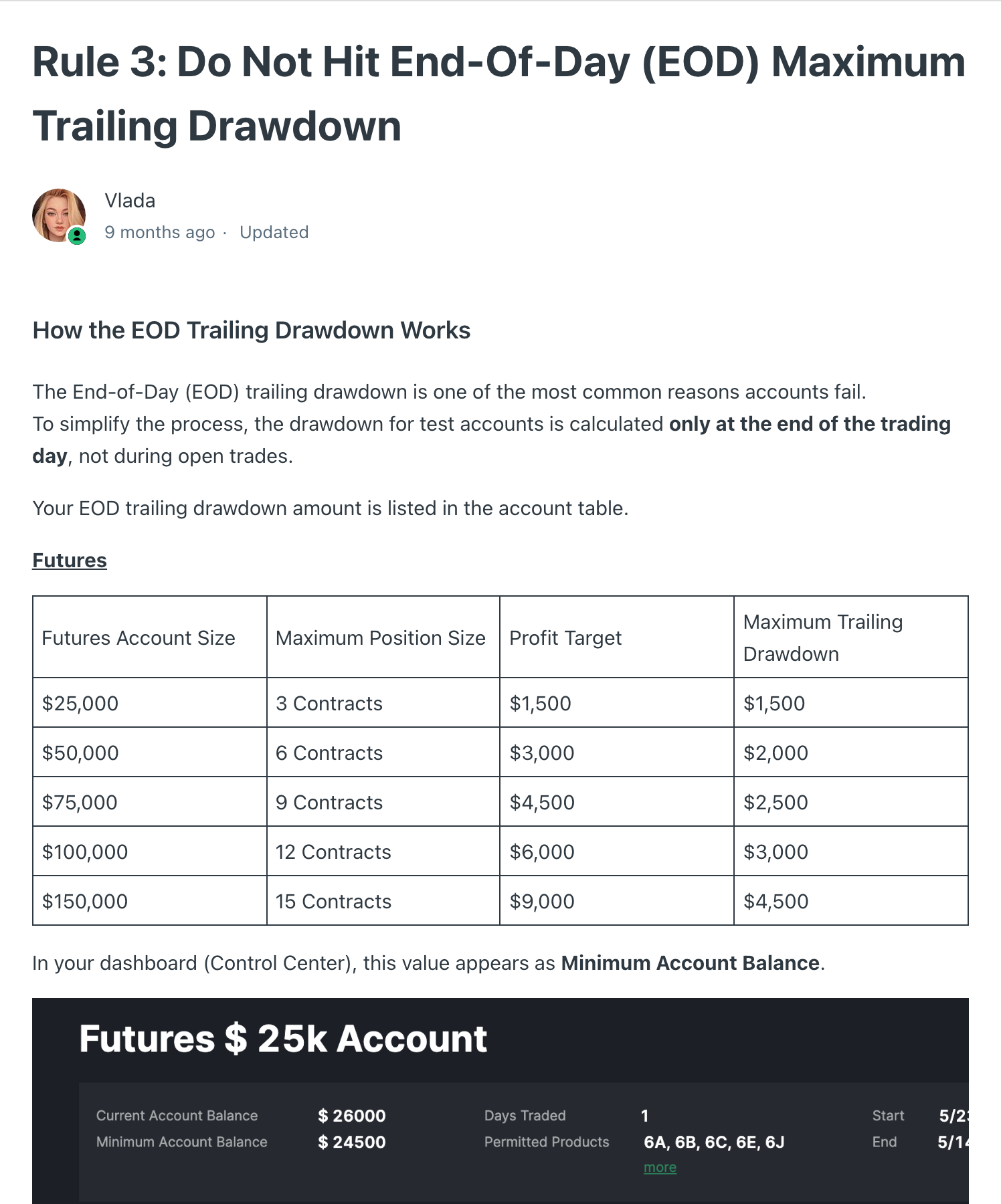
The wording is unambiguous: the drawdown for test accounts is calculated “only at the end of the trading day, not during open trades”. Go $900 underwater at 11 AM on a 25K, recover, close green: nothing happened. Only the closing balance is read.
What this permits. Wider stops, positions that need room to work, and the ordinary experience of being wrong for an hour before being right. On the Test, being temporarily underwater is free.
On a funded PRO account: measured intraday, on unrealized gains
The moment you pass, the measurement changes. Not the amount, the method.
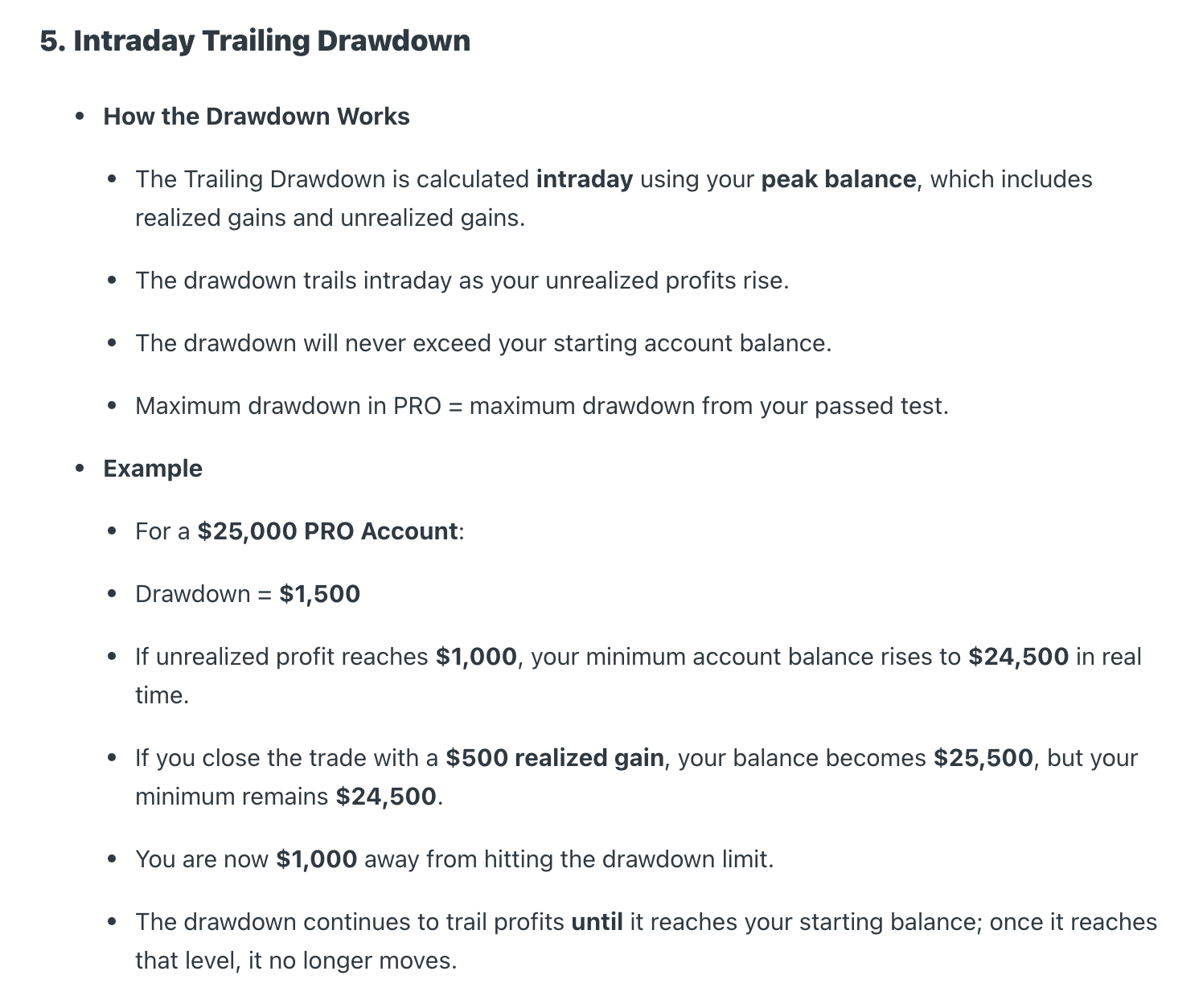
On a PRO account the trailing drawdown is calculated intraday, using your peak balance, which includes realized gains and unrealized gains. It trails as your unrealized profit rises.
Their example, and what it really says
A 25K PRO account, drawdown $1,500, minimum starts at $23,500.
Your open trade reaches $1,000 of unrealized profit. Your minimum account balance rises to $24,500 in real time.
You close it for a $500 realized gain. Balance $25,500. Minimum: still $24,500.
You are now $1,000 from liquidation instead of $1,500. The $500 you never banked did that, and it is permanent. You gave back half a winner and it cost you a third of your room, forever.
Nothing about this is hidden. It is published, with numbers, on a page anyone can read. But it is the opposite of what “you passed, welcome to the funded team” leads a trader to expect, and it is the single most common way a PRO account dies in its first week.
You earn the lock twice
Here is the part almost nobody spells out. Passing the Test does not carry your progress forward.
Take Profit Trader states it plainly: maximum drawdown in PRO equals the maximum drawdown from your passed test. And their PRO example starts a 25K account with the minimum at $23,500, exactly where the Test started.
So the sequence is: cover $1,500 under generous rules, then cover the same $1,500 again under strict ones, and only then does your limit stop moving. The reward for succeeding is a harder version of the task you just completed.
The same three sessions, run under both regimes
A 50K account, $2,000 drawdown, minimum starting at $48,000. Identical trading in both columns. Only the measurement differs.
Same trades. Same trader. One account is alive and one is gone. The difference was created in session one, by a profit that was never realised, and it was invisible until session three.
The 25K is twice as hard as the 150K, and the maths says so
Take Profit Trader sets the profit target at a constant 6% of account size across the whole range. It does not set the drawdown proportionally. Put the two side by side and something uncomfortable appears.
Computed from Take Profit Trader’s Rule 1 and Rule 3 tables. The target is a flat 6% everywhere; the drawdown is not.
On a 25K you are asked to make $1,500 while being allowed to lose $1,500. One unit of reward for one unit of risk. On a 100K or 150K you are asked to make twice what you are allowed to lose. Same test, same rules, and the cheapest account demands the least favourable ratio in the range.
This inverts the usual advice. Beginners are told to start small, and on most products that is right. Here the small account is the one where the drawdown is proportionally largest, where the commission schedule bites hardest, and where a single bad hour on a funded account ends everything. If your reason for choosing the 25K is that you are new, the 50K is arguably the more forgiving place to be new, at the cost of a higher monthly subscription.
The buffer zone is not the drawdown, even though it is the same number
These two get confused constantly, partly because they are always equal. They are not the same thing.
The trailing drawdown
Sits below your starting balance and decides whether the account survives. Touch it and you are liquidated immediately.
The buffer zone
Sits above your starting balance and decides whether you can withdraw. On a 50K it is $52,000, which is $50,000 plus the same $2,000.
The symmetry is neat and slightly cruel: you must climb $2,000 to stop the limit moving, and the identical $2,000 is what stands between you and your first withdrawal. One number, two walls, in opposite directions.
What happens to the money held inside that buffer, and why closing the account early only returns half of it, is covered in Take Profit Trader payout rules.
Where to read your real number, live
Your minimum account balance appears in the Control Center, but the value that matters second by second lives in your trading platform, and it depends on the data feed you chose at purchase.
On Rithmic. Log in to RTrader Pro, open the Trader Dashboard, and read the field “Auto Liquidate Threshold Value”. That is your minimum account balance.
On CQG. Log in to Tradovate, open the modules window with the plus sign, drag the Accounts widget onto your screen, then use the settings wheel and Select Columns to add “Drawdown Auto Liq Level” and “Dist Drawdown”. The second one tells you how much room you have left.
Do this before your first funded session, not during it. On a PRO account the number moves while you hold a position, and the dashboard is not where you will be looking when it matters.
What an intraday limit does to position sizing
An intraday trailing drawdown punishes one behaviour above all others: holding a winner that comes back. That has direct consequences for how you size.
On a 25K you have $1,500 of room and up to 3 contracts. Three ES contracts move $37.50 per tick, so $1,500 is forty ticks, ten points. Thirty micros carry identical exposure and identical tick value.
The difference is the bill. A max-size round trip costs $13.50 in minis and $45.00 in micros, because Take Profit Trader charges $4.50 per contract and $1.50 per micro, and a micro is one tenth of a mini. So the instrument that lets you scale out in small pieces, which is exactly the defence against an intraday trail, is the one taxed 3.33 times more per unit of exposure.
The practical answer is to take partial profits earlier than your instinct says, because on a PRO account an unrealized gain that you do not bank still moves your limit permanently. Scaling out converts a temporary tightening into a permanent one you actually got paid for. It is also the most expensive way to trade under this commission schedule. That tension is the real cost of the intraday rule.
The full commission arithmetic, including how many round trips erase a drawdown in fees alone, is in our complete Take Profit Trader breakdown.
PRO+ changes it a third time
If Take Profit Trader invites you to a PRO+ account, the measurement flips back. PRO+ runs an end-of-day drawdown, like the Test, on a live account routed straight to the exchange.
So the full arc is: lenient during the evaluation, strict while you prove yourself on simulated capital, lenient again once you are trading the firm’s real money. It is coherent as a risk policy, since the strictest measurement sits exactly where the firm is most exposed to an untested trader.
One detail worth knowing before you accept. A PRO+ account starts at $0 balance, carrying an end-of-day drawdown equal to your original PRO drawdown. Your PRO account is put on hold and $5,000 of its profit is frozen for as long as the PRO+ is active. Anything above that $5,000 can be withdrawn at the normal PRO split.
Which means the promotion to real capital begins with a fresh account at zero and part of your earned profit locked behind you. The drawdown gets kinder; the balance sheet does not.
How to survive your first week on a PRO account
The intraday switch kills accounts in the first few sessions, when the trader is still operating on Test reflexes. Five practical adjustments, all of which follow directly from the mechanics above.
1. Put the live number on your screen before you place a trade. “Dist Drawdown” on Tradovate, or the Auto Liquidate Threshold on RTrader Pro. Not the dashboard. You cannot manage a limit you are not watching.
2. Treat the first $1,500 to $4,500 as the real evaluation. Until your minimum account balance reaches your starting balance, you are still being tested, just with money you are allowed to withdraw at the other end.
3. Bank partials earlier than feels natural. An unrealized gain tightens your limit whether or not you keep it. Taking half off converts a tightening you suffered into one you were paid for.
4. Size down for the lock, not for the target. The account does not fail at the profit target, it fails at the limit. Small size until it locks costs you time; large size before it locks costs you the account.
5. Remember there is no daily stop to catch you. Take Profit Trader removed its daily loss limit, so nothing pauses a session that is going badly. Your own rule is the only one that exists.
With no daily loss limit, this is the only wall
Take Profit Trader removed its daily loss limit, and shows it struck through on its own pricing page. That is a real freedom and worth saying clearly: no forced stop, no lockout, no session ended for you.
It also means there is nothing between you and liquidation except the trailing drawdown. On firms that keep a daily limit, a bad day usually ends in a pause and the account survives. Here, a bad day ends where your minimum account balance is, and that is a permanent failure rather than a suspension.
Freedom and exposure are the same fact seen from two sides. If you already run a mechanical daily stop, the removal is pure gain. If you relied on the firm to stop you, nothing will.
6 hours 18 minutes.
Will the Take Profit Trader drawdown work against you?
Four questions on what you do with a winner, how much room you give a losing trade, how long you hold and how often you trade. The diagnostic tells you which side of the intraday rule you fall on, and what it will cost you specifically. No email.
40-second diagnostic
Will the Take Profit Trader drawdown work against you?
Take Profit Trader trailing drawdown: frequently asked questions
Does the trailing drawdown ever go away in Take Profit Trader?
Yes. It stops trailing once your minimum account balance reaches your original starting balance, and it is fixed from then on. On a 25K with a $1,500 drawdown you need to gain $1,500; on a 100K with a $3,000 drawdown you need $3,000. The gain required always equals the drawdown. You do this twice, though: once during the Test and again on the funded account, which starts fresh at the same minimum.
Is the Take Profit Trader drawdown intraday or end of day?
Both, depending on the stage. On the Test it is measured only at the end of the trading day, so intraday swings do not affect it. On a funded PRO account it is measured intraday, using your peak balance including unrealized gains. PRO+ accounts go back to an end-of-day calculation.
Do unrealized profits move the Take Profit Trader drawdown?
On a funded PRO account, yes, and permanently. Take Profit Trader’s own example: on a 25K, an open trade showing $1,000 of unrealized profit lifts your minimum account balance to $24,500 in real time. Close it for only $500 and your minimum stays at $24,500 while your balance is $25,500. You have lost $500 of room without losing any money. On the Test, unrealized profit does not move anything.
What is the Take Profit Trader minimum account balance?
It is the label Take Profit Trader uses in your Control Center for your liquidation level. It starts one full drawdown below your account size, so $23,500 on a 25K, $48,000 on a 50K, $97,000 on a 100K and $145,500 on a 150K. Touch it at any moment, through realized or unrealized losses, and the account is liquidated immediately.
How much do I need to make for the Take Profit Trader drawdown to stop trailing?
Exactly the amount of the drawdown itself: $1,500 on a 25K, $2,000 on a 50K, $2,500 on a 75K, $3,000 on a 100K, $4,500 on a 150K. At that point your minimum account balance equals your starting balance and stops moving. Note this is also the size of the buffer zone you must clear before withdrawing, which is why the two are so often confused.
Is the buffer zone the same as the trailing drawdown?
No, although they are always the same number. The trailing drawdown sits below your starting balance and determines whether the account survives. The buffer zone sits above it and determines whether you can withdraw. On a 50K account the drawdown is $2,000 and the buffer zone is $52,000, which is the starting balance plus that same $2,000.
Does the Take Profit Trader drawdown reset when I pass the Test?
Yes, and this is the least advertised part of the product. Take Profit Trader states that maximum drawdown in PRO equals the maximum drawdown from your passed test, and its PRO example starts a 25K account with the minimum back at $23,500. Whatever you climbed during the evaluation does not carry over. You cover the same distance again, this time under intraday measurement.
Where can I see my Take Profit Trader drawdown in real time?
Not on the dashboard, in your platform. On Rithmic: RTrader Pro, Trader Dashboard, the field “Auto Liquidate Threshold Value”. On CQG: Tradovate, add the Accounts widget, then select the columns “Drawdown Auto Liq Level” and “Dist Drawdown”, the latter showing how much room remains. Set this up before your first funded session.
Does Take Profit Trader have a daily loss limit as well?
No, it was removed, and the pricing page still shows the old amount struck through with a “Removed” badge. That gives you genuine freedom day to day, and it also means the trailing drawdown is the only limit standing between you and account closure. There is no pause, only liquidation.
What happens if I hit the trailing drawdown?
The account is liquidated immediately, whether the loss is realized or unrealized. There is no warning stage, no suspension and no recovery: Take Profit Trader treats it as a hard stop at the moment your balance touches the minimum. On a Test account you can pay to reset, from $79 to $199 by size. On a PRO account a reset costs between $449 and $1,499 and is limited to three per account.
Useful resources
Rule 3: Do Not Hit End-Of-Day (EOD) Maximum Trailing Drawdown, the Test rules and the parameter table.
PRO Account Rules, including the intraday drawdown and the 25K worked example.
Trailing drawdown, explained, how the mechanism works across the whole prop firm market.
Phidias Express to Live, a static drawdown that never trails.
About the author
William G. is a futures trader and prop firm analyst at Phidias Propfirm. He reads competitors’ rulebooks against their own published documentation, and writes about what actually happens between passing an evaluation and being paid. Every Take Profit Trader figure in this guide comes from the Take Profit Trader help center, read in August 2026.
Last reviewed: 2026.
More on Take Profit Trader
Take Profit Trader Explained 2026, the three accounts, the rules and what it really costs.
Tradeify vs Take Profit Trader 2026, two takes on the trailing drawdown.
Take Profit Trader vs Apex 2026, subscription against one-time fee.
Risk disclosure: trading futures carries a substantial risk of loss and is not suitable for every investor. Past results do not guarantee future performance. Take Profit Trader drawdown amounts, buffer zones, account parameters, commissions and reset prices reflect the information published in the Take Profit Trader help center and on takeprofittrader.com in August 2026 and are subject to change. Verify current terms on takeprofittrader.com before purchasing. This article is informational and is not financial advice.