Take Profit Trader, 2026
Pass the Test and your drawdown stops being calculated at the close: it goes intraday, unrealized gains included. Get funded and your first $1,500 to $4,500 locks inside a buffer. Get invited to PRO+ and $5,000 of your profit freezes.
Every number on this page comes from Take Profit Trader’s own help center and pricing page, read in full in August 2026. Here is what each stage actually costs you.
Want a drawdown that never moves and a live account at your first payout? That is Phidias Express to Live. First, how Take Profit Trader really works.
What is Take Profit Trader?
Take Profit Trader is a futures prop firm that runs a four-stage ladder. You buy a Test as a monthly subscription and pass it under six rules. You are promoted to a PRO account, which is simulated, pays an 80/20 split, and lets you withdraw from day one once you clear a buffer. The top two stages, PRO+ Development and PRO+, are live capital. Neither is a promotion you can apply for: both are placements Take Profit Trader decides on.
Compiled from Take Profit Trader’s own help center, read in full in August 2026.
Our verdict (William G.)
Take Profit Trader has the most trader-friendly payout policy in futures prop and I will not pretend otherwise: no daily loss limit, no scaling plan, no funded consistency rule, withdrawals from day one. What almost nobody tells you is that the constraints move in the opposite direction to the rewards. Each step up hands you a better split and a tighter cage.
The three accounts, and why the naming matters
Most firms sell you an evaluation and a funded account. Take Profit Trader sells you three distinct products, and only the last one touches a real exchange. The vocabulary hides that: you are called a member of the “Funded Team” from the PRO stage onward, while the account is still a simulation.
Test. A monthly subscription. Six rules, no time limit, resets at a fee. This is the tryout.
PRO. The subscription stops, the payouts start. You keep 80%, you can request money on day one, and there is no consistency rule at this stage. The account is simulated and Take Profit Trader is upfront about it.
PRO+. Live capital, $0 margin, 90/10, no buffer. You do not apply for it. You are invited, or you are not.
How much does a Take Profit Trader account cost?
The Test is billed monthly, not once. That single detail separates Take Profit Trader from Tradeify, Apex and Lucid, and it is the number one thing people get wrong when they compare prices.
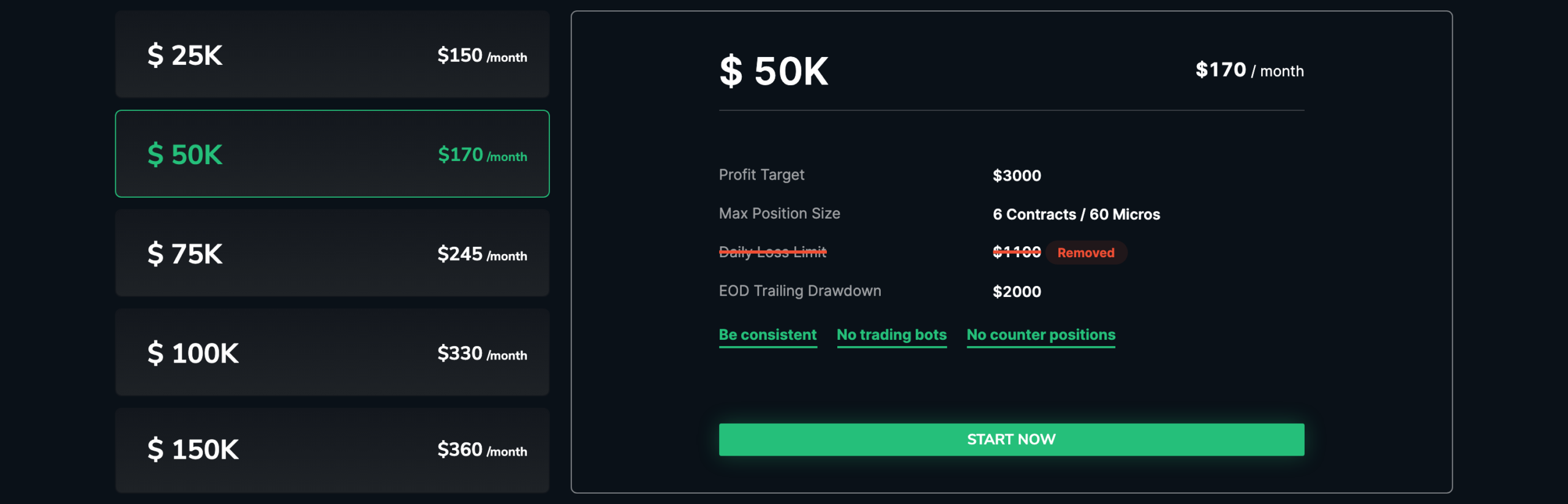
List prices read on takeprofittrader.com in August 2026. Rules and reset prices from the Take Profit Trader help center.
NOFEE40 is not a flash sale. It sits on the homepage permanently and gives 40% off for the life of that test plus the $130 PRO activation fee waived for life on that account, resets included. Take Profit Trader’s own example: a 50K test passed inside 30 days without a reset comes to $102 total.
The price you pay is not the price on the page
There is no time limit on the Test, which sounds generous and is, until you remember the meter is running monthly. A 100K test that takes you three months costs $594 with NOFEE40, not $198. And breaking a rule does not stop the billing: “If you break a rule, your subscription will not cancel automatically. You must manually cancel it.” Blow the account on a Tuesday, forget the dashboard, and you are charged again next month for a test you can no longer trade.
The Test, and its six core rules
Take Profit Trader groups its evaluation rules under a heading it calls The 6 Core Rules. Here they are, condensed.
Rule 5 is the one that surprises people, and it is gentler than it reads. Go above 50% on your best day and you have not failed. Your target simply moves: the new requirement becomes net P/L multiplied by two. Their own worked example: a 50K account, $2,000 on day one, $1,100 across the rest, net P/L $3,100. That best day is 65% of the total, so the goal becomes $6,200 instead of $3,000. Painful, not fatal.
Rule 4 has a quieter trap. Holiday sessions close early, and Take Profit Trader puts that on you: miss a holiday-adjusted close and the account is liquidated, not paused.
The drawdown that changes the day you pass
This is the single most consequential thing on this page, and it is the reason “does the trailing drawdown ever go away in Take Profit Trader” is one of the most searched questions about this firm.
The answer is yes, it stops. Your minimum account balance trails your highest balance upward until it reaches your original starting balance, then it freezes there forever. On a 25K with a $1,500 drawdown, you need $1,500 of gain before the minimum account balance locks at $25,000.
But that is only half the story, and the other half is rarely told.
On the Test
The drawdown is calculated only at the end of the trading day. In Take Profit Trader’s words, “not during open trades”. Your intraday swings are yours. Only the closing balance moves your minimum account balance.
On PRO, once you pass
The drawdown becomes intraday, based on peak balance including realized and unrealized gains. An open trade in profit raises your minimum account balance in real time, and it stays raised when the trade gives that profit back.
Take Profit Trader’s own worked example, on a 25K PRO account. Drawdown $1,500, so the minimum account balance starts at $23,500. An unrealized gain of $1,000 lifts your minimum to $24,500 the instant the trade is up. You close for a realized $500: your balance is $25,500, your minimum is still $24,500. You are now $1,000 from liquidation instead of $1,500, and the $500 that never made it to your balance did the damage.
Read that again. On PRO, a trade that goes your way and comes back permanently raises your minimum account balance. You do not have to lose money to lose room.
Where to read it live. This number is not on the Take Profit Trader dashboard in real time, it is in your platform.
Rithmic: RTrader Pro, Trader Dashboard, the field “Auto Liquidate Threshold Value”.
CQG: Tradovate, Accounts widget, add the columns “Drawdown Auto Liq Level” and “Dist Drawdown”.
The full mechanics, the lock threshold per account size and what an intraday limit does to position sizing are in our dedicated guide: Take Profit Trader trailing drawdown, explained.
What a PRO account actually is
Take Profit Trader does not hide this, and credit where it is due: the explanation is published plainly in the help center rather than buried in terms.
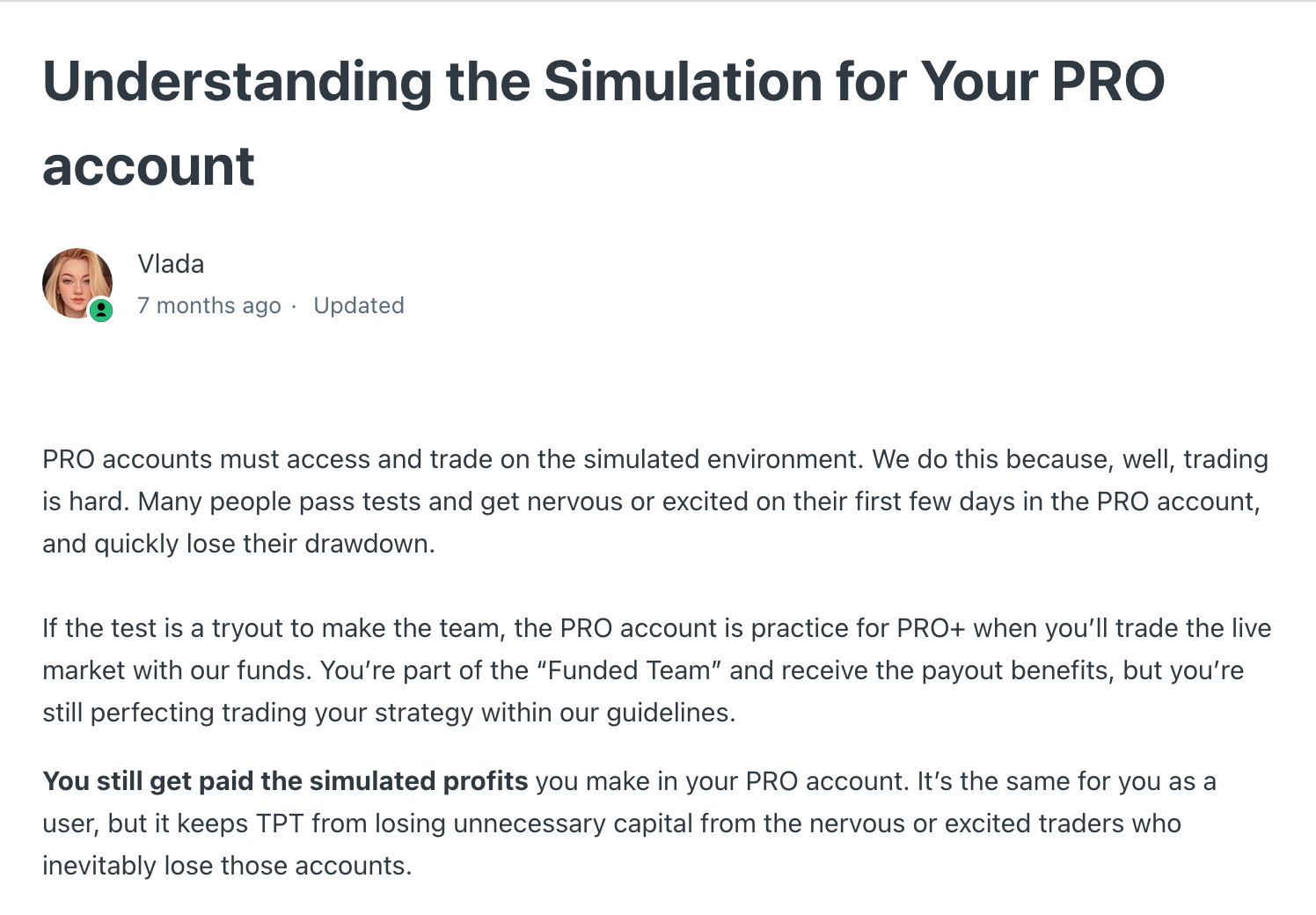
The reasoning they give is honest: traders get nervous or excited in their first funded days and lose the account, and simulating that stage saves the firm from paying for it. They also point out two genuine upsides. Fills are easier in simulation, so making money there is easier than live. And PRO accounts are set up faster than live accounts.
You are still paid on the simulated profits. That matters, and it is the part critics skip. A payout from a PRO account is real money in your bank.
What it does mean is that the phrase “funded trader” is doing some work. At the PRO stage you are a paid simulation trader with a real payout policy. The live market comes later, if it comes.
Three PRO rules catch people, and none of them exist on the Test:
No bots, no algos, of any kind. Every trade must be manually executed. If your edge is automated, PRO is not for you.
Trade at least one day per calendar week. One round trip on a permitted instrument counts. Go quiet and the account closes. Take Profit Trader calls this preventing traders from “squatting” on an account, and will grant exceptions for life circumstances if you contact support.
Be flat around prohibited news. No open positions and no working orders one minute before, during, and one minute after FOMC (2:00 PM ET Wednesdays), NFP (8:30 AM ET) and CPI. Crude Oil Inventories block CL specifically, Bond Auctions block the 10-Year Note and 30-Year Bond. Fed speakers and FOMC minutes are allowed.
The buffer: your first profit is not yours yet
Take Profit Trader lets you withdraw from day one in PRO. True, and unusually good. The condition is the buffer zone: you can only take money out once your balance sits above your starting balance plus your full drawdown amount.
The buffer always equals the maximum drawdown on that account size.
Above that line, Take Profit Trader is genuinely unrestricted. No minimum days, no consistency rule in PRO, no payout windows, no maximum withdrawal, no scaling plan. Get in, get out, get paid, on whatever day suits your strategy. Very few firms can say that.
The part that deserves more attention
The money inside the buffer is not lost, but it is not available either. You can only take it by terminating the account, and what you receive depends on how long the account lived:
60 trading days or fewer since the account opened: you receive 50% of the buffer profits.
More than 60 trading days: you receive 80%, the standard split.
So on a 100K, $3,000 sits immobilised for as long as you keep trading that account, and closing it early to collect hands back half. The buffer is not a hurdle you clear once, it is a permanent deposit the account holds against you.
How payouts work once you are above the buffer
Take Profit Trader rebuilt this in July 2026, and the result is the fastest first leg in the industry.
Account to wallet: 5 to 10 seconds. Fully automated, no manual review, no pending window. The only condition is being flat at the moment you submit, no open positions and no working orders. Then you go straight back to trading.
Wallet to bank: a separate step. The Profit Team reviews it manually for compliance, up to 12 business hours, usually faster. Same-day bank deposit is not guaranteed.
Methods: Plaid for US banks (typically real time), PayPal, or Wise across 160 countries. Anti-money-laundering rules apply: the payee name must match your Take Profit Trader registration, or the payout is delayed for review or denied.
One fee to know: withdrawals above $250 are free, and a request of $250 or less costs you $50, deducted automatically. On a $200 withdrawal that is a quarter of the money.
The instant leg covers most Tradovate PRO accounts. Rithmic PRO, PRO+ and archived accounts remain manual, so the platform you picked at purchase decides whether your payouts are automated.
PRO+, if they choose you
PRO+ is the real thing: a live account, routed directly to the exchange, $0 margin, 90/10, no buffer at all, and the drawdown goes back to end-of-day. On paper it is the best product Take Profit Trader offers.
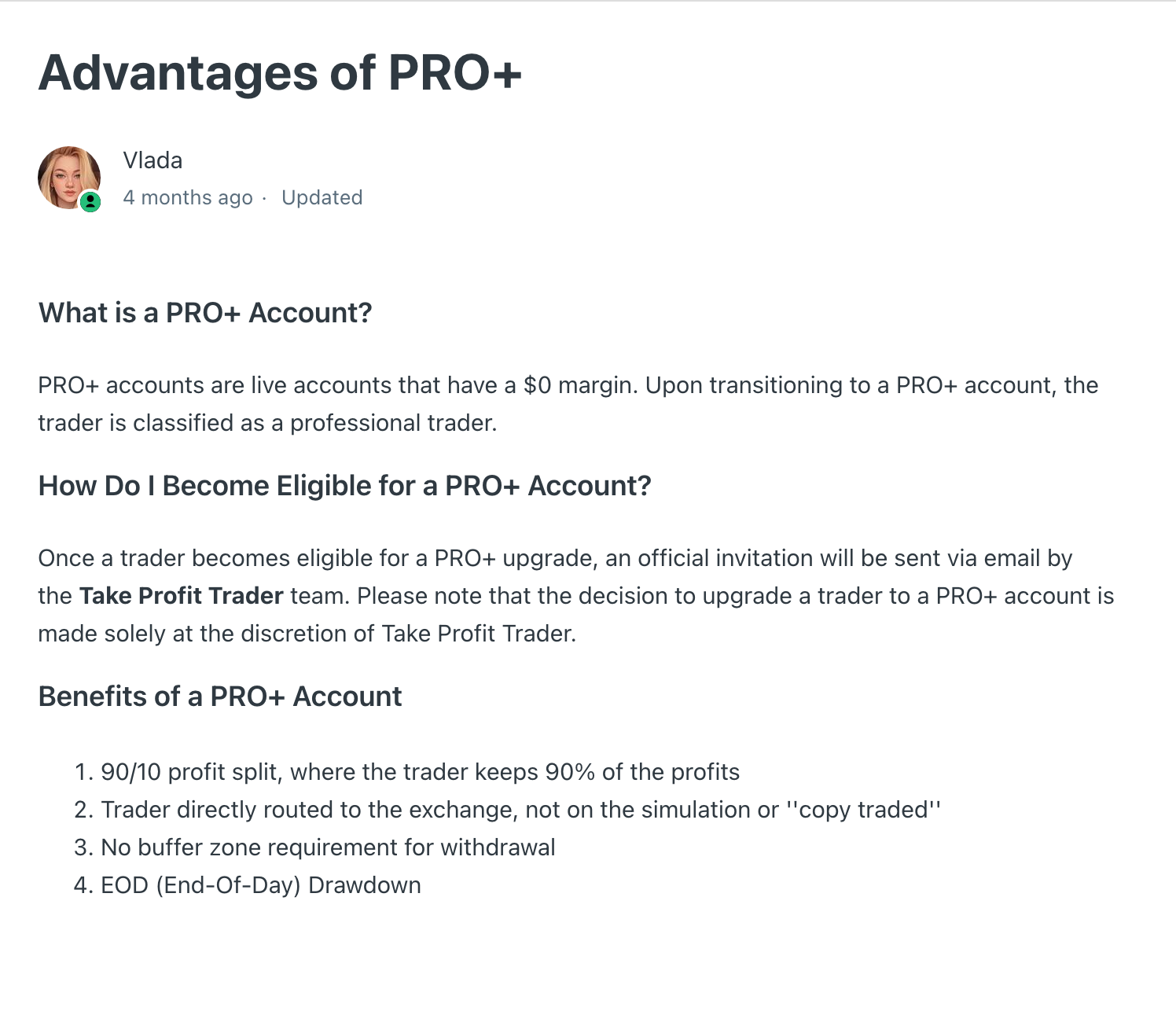
You cannot buy it, apply for it, or earn it against a published threshold. Take Profit Trader states that promotion is decided on a holistic review of consistency, risk management, execution patterns and discipline, and adds: “There isn’t a single threshold that determines promotion.” The invitation arrives by email, or it does not.
What the upgrade actually does to your money. Your PRO account is placed on hold. $5,000 of its profit is frozen and must stay there while the PRO+ is active; anything above $5,000 you can withdraw at the normal PRO split. The PRO+ account then starts at $0 balance, carrying an end-of-day drawdown equal to your original PRO drawdown. From that point, all trading and all withdrawals happen on the PRO+ only.
So the promotion to live capital begins with $5,000 of your own earned profit locked behind you and a fresh account at zero in front of you.
PRO+ Development, the stage nobody writes about
There is a fourth account, and almost no page covering this firm mentions it. PRO+ Development is live capital like PRO+, but with three restrictions bolted on, and Take Profit Trader is direct about why it exists: it targets “oversized positions, held losers, and runaway drawdowns in a single session”.
You do not get promoted into it. You get placed there. Take Profit Trader states that placement follows “a review of your overall trading performance, strategy, and risk behavior across both PRO and live accounts”. In practice this is the tier you land in when the firm wants you trading smaller.
Read the middle column carefully. The daily loss limit that Take Profit Trader proudly struck through on its pricing page is back here. It is a soft breach, so it pauses you for the day rather than ending the account, and their payout policy is unchanged. But the drawdown is smaller than standard PRO+ and your position size is cut hard: one mini on a 25K, five on a 150K.
What it costs to trade, not just to start
Commissions at Take Profit Trader are $4.50 per round trip per contract and $1.50 per round trip per micro. The help center is refreshingly direct about where these come from: “these commissions are not imposed by a third party; rather, they are established and regulated by TakeProfitTrader.” They apply to Test and PRO alike, which means they are charged inside a simulated environment.
Now do the arithmetic nobody does. A micro is one tenth of a mini. So to hold the same exposure you need ten micros for every mini.
Applied to maximum position size, against the drawdown you are actually defending:
On a 100K, seventeen max-size round trips in micros erase the entire drawdown in commissions alone. In minis it takes fifty-six.
Why this quietly pushes you toward more risk
With $1,500 of drawdown on a 25K, the instrument that fits the risk is the micro: ten times finer granularity, ten times smaller tick value, far easier to size a stop against a tight drawdown. But the micro is taxed 3.33x per unit of exposure. The fee schedule therefore rewards you for trading the mini, where every tick is worth ten times more against the same drawdown limit. A trader who follows the pricing incentive takes ten times the risk per tick. That is not a rule anyone breaks, it is a nudge nobody notices.
A worked example: what a 50K really costs from purchase to first payout
Marketing quotes you the monthly price. Here is the whole bill for a realistic path, using Take Profit Trader’s own numbers and the permanent NOFEE40 code.
Month 1. You buy a 50K Test at $102 with NOFEE40. You trade five days, you are up $1,400, and on day nine you clip the trailing drawdown. You reset for $99. Note what did not happen: the reset did not move your renewal date.
Month 2. The subscription renews at $102. This time you reach $3,000 across eight sessions, no single day above 50% of net profit, and you pass. The subscription cancels automatically and the $130 activation fee is waived by the code.
Cost to reach a funded account: $303. Not $102, and not the $170 sticker either.
Now the PRO account. You start at $50,000 with a $2,000 drawdown that is now measured intraday. Your buffer zone is $52,000. Every dollar up to that line is unavailable to you.
You make $2,600 over three weeks. Balance $52,600. You may withdraw the $600 above the buffer, at 80%, so $480 lands in your wallet in about eight seconds. The other $2,000 stays in the account.
The arithmetic that matters: you have earned $2,600 and paid $303 to get there. You can touch $480 of it. To release the remaining $2,000 you would have to close the account, and doing that before 60 trading days returns half of it. Take Profit Trader is not withholding your money, it is holding a deposit against the account for as long as the account exists.
Payout caps, timings, methods and the full withdrawal mechanics are covered in Take Profit Trader payout rules.
Add trading costs on top. At maximum size on a 50K, one round trip is $27 in minis or $90 in micros. Thirty round trips over those three weeks is $810 in minis, or $2,700 in micros, which on this path is more than the profit itself.
What you can actually trade
Futures only. Around 38 symbols across CME, CBOT, NYMEX and COMEX: index futures (ES, NQ, YM, RTY and the micros MES, MNQ, MYM, M2K), currencies (6A, 6B, 6C, 6E, 6J, 6N, 6S, E7), energy (CL, MCL, QM, NG), metals (GC, MGC, SI, QI, HG), rates (ZT, ZF, ZN, UB), agriculturals (ZS, ZL, ZW, LE) and two crypto futures, MBT Micro Bitcoin and MET Micro Ether.
There are no stocks. A lot of people search for Take Profit Trader stocks every month and the honest answer is that the product does not exist: this is a futures firm. If an instrument you want is missing, Take Profit Trader invites you to ask support and says it will review adding it.
Platforms and data feeds
You choose a data feed at purchase, Rithmic or CQG, and that choice determines your platform list. Rithmic opens RTrader Pro, NinjaTrader, Quantower, MotiveWave, MultiCharts, BookMap and Finamark. CQG opens Tradovate and TradingView, plus NinjaTrader 8.
Two consequences worth weighing before you click buy. The feed decides whether your payouts are automated, since the 5-second instant leg currently covers Tradovate accounts. And Take Profit Trader’s connection guides are written per platform, so switching later means relearning the setup.
How many Take Profit Trader accounts you can run
Tests: unlimited, and you can trade them simultaneously. PRO and PRO+ combined: five active accounts maximum, per person. Three PRO plus two PRO+ is allowed, five of each is not.
There is a second, less known ceiling: you may activate 10 passed tests within any 30 calendar days. Pass twelve, and two of them wait. Combined with the five-account cap, this is what stops the bank-a-pile-of-passes strategy from scaling indefinitely.
Where Take Profit Trader is genuinely good
This article has been hard on the mechanics, so let us be precise about what this firm does better than most, because it is a real list.
No daily loss limit on the Test or on a PRO account. They removed it, and they show it struck through on their own pricing page, where most futures prop firms still run one. One does reappear on PRO+ Development, covered above.
No time limit on the Test. Take as long as you need to hit the target.
No consistency rule once funded. Rule 5 applies to the Test only. In PRO your best day can be your whole month.
No scaling plan and no maximum withdrawal above the buffer. You are not drip-fed your own profits.
Withdrawals from day one, with no minimum profitable days.
A 5 to 10 second automated first leg, and a permanent promo code that waives the activation fee for life.
If your problem with prop firms is being told when you may take your own money, Take Profit Trader answers that better than almost anyone. The cost is everything this page has already covered: a drawdown that tightens the day you succeed, a buffer that holds a deposit against you, and a live account you cannot earn on published terms.
Who Take Profit Trader is for, and who should look elsewhere
A good fit
Discretionary traders who want cash flow control above all: daily access, no caps, no scaling.
Traders who hate a daily loss limit and manage risk themselves.
Slow, deliberate traders who need months, not days, and are happy to pay monthly for the room.
A poor fit
Automated traders. No bots or algos on PRO, at all.
Anyone who wants real market capital on a known timetable, since PRO+ has no published threshold.
Traders who run tight stops in micros, where the fee schedule works hardest against them.
6 hours 18 minutes.
Which Take Profit Trader account is right for you?
Six questions on how you actually trade, your experience with funded accounts, your budget, the size you need and what you want once you are funded. The quiz names the right Take Profit Trader account for you and the exact point where Phidias does better, or tells you plainly if no Take Profit Trader account fits how you trade. No email.
60-second quiz
Which Take Profit Trader account is right for you?
Take Profit Trader: frequently asked questions
What is Take Profit Trader?
Take Profit Trader is a futures prop firm built on four stages. You buy a Test as a monthly subscription and pass six rules. You are promoted to a PRO account, which is simulated, pays 80/20, and allows withdrawals from day one above a buffer. PRO+ is the only live-capital stage, and it is offered by invitation at Take Profit Trader’s sole discretion.
How does Take Profit Trader work?
You pick an account size from 25K to 150K and pay a monthly subscription. You hit a 6% profit target over a minimum of 5 trading days, without letting a single day exceed 50% of your net profit and without touching the trailing drawdown. Pass, and the subscription stops and the PRO account begins. From there you keep 80% of profits and can withdraw daily once your balance clears the buffer zone.
Does the trailing drawdown ever go away in Take Profit Trader?
Yes. It stops trailing once your minimum account balance reaches your original starting balance, then stays fixed there. On a 25K with a $1,500 drawdown, that means gaining $1,500 before the minimum account balance locks at $25,000. The catch is what happens in between: on the Test the drawdown is measured only at the close, but on a funded PRO account it is measured intraday and includes unrealized gains, so an open trade in profit raises your minimum account balance in real time and it does not come back down when the trade gives that profit back.
How much does Take Profit Trader cost?
The Test is a monthly subscription: $150 for the 25K up to $360 for the 150K, or $90 to $216 with the permanent NOFEE40 code, which also waives the $130 PRO activation fee for life. Because there is no time limit but the billing is monthly, the real cost is the monthly price times the number of months you take. Resets run $79 to $199 on a Test, where no cap is published, and $449 to $1,499 on a PRO account, which Take Profit Trader caps at three per account.
Is a Take Profit Trader PRO account real money?
The account is simulated, the payouts are real. Take Profit Trader states plainly that PRO accounts trade in a simulated environment, and explains why: it protects the firm from funding traders during their most volatile first days. You are still paid on the profits you make there. Live market execution starts only at PRO+.
What is the Take Profit Trader buffer zone?
The buffer is the amount you must build above your starting balance before you can withdraw, and it always equals your maximum drawdown: $1,500 on a 25K, $2,000 on a 50K, $3,000 on a 100K, $4,500 on a 150K. Above it there are no restrictions at all. The money below it can only be released by terminating the account, at 50% if that happens within 60 trading days and 80% after.
Does Take Profit Trader have a consistency rule?
On the Test only. No single trading day may exceed 50% of your net profit, and you must trade at least 5 days. Exceeding 50% does not fail the account: your required profit is recalculated to net P/L multiplied by two. Once you are in a PRO account there is no consistency rule at all, which is one of the firm’s genuine strengths.
Does Take Profit Trader have a daily loss limit?
No. It was removed, and the pricing page still shows the old figure struck through with a “Removed” badge. The only hard risk limit is the trailing drawdown, which is a fatal breach rather than a pause. That combination is unusual: more freedom day to day, and no safety net between you and account closure.
How many Take Profit Trader accounts can I have?
Unlimited Tests, and five active PRO or PRO+ accounts combined, per person, in any mix. A second limit caps you at 10 passed-test activations per 30 calendar days, so banking a large pile of passed evaluations does not let you activate them all at once.
Can you trade stocks on Take Profit Trader?
No, Take Profit Trader is futures only. The permitted list covers roughly 38 symbols on CME, CBOT, NYMEX and COMEX, including index, currency, energy, metal, rate and agricultural futures plus Micro Bitcoin and Micro Ether. There is no equities product of any kind.
Useful resources
Take Profit Trader: The 6 Core Rules, the evaluation rulebook in full.
Understanding the Simulation for Your PRO account, the firm’s own explanation of the PRO environment.
Advantages of PRO+, the invitation terms and the live-account benefits.
Best futures prop firms, where Take Profit Trader sits against the field.
Phidias Express to Live, a static drawdown and a live account at the first payout.
About the author
William G. is a futures trader and prop firm analyst at Phidias Propfirm. He reads competitors’ rulebooks against their own published documentation, and writes about what actually happens between passing an evaluation and being paid. Every Take Profit Trader figure in this guide comes from the Take Profit Trader help center and pricing page, read in August 2026.
Last reviewed: 2026.
Take Profit Trader compared
Topstep vs Take Profit Trader 2026, two payout policies that could not be more different.
Take Profit Trader vs Apex 2026, subscription against one-time fee.
Tradeify vs Take Profit Trader 2026, two takes on the trailing drawdown.
Lucid Trading vs Take Profit Trader 2026, how many payouts before a live account.
Risk disclosure: trading futures carries a substantial risk of loss and is not suitable for every investor. Past results do not guarantee future performance. Take Profit Trader rule specifications, prices, drawdown amounts, buffer zones, profit splits, commissions and promotional terms reflect the information published in the Take Profit Trader help center and on takeprofittrader.com in August 2026 and are subject to change. Verify current terms on takeprofittrader.com before purchasing. This article is informational and is not financial advice.
Related Take Profit Trader guides
Take Profit Trader Rules 2026: what changes between the Test, PRO and PRO+, rule by rule.
Take Profit Trader Trailing Drawdown 2026: end of day on the Test, intraday once you are funded, and why that matters.
Take Profit Trader Payout Rules 2026: no caps, no scaling, and the one deposit that stays behind.
Take Profit Trader Activation Fee 2026: what you actually pay once you pass, and when the subscription stops.
Take Profit Trader PRO Account 2026: rules, payouts, resets and the two tiers above it.
Take Profit Trader Platforms 2026: which are free, and what the free option costs you in fill quality.
Take Profit Trader Stocks 2026: you cannot buy a share here, and what replaces it.
When Does Take Profit Trader Update 2026: the evening window that gates your payout request.
Take Profit Trader Copy Trading 2026: allowed, with a named list, and the red line that is not the tool.
How Many Take Profit Trader Accounts 2026: three separate caps, including one almost nobody knows about.
Take Profit Trader Promo Code 2026: the permanent code, and why timing still changes the total.
Take Profit Trader Review 2026: what traders actually complain about, from their own words.
Take Profit Trader Alternative 2026: an honest comparison, including where they beat us.